
Falmouth History: From Wabanaki Roots to Modern Suburbia
The story of Falmouth, Maine, is a narrative of resilience and transformation. From its earliest days as a vital hub for Native American trade to its evolution into one of Maine's most affluent residential communities, the region has been shaped by its strategic location along the coast and the Presumpscot River. This journey reflects the broader history of New England, marked by colonial conflict, industrial growth, and the eventual shift toward suburban living.
The First Inhabitants: The Wabanaki
Long before European arrival, Native Americans followed receding glaciers into Maine around 11,000 BCE. By the sixteenth century, the area now known as Falmouth was inhabited by people speaking an eastern dialect of the Abenaki-Pennacook language. In 1614, Captain John Smith encountered a local band he called the "Aucocisco," though regional expert Alvin Morrison identifies them as the Presumpscot River Wabanaki.
The Wabanaki established a primary summer town on the lower Presumpscot River, where they cultivated corn, beans, and squash. In 1624, English explorer Christopher Levett met with the Sagamore Skitterygusset at a summer fishing camp at Presumpscot Falls, reporting a positive interaction despite being unable to return as promised.
However, the era of early contact was fraught with instability. A "shatter zone" of political upheaval was created by the introduction of European goods in the 1500s, which disrupted traditional trade and sparked warfare between groups like the Mi'kmaq and Penobscot. This was compounded by devastating European pathogens; a notorious epidemic between 1614 and 1620 caused mortality rates exceeding 90 percent in coastal New England. While the Wabanaki maintained a presence in Casco Bay until the 1740s, French military defeats and increasing English migration eventually led them to assimilate into colonial society or migrate toward New France and further up the coast.
The Era of New Casco (1630–1765)
The early European footprint in the region began with Arthur Mackworth, who settled on the east bank of the Presumpscot River around 1630. Originally, the bounds of Falmouth were vast, encompassing what are now Portland, South Portland, Westbrook, and Cape Elizabeth. The specific area of today's town was then known as New Casco.
In 1658, the Massachusetts Bay Colony assumed political control from the heirs of Sir Ferdinando Gorges and renamed the area Falmouth, honoring a Parliamentarian victory in the English Civil War. To distinguish it from Falmouth, Massachusetts, it was often called "Falmouth in Casco Bay." The town was formally incorporated on November 12, 1718.
Because it sat on the northernmost edge of British colonial settlement until 1713, the area was a volatile borderland. Between 1675 and 1763, constant warfare between the British, French, and Native Americans forced English colonists to abandon Casco Bay entirely twice—first in 1676 and again in 1690.
A key landmark of this period was Fort Casco, a palisaded fort and trading post built in 1698. Established at the request of the Abenaki for tool and weapon repair, the fort symbolized a brief alliance cemented in 1701 with the erection of stone cairns. These cairns gave their name to the nearby Two Brothers Islands.
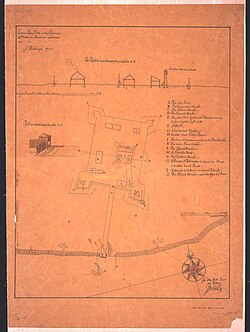
The peace was short-lived. During Queen Anne's War, Governor Joseph Dudley attempted to prevent the Abenaki from allying with the French in 1703, but failed. The fort was besieged by French allies and Abenaki Sagamores Moxus, Wanungonet, and Assacombuit, only to be relieved by the arrival of the ship Province Galley. Following the Treaty of Portsmouth in 1713 and the resettlement of Portland in 1716, the fort was demolished.
Permanent Settlement and Early Industry
Permanent British settlement only became viable after the fall of Quebec in 1759 removed the French threat. Prior to this, the area was perilous; in 1725, only one family lived in the town, and raids continued through 1751. After 1740, the population grew to 62 families, who established their own parish in 1753 (now the Falmouth Congregational Church).
For the next two centuries, the population remained between 1,000 and 2,000 residents. The economy relied on farming, fishing, and the harvesting of masts. By the 1800s, the Presumpscot River, Piscataqua River, and Mussel Cove powered sawmills and factories that processed agricultural goods and manufactured finished products.
The Transition to Modern Falmouth
As the population grew, logistics necessitated the division of the original town. Cape Elizabeth seceded in 1765, followed by Portland in 1786 and Westbrook in 1814. By 1859, while farming and fishing remained dominant, the town supported shipbuilders, brickmakers, a tannery, and mills. By 1886, production expanded to include tinware, carriage stock, and footwear.
The turn of the century brought a dramatic shift. In 1898, trolley service extended from Portland to the Falmouth Foreside, transforming the rural community into an urban consumer society. The Foreside became a retreat for Portland's elite, leading to the relocation of the Portland Yacht Club (1885) and the Portland Country Club (1913) to Falmouth.
To attract passengers, the Portland and Yarmouth Electric Railway Company opened Underwood Spring Park in 1899, featuring a hotel, casino, and outdoor theater. However, the park was destroyed by fire in 1907 and never rebuilt.
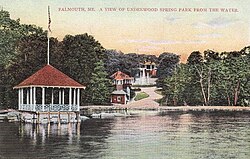
The rise of the automobile eventually ended trolley service in 1933 and accelerated Falmouth's transition into a residential suburb. Growth was further bolstered between 1941 and 1944, when military personnel arrived as Casco Bay served as a base for the U.S. destroyer fleet. This "urban exodus" from Portland, driven by a desire for open space and lower taxes, saw the population jump from 5,000 to over 10,000 in fifty years.
Today, Falmouth is one of Maine's most affluent towns, known for its respected public schools and coastal beauty. This prestige is reflected in the addition of two more country clubs in the late 1980s. Additionally, Mackworth Island, donated by Percival Proctor Baxter in 1943 as a wildlife refuge, now houses the state school for the deaf and hard of hearing.
Key Facts
- Original Name: The area was known as New Casco before being renamed Falmouth in 1658.
- Indigenous Roots: Inhabited by the Presumpscot River Wabanaki, who grew corn, beans, and squash.
- Colonial Conflict: The region was a volatile borderland, leading to the total abandonment of Casco Bay in 1676 and 1690.
- Fort Casco: Built in 1698 as a trading post and fort; later demolished in 1716.
- Economic Shift: Transitioned from farming, fishing, and mast harvesting to a residential suburb of Portland.
- Transport Evolution: Trolleys transformed the town in the late 1890s before being replaced by automobiles by 1933.
| Era | Primary Characteristics | Key Events/Developments |
|---|---|---|
| Pre-Colonial | Wabanaki Settlement | Agricultural towns on the Presumpscot River |
| 1630–1765 | Colonial Borderland | Establishment of New Casco; construction of Fort Casco |
| 1765–1890s | Rural Industry | Secession of Portland/Westbrook; farming and shipbuilding |
| 1898–1940s | Urban Transition | Trolley service; Underwood Spring Park; WWII naval base |
| 1950s–Present | Affluent Suburbia | Population growth; focus on education and residential luxury |
Frequently Asked Questions
Who were the original inhabitants of the Falmouth area?
The area was inhabited by Native Americans who arrived around 11,000 BCE. By the time of European contact, the region was home to the Presumpscot River Wabanaki (also referred to as the Aucocisco), who established summer towns on the lower Presumpscot River.
Why was the town renamed from New Casco to Falmouth?
When the Massachusetts Bay Colony took political control of Maine in 1658 from the heirs of Sir Ferdinando Gorges, they renamed the area Falmouth to commemorate a significant Parliamentarian victory during the English Civil War.
What was the significance of Fort Casco?
Built in 1698, Fort Casco served as a palisaded fort and trading post. It was intended to provide a convenient location for the local Abenaki to trade and repair tools and weapons, symbolizing a brief period of alliance between the Wabanaki and Massachusetts officials.
How did the trolley system change the town?
The extension of trolley service in 1898 shifted Falmouth from a rural community to an urban consumer society. It connected the town more closely to Portland and turned the Foreside neighborhood into a popular leisure destination for city dwellers.
What is the current use of Mackworth Island?
Donated to the state by Percival Proctor Baxter in 1943 as a wildlife refuge, Mackworth Island is now the site of the state school for the deaf and hard of hearing.