
FCC Particle Accelerator Technologies: Engineering the Next Frontier
The development of a next-generation particle accelerator requires a leap in engineering and material science. The Future Circular Collider (FCC) study is currently evaluating the equipment and machinery necessary to realize this ambitious project, drawing on decades of experience from previous accelerator initiatives. To push the boundaries of physics, researchers are focusing on three primary pillars of research and development: high-field magnets, powerful radiofrequency acceleration systems, and large-scale cryogenic infrastructure.
These advancements are not merely incremental; they represent a fundamental shift in how we manipulate particles at high energies. By integrating expertise from accelerator physics, vacuum technology, civil engineering, and material science, the FCC aims to create a reliable, sustainable, and efficient machine.

Key Facts
- Magnetic Field Goal: The FCC requires 16-tesla dipoles to steer a 50 TeV beam through a 100 km tunnel.
- Power Requirements: Radiofrequency cavities must provide up to 50 MW of power to each beam to compensate for energy loss.
- Cryogenic Scale: Future systems must be two to four times larger than current deployments, operating at temperatures as low as 1.8 K.
- Energy Storage: Each beam will store approximately 8.3 GJ of energy, requiring precision collimation to prevent machine damage.
- Efficiency Gains: R&D aims to increase klystron peak efficiency from 65% to over 80%.
High-Field Superconducting Magnets
Superconducting magnets are the essential tools used to bend and focus particle beams. For a frontier hadron collider, the goal is to implement 16-tesla dipoles—double the strength of those used in the Large Hadron Collider (LHC). This is critical for steering a 50 TeV beam across a massive 100 km circumference.
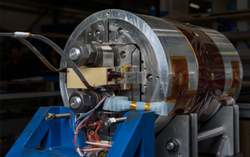
Current research focuses on Niobium-Tin (Nb3Sn) dipole magnets. The objective is to prove these magnets can be produced at an accelerator-grade quality while remaining cost-effective. Engineers are working to push conductor performance beyond current limits and reduce the "margin on the load line," which allows for smaller magnets and less conductor material.
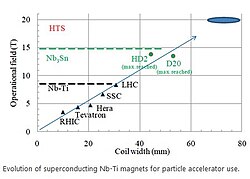
While the immediate focus is on Low-Temperature Superconductors (LTS) up to 16 T, researchers are also exploring High-Temperature Superconductors (HTS) to potentially reach the 20 T range, overcoming the inherent technological challenges of these advanced materials.
Superconducting Radiofrequency (RF) Cavities
Particles in a circular accelerator lose energy through synchrotron radiation—the emission of electromagnetic radiation when charged particles are accelerated radially. This loss is particularly significant for electrons and positrons, who can lose up to 5% of their energy every turn. To maintain beam energy, RF cavities must constantly inject power.
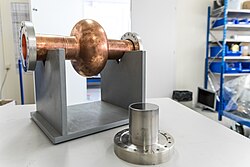
The FCC study is developing novel superconducting thin-film coating technologies. These coatings allow RF cavities to operate at higher temperatures, which reduces the electrical load on cryogenic systems and increases the accelerating gradient, thereby reducing the total number of cavities needed.
Additionally, in collaboration with the linear collider community, efforts are underway to improve klystrons (specialized vacuum tubes that amplify RF signals), aiming to raise their peak efficiency from 65% to above 80%. These high-gradient, high-temperature cavities have potential applications far beyond particle physics.
Cryogenics and Vacuum Systems
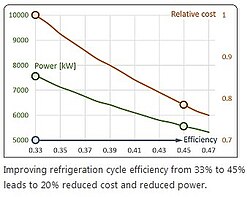
Cryogenics involves the production and management of extremely low temperatures. Because superconducting devices operate at 4.5 K and 1.8 K, the FCC requires a massive infrastructure for the distribution, recovery, and storage of cryogenic fluids. These systems must be two to four times larger than existing ones, with a heavy emphasis on energy efficiency.
The beam vacuum system faces a significant challenge: it must absorb 50 W of energy per meter at cryogenic temperatures. To protect the magnet's cold bore, the system must be robust against electron cloud effects (the buildup of electrons that can destabilize the beam) and remain stable during a superconducting quench (the sudden loss of superconductivity). To achieve this, researchers are developing new composite materials and exploring thin-film NEG (Non-Evaporable Getter) coatings for copper vacuum chambers.
Collimation and Beam Protection
Managing a 100 TeV hadron collider requires extreme precision. With 8.3 GJ of stored energy in each beam and an expected 100 kW of hadronic background at interaction points, the risk of irreversible machine damage is high.
To mitigate this, the FCC requires robust collimators—devices that "trim" the beam—equipped with self-adapting control systems and sub-millimeter gaps. Research is focused on creating novel composites that can withstand massive energy loads without permanent deformation or damage, utilizing insights from the FP7 HiLumi LHC DS and EuCARD2 programs.
Technology Summary
| Technology | Target Specification | Primary Goal |
|---|---|---|
| Dipole Magnets | 16 Tesla (up to 20 T with HTS) | Steer 50 TeV beam in 100 km tunnel |
| RF Cavities | Up to 50 MW per beam | Compensate for synchrotron radiation loss |
| Klystrons | >80% Peak Efficiency | Reduce power consumption from grid |
| Cryogenics | 1.8 K to 4.5 K | Cool superconducting components at scale |
| Collimation | Sub-millimeter gaps | Manage 8.3 GJ stored beam energy |
Frequently Asked Questions
Why are 16-tesla magnets necessary for the FCC?
To steer a high-energy beam of 50 TeV through a tunnel with a 100 km circumference, a magnetic field strength of 16 tesla is required. This is twice the strength of the magnets currently used in the LHC.
What is synchrotron radiation and why does it matter?
Synchrotron radiation is energy lost by charged particles as they are accelerated in a curve. In the FCC, electrons and positrons can lose up to 5% of their energy per turn, necessitating powerful RF cavities to replenish that energy.
How does the FCC improve cryogenic efficiency?
The project is developing larger-scale distribution systems and exploring thin-film coatings for RF cavities that allow them to operate at higher temperatures, which significantly lowers the electrical power required for cooling.
What is a superconducting quench?
A quench occurs when a part of the superconducting magnet suddenly returns to a resistive state, causing rapid heating. The vacuum systems must be designed to remain stable and robust under these conditions to prevent damage.
What role do collimators play in the accelerator?
Collimators act as a safety mechanism to manage the 8.3 GJ of stored energy in the beams. They prevent hadronic background interference and protect the machine from irreversible damage by precisely controlling the beam edges.