
Foie Gras Production: Methods, Species, and Alternatives
Foie gras is a luxury food product prized for its buttery consistency, achieved through the enlargement of a waterfowl's liver. This process relies on the biological capacity of certain birds to store fat in preparation for migration, a physiological trait that is intensified through specific farming techniques.
Key Facts
- Dominant Species: Ducks account for 95% of global production, primarily the Mulard hybrid and Muscovy duck.
- The Process: Gavage (force-feeding) is the primary method used to induce steatosis, or fatty liver.
- Liver Growth: By the time of slaughter, the liver is typically 6 to 10 times its normal size.
- Timeline: Ducks are usually slaughtered around 93 to 100 days of age; geese around 112 days.
- Alternatives: Ethical and vegan alternatives are emerging to address animal welfare concerns.
Species and Breeds Used in Production
Ducks
Ducks are the primary source of foie gras, representing 95% of production as of 2014. The most common breeds include the Muscovy duck (Cairina moschata), also known as the Barbary duck, and the Mulard duck. The Mulard is a sterile hybrid cross between a male Muscovy and a female Pekin duck (Anas platyrhynchos domestica). In France, approximately 95% of duck foie gras comes from Mulards.
Due to weight differences, male Mulards are preferred. Traditionally, female ducklings were slaughtered after hatching during the sexing process. However, a newer method that identifies sex in the egg via eye color is expected to replace this practice.
Geese
While historically central to the industry, geese now account for a small fraction of production—less than 10% globally by 2004 and only 5% of French production by 2014. The primary breeds used are the Toulouse goose and the grey Landes goose (Anser anser). Hungary has been a major producer, accounting for 80% of the world's goose foie gras in 2016, though bird flu outbreaks have impacted these rates.
The Physiological Basis of Liver Enlargement
The production of foie gras is based on the natural ability of some waterfowl to expand their esophagus and accumulate weight in the liver to survive migration. For example, wild geese can consume 300 grams of protein and 800 grams of grasses daily. In farmed settings, geese grazing on carrots may consume up to 2,500 grams of carrots per day.
This capacity for expansion allows the lower esophagus to dilate. Interestingly, the Mulard and Muscovy ducks used in commercial production are not migratory and cannot fly well, yet they retain this physiological trait.
The Production Process
Pre-feeding Phase
Before the final fattening, birds undergo a three-stage preparation:
- Start-up (0–4 weeks): Young birds are kept in large indoor groups, often on straw.
- Growth (4–9 weeks): Birds are moved outdoors to graze ad libitum (at will) to utilize the natural dilation capacity of the esophagus.
- Pre-fattening (9–12 weeks): Birds return indoors and are transitioned to a high-starch diet with gradually increasing meal sizes.
The Feeding Phase (Gavage)
The final stage, known as gavage or finition d'engraissement (completion of fattening), involves the forced ingestion of feed. This lasts 10 to 12 days for ducks and 15 to 18 days for geese. Ducks are typically fed twice daily, while geese are fed three times.
To manage the birds during this phase, producers use elevated collective cages, elevated collective pens, or ground pens. Individual cages, known as épinettes, are banned in Europe.
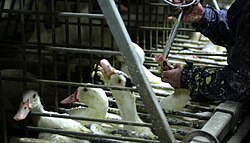
The feeding process uses a funnel with a 20–30 cm metal or plastic tube to deliver feed directly into the esophagus. While older auger systems took 45 to 60 seconds, modern pneumatic pumps can feed a duck in 2 to 3 seconds.
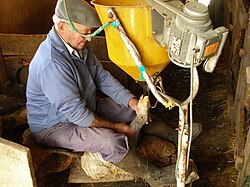
The feed, usually corn boiled with fat, is administered in increasing amounts. A bird may start at 250 grams of dry feed per day and reach 1,000 grams by the end. Because water is added (pellets are roughly 53% dry and 47% liquid), the total mass can reach approximately 1,900 grams per day. This process induces steatosis, a condition where fat accumulates in the liver cells, creating the desired buttery texture.
Alternative Production Methods
Ethical concerns have led to the development of non-gavage alternatives. In France, these cannot be legally called "foie gras" and are instead labeled "fatty goose liver." Internationally, they may be marketed as "ethical" or "humane" foie gras.
Natural and Technical Alternatives
- Migration Timing: Some producers in Spain time slaughter to coincide with natural winter migration fattening.
- Fat Blending: Some products, such as "faux gras," blend free-range liver with additional fat. Others use high-pressure processes to apply fat to duck liver meat.
- Biological Intervention: Research has explored lesioning the hypothalamus to reduce satiety or using probiotics to produce fatty livers over six months without force-feeding.
Vegan Alternatives
Plant-based substitutes have entered the market, using ingredients like cashew nuts, coconut oil, and beetroot to mimic the texture and flavor of the original product.
| Feature | Mulard Duck | Muscovy Duck | Geese (Landes/Toulouse) |
|---|---|---|---|
| Production Share | Majority (approx. 95% in France) | Minority (approx. 5% in France) | Low (<10% globally by 2004) |
| Biological Status | Sterile Hybrid | Pure Breed | Pure Breed |
| Gavage Duration | 10–12 Days | 10–12 Days | 15–18 Days |
| Slaughter Age | 93–100 Days | 93–100 Days | 112 Days |
Frequently Asked Questions
What is gavage?
Gavage is the process of force-feeding waterfowl a controlled amount of high-starch feed, typically corn boiled with fat, to enlarge the liver for foie gras production.
Why are Mulard ducks used so frequently?
Mulards are a sterile hybrid of Muscovy and Pekin ducks that are efficient at gaining weight and possess the physiological capacity for liver enlargement.
What is steatosis in the context of foie gras?
Steatosis is the medical term for the accumulation of fat within the liver cells, which results in the liver growing 6 to 10 times its normal size and gaining a buttery consistency.
Are there legal differences in how alternative foie gras is labeled?
Yes. In France, products made without gavage cannot be called "foie gras" and must be labeled as "fatty goose liver," whereas outside France they may be called "ethical" or "humane" foie gras.
What are vegan foie gras alternatives made of?
Vegan alternatives typically use a base of cashew nuts, coconut oil, and beetroot to replicate the rich texture and color of traditional foie gras.