
Frederick Lanchester: Pioneer of Automotive and Aeronautical Engineering
Frederick Lanchester was a visionary engineer whose contributions spanned the birth of the motorcar, the evolution of internal combustion, and the foundational science of flight. From his early days in Birmingham to his influential consultancy with Daimler, Lanchester's career was defined by a relentless pursuit of mechanical efficiency and scientific precision.
Early Innovations in Gas Engines
In late 1888, Lanchester joined the Forward Gas Engine Company in Saltley, Birmingham, as assistant works manager. Demonstrating a keen sense of intellectual independence, he ensured his employment contract did not grant the company ownership of his personal technical improvements. This foresight paid off in 1889 when he patented a Pendulum Governor to control engine speeds, earning royalties for every unit fitted to Forward Engines.
By 1890, he expanded his portfolio with a Pendulum Accelerometer for recording the acceleration and braking of rail and road vehicles. After being promoted to works manager, Lanchester designed a high-power vertical gas engine featuring horizontal, opposed poppet valves. While it had a low compression ratio, it was noted for its exceptional economy. He also developed a self-starting device for gas engines, the rights to which were sold to the Crossley Gas Engine Company.
Operating from a private workshop, Lanchester built a small 3 bhp (2.2 kW) vertical single-cylinder gas engine running at 600 rpm. This engine was coupled to a dynamo to provide electricity for the company's office and factory.
The Transition to Petrol and the First British Motorboat
Seeking more freedom for his research, Lanchester resigned in 1893. He soon developed a benzene-powered engine running at 800 rpm, featuring a revolutionary wick carburettor—a device that drew fuel into wicks for vaporization, which he patented in 1905.
Lanchester applied this technology to maritime transport, building a flat-bottomed launch in his garden in Olton, Warwickshire. Driven by a stern paddle wheel, the boat was launched in Oxford in 1904, marking the first motorboat built in Britain.
The Birth of the Lanchester Car
Lanchester's transition to road transport began with a four-wheeled vehicle powered by a 5 bhp (3.7 kW) petrol engine. To ensure smoothness, he utilized two crankshafts rotating in opposite directions and employed air cooling via flywheel vanes. The vehicle featured an early epicyclic gearbox—a planetary gear system—providing two forward speeds and reverse, driving the rear wheels via chains.
Although the 1895 prototype proved underpowered, Lanchester iterated quickly. He designed a new 8 hp (6 kW) 2,895 cc air-cooled engine with two horizontally opposed cylinders and a redesigned gearbox connected to a live axle via a driveshaft.
By 1898, Lanchester produced a second car featuring his own cantilever suspension. This vehicle, known as the Gold Medal Phaeton, won a gold medal for design and performance at the Richmond Automobile Exhibition and Trials. It later successfully completed the first Royal Automobile Club 1,000 Miles Trial in 1900.
The Lanchester Engine Company and Technical Breakthroughs
In 1899, the Lanchester Engine Company was formed to bring cars to the public. Operating from the Armourer Works in Birmingham, Lanchester introduced several industry-firsts:
- Worm Drive Transmission: He designed and patented a machine in 1905 to cut precise worm gears.
- Splined Shafts: He replaced traditional keys and keyways with splined shafts and couplings.
- Disc Brakes: He patented a system in 1902 that clamped the clutch disc for braking.
- Engine Placement: His 10 hp car (1901–1905) placed the engine between the front seats and used a side-mounted tiller.
As he moved to larger engines, Lanchester tackled the problem of torsional oscillation (the twisting and vibrating of a crankshaft) in straight-6 engines. In 1907, he patented a torsional crankshaft vibration damper using a secondary flywheel and a viscous clutch. He also invented a harmonic balancer for four-cylinder engines to cancel secondary unbalanced forces.
Despite these triumphs, the company faced bankruptcy in 1904 due to board incompetence and was reformed as The Lanchester Motor Company. During this era, Lanchester pioneered fuel injection, turbochargers, the accelerator pedal, detachable wire wheels, and stamped steel pistons.
Consultancy with Daimler and War Efforts
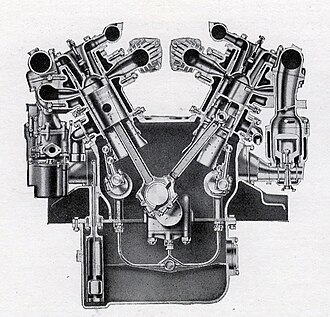
In 1909, Lanchester became a technical consultant for the Daimler Company. He worked extensively on the Daimler-Knight engine, a double sleeve-valve design. While Lanchester viewed the design as fundamentally flawed, his refinements powered various projects, including the petrol-electric KPL bus and the Daimler-Renard Road Train.
His most significant contribution to the war effort was the development of a 105 hp Daimler-Knight engine. This powerful unit, combined with William Tritton's transmission, powered the British Mark I-IV tanks and the "Little Willie" during World War I.
Aeronautics and the Science of Flight
Long before the Wright brothers, Lanchester studied the flight of herring gulls to understand how motionless wings capture air currents. This led to his circulation theory of flight, which forms the basis of modern aerodynamics and aerofoil theory.
His work was initially rejected by the British scientific community, but his 1906 publication, Aerial Flight, was mathematically confirmed by German scientist Ludwig Prandtl. Lanchester's subsequent work, Aerodonetics (1908), introduced the phugoid theory to describe aircraft oscillations and stalls, outlining the basic layout for most modern aircraft.
In 1909, he was appointed to the Advisory Committee for Aeronautics and patented contra-rotating propellers. He correctly predicted that aircraft would fundamentally change the nature of warfare.
Lanchester's Power Laws and Operations Research
In 1916, Lanchester published Aircraft in Warfare: The Dawn of the Fourth Arm. In it, he introduced Lanchester's Power Laws, a set of differential equations describing the attrition of two opposing forces in combat. He demonstrated that modern long-range weaponry meant a force twice the size of its opponent was actually four times as powerful (the square of the quotient).
These laws laid the groundwork for Operations Research (OR), a discipline now widely used in military logistics and global business management.
The Final Years and Legacy
Post-war, the company produced the Forty engine and a 21 hp six-cylinder engine in 1924. Lanchester was a pioneer in exports, being the first to export left-hand drive cars, and introduced tinted glass to the market. The final "real" Lanchester was a 4440 cc straight-eight engine introduced in 1928. In 1931, the company was fully acquired by BSA, and Lanchester cars were produced as sister vehicles to Daimler until 1956.
| Field | Innovation | Impact/Significance |
|---|---|---|
| Automotive | Epicyclic Gearbox | Early implementation of planetary gearing for road vehicles. |
| Automotive | Torsional Vibration Damper | Solved crankshaft oscillation in straight-6 engines. |
| Automotive | Disc Brake System | Patented a clutch-clamping brake system in 1902. |
| Aeronautics | Circulation Theory | Foundation of modern aerofoil theory and aerodynamics. |
| Military Science | Lanchester's Power Laws | Created the basis for modern Operations Research (OR). |
| Engines | Wick Carburettor | Innovative fuel vaporization method patented in 1905. |
Key Facts
- First British Motorboat: Lanchester built the first motorboat in Britain, launched in Oxford in 1904.
- Tank Development: His 105 hp engine powered the British Mark I-IV tanks of WWI.
- Aeronautical Pioneer: Developed the vortex theory of lift and drag before powered flight was achieved.
- Mathematical Combat: His Power Laws shifted the understanding of force attrition in warfare.
- Mechanical Firsts: Early adopter of fuel injection, turbochargers, and the accelerator pedal.
Frequently Asked Questions
What was the significance of Lanchester's Power Laws?
Lanchester's Power Laws used differential equations to show that the combat power of a force is proportional to the square of its size when using long-range weapons, rather than a simple linear relationship. This became the foundation for modern Operations Research.
How did Lanchester contribute to early aviation?
He formulated the circulation theory of flight and the vortex theory of lift and drag by studying birds. His work on aircraft stability and the phugoid theory helped define the basic layout of modern aircraft.
What was the "Gold Medal Phaeton"?
The Gold Medal Phaeton was a car completed in 1898 that featured Lanchester's own cantilever suspension. It won a gold medal for design and performance at the Automobile Exhibition and Trials at Richmond.
What role did Lanchester play in World War I?
Lanchester designed the 105 hp Daimler-Knight engine used in the British Mark I-IV tanks and the "Little Willie." He also correctly predicted the increasing importance of aircraft in warfare.
What is a torsional vibration damper?
It is a device patented by Lanchester in 1907 to solve the problem of crankshaft torsional oscillation in six-cylinder engines, using a secondary flywheel and a viscous clutch to balance the engine.