
Fremantle: A Legacy of British Marksmanship and Ballistics
Described in a 1956 obituary as "one of the finest shots Britain has ever known," Fremantle was more than just a competitive marksman. He was a pivotal figure in the evolution of British shooting, combining a lifelong passion for competition with rigorous scientific research into ballistics—the science of projectiles and firearms.
Fremantle's influence spanned over six decades, during which he transitioned from a competitive firer to a respected coach, captain, and administrator. His contributions helped shape the modern landscape of target shooting and the technical specifications of British military weaponry.
Key Facts
- Competitive Longevity: Competed for the English Eight for over 60 years, serving as a firer for 27 years.
- Military Impact: His ballistic research contributed to the British military's transition from muzzle-loading to breech-loading rifles.
- Leadership: Served as Chairman of the National Rifle Association (NRA) from 1931 to 1939.
- Olympic Involvement: Helped organize the shooting events for the 1908 Summer Olympics and competed in the 1,000-yard free rifle event.
- Academic Contribution: Authored Notes on the Rifle (1896) and contributed to the War Office's Text Book of Small Arms.
Competitive Career and International Leadership
Fremantle first entered the international stage in 1885 as part of the English Eight, the match rifle team competing for the Elcho Shield. His skill was evident early on, reaching the final of the Queen's Prize in 1893 and again in 1921.
As a leader, Fremantle captained Great Britain in several high-profile international events. In June 1899, he led the team at The Hague in Holland. While the team placed seventh out of eight, the poor result was attributed to difficult range conditions, the use of the Lee–Metford service rifle, and a strategic over-reliance on the standing position.
Success followed in 1902, when Fremantle captained the victorious Great Britain team in the Palma Match near Ottawa. He continued this leadership role in 1903 at Bisley, where the team placed second, and again in 1908. During the 1908 International Match, Great Britain finished second behind the United States. Fremantle noted that the Americans' victory was largely due to their use of aperture rearsights—a novel sighting system at the time—though the American captain praised the British team as the strongest he had ever faced.
Fremantle's success continued into the 20th century, captaining and coaching Great Britain to victories in the 1910 and 1912 Empire Matches. He also frequently represented the House of Lords in the Vizianagram Match against the House of Commons.
Scientific Research and Ballistic Innovation
Beyond the firing line, Fremantle was a dedicated researcher. Starting in 1887, he collaborated with engineer William Ellis Metford and his mentor, Henry St John Halford. Working at Wistow Hall in Leicestershire—which featured a 1,000-yard range, an iron target, and a ballistic pendulum hut—the trio experimented with trajectories at distances up to 2,000 yards (1,800 m).
These experiments were instrumental in the British military's decision to adopt breech-loading rifles over the older muzzle-loading designs. After Halford's death in 1897, Fremantle inherited Wistow Hall and continued these trials. He and Metford developed a new form of ballistic pendulum (a device used to measure the velocity of a projectile), which Fremantle presented at the 1904 Imperial Meeting.
In 1909 and 1911, Fremantle worked with engineer Arthur Mallock to determine the maximum range of the Short Magazine Lee–Enfield when using Mark VII ammunition. His expertise led him to become a recognized authority on rifle design, contributing to Baily's Magazine and serving as president of the Society for Army Historical Research.
Administration and the National Rifle Association
Fremantle's administrative contributions were as significant as his shooting. Joining the British National Rifle Association (NRA) as assistant secretary in 1889, he played a key role in moving the association from Wimbledon Common to Bisley Camp for the 1890 Imperial Meeting.
His leadership within the NRA grew steadily; he was elected to the governing council in 1891 and eventually served as chairman from 1931 to 1939. He was also appointed to the organizing committee for the 1908 Summer Olympics shooting events held at Bisley.
At those Olympics, Fremantle competed in the 1,000-yard free rifle event, scoring 87 out of 100 to place joint sixteenth.
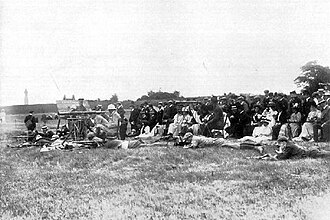
Fremantle's legacy at Bisley extends beyond his scores. He donated several trophies, including a cup in memory of Halford, and organized the first collection of small arms at Bisley, which evolved into the NRA museum. He continued to shoot at Bisley until 1946, at the age of 84.
Summary of Career Achievements
| Category | Key Achievement / Role | Details |
|---|---|---|
| Competition | Palma Match (1902) | Captained the victorious Great Britain team. |
| Research | Breech-loading Transition | Research led to military adoption of breech-loading rifles. |
| Leadership | NRA Chairman | Led the National Rifle Association from 1931 to 1939. |
| Olympics | 1908 Summer Games | Organizer and competitor (1,000-yard free rifle). |
| Literature | Notes on the Rifle | Published in 1896 based on his research and articles. |
Frequently Asked Questions
What was Fremantle's contribution to military technology?
Through his research with William Ellis Metford and Henry St John Halford, Fremantle conducted trajectory experiments that led the British military to replace muzzle-loading weapons with breech-loading rifles.
How did the 1908 International Match impact British shooting?
Great Britain placed second to the United States. Fremantle attributed the American victory to their use of novel aperture rearsights, highlighting a technological gap in sighting systems.
What role did Fremantle play in the National Rifle Association (NRA)?
He served as assistant secretary, a member of the governing council, and eventually as chairman from 1931 to 1939. He also helped move the association to Bisley Camp and founded the NRA museum.
What was the significance of the research at Wistow Hall?
Wistow Hall provided the facilities—including a 1,000-yard range and a ballistic pendulum hut—necessary to conduct scientific experiments on round trajectories up to 2,000 yards.
In which Olympic event did Fremantle compete?
Fremantle competed in the 1,000-yard free rifle event at the 1908 Summer Olympics, where he finished joint sixteenth with a score of 87/100.