
Friedel Oscillations in Electron Gases
In the realm of quantum physics, the behavior of electrons in a metal or semiconductor differs fundamentally from that of a classical gas. When a perturbation—such as a boundary or a foreign impurity—is introduced into a sea of electrons, the system does not respond with a simple, smooth decay. Instead, it creates rhythmic ripples in the electron density known as Friedel oscillations.
The One-Dimensional Electron Gas Model
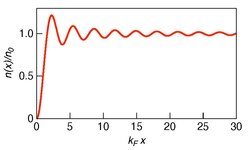
To understand these oscillations, we can look at a simplified model of a one-dimensional electron gas occupying a half-space where x > 0. In this scenario, electrons cannot penetrate the region where x ≤ 0, creating a strict boundary condition where the electron wave function ψ(x = 0) = 0.
Because electrons are fermions, they obey Fermi-Dirac statistics, meaning they fill available energy states from the lowest level up to a maximum known as the Fermi energy (EF). The corresponding maximum wave vector is the Fermi wave vector (kF). When we calculate the electron density n(x) by summing the squares of the wave functions for all occupied states, the result is not a constant value near the boundary.
Instead, the boundary perturbs the density, creating spatial oscillations with a period of λF = π/kF. These oscillations decay as they move further into the bulk of the material. As x approaches infinity, the density eventually stabilizes at the unperturbed value of 2kF/π.
Scattering and Impurities in Solids
In a real-world metal or semiconductor, electrons behave like a Fermi gas with plane wave-like wave functions. They occupy a sphere in k-space (momentum space) up to the radius kF. When a foreign atom, or impurity, is embedded in the material, it creates a deviating potential that scatters the electrons.
Not all electrons participate in this scattering. Because of the Pauli exclusion principle, only electrons with energies near the Fermi level can be scattered, as they are the only ones with access to empty final states. This limited range of participating wavelengths results in a density modulation around the impurity. The resulting charge density ρ(r) follows a specific pattern where the modulation decays relative to the cube of the distance (|r|3) from the impurity.
Quantum vs. Classical Charge Screening
Friedel oscillations represent a quantum mechanical departure from classical electric charge screening. In a classical mobile charge-carrying fluid, the concentration of charges around a charged object decreases exponentially, a process governed by the Poisson-Boltzmann equation.
In contrast, the quantum description—often modeled by the Tomonaga-Luttinger liquid for one-dimensional Fermi fluids—treats electrons as waves rather than point entities. Rather than a smooth continuum, fermions arrange themselves at discrete intervals. While classical screening results in a concentrated cloud of opposite charges, Friedel oscillations create periodic arrangements of oppositely charged fermions separated by regions of the same charge.
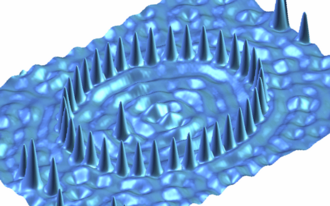
These effects can be visualized using a scanning tunneling microscope (STM), which can detect regions of low electron density on a surface. In these low-density regions, atomic nuclei are more "exposed," resulting in a net positive charge that appears as circular ripples in the STM image.
Key Facts
- Nature of Oscillations: Friedel oscillations are spatial modulations of electron density caused by perturbations like boundaries or impurities.
- The Fermi Wave Vector (kF): This critical value determines the period of the oscillations (λF = π/kF).
- Quantum Requirement: Only electrons near the Fermi energy (EF) participate in scattering because they have available empty states to move into.
- Decay Pattern: In three dimensions, the density modulation around an impurity decays proportional to 1/|r|3.
- Observation: These oscillations are observable via scanning tunneling microscopy (STM) as ripples of electron density.
| Feature | Classical Screening | Quantum (Friedel) Screening |
|---|---|---|
| Particle Model | Point entities | Wave vectors (Fermions) |
| Density Profile | Exponential decay | Periodic oscillations |
| Governing Logic | Poisson-Boltzmann equation | Fermi-Dirac statistics / Tomonaga-Luttinger |
| Distribution | Smooth continuum | Discrete periodic arrangements |
Frequently Asked Questions
What causes Friedel oscillations?
They are caused by the screening response of a Fermi gas to a localized perturbation, such as a boundary or an impurity atom, which disrupts the uniform electron density.
Why do only electrons near the Fermi level participate in scattering?
Because electrons are fermions, they obey the Pauli exclusion principle. Electrons deep within the Fermi sea cannot scatter because all nearby energy states are already occupied; only those near the Fermi level have access to empty states.
How does the period of the oscillation relate to the Fermi wave vector?
The period of the oscillations, denoted as λF, is inversely proportional to the Fermi wave vector, defined by the formula λF = π/kF.
How are Friedel oscillations detected experimentally?
They are typically imaged using scanning tunneling microscopy (STM), which maps the local density of states on a material's surface, revealing the characteristic ripples around impurities.
What is the difference between classical screening and Friedel oscillations?
Classical screening results in a smooth, exponential decrease in charge density, whereas Friedel oscillations create a wave-like pattern of alternating charge density due to the wave nature of electrons.