
Froghall Industrial Heritage: Copper, Limestone, and Canals
Despite its modest size, the village of Froghall has served as a powerhouse of industrial development for several centuries. From pioneering global communications to fueling the regional pottery trade, the area's history is defined by its strategic use of natural resources and innovative engineering.
The Legacy of Thomas Bolton and Sons
The most prominent landmark in Froghall's industrial history is the copper factory established by Thomas Bolton and Sons, later known as Bolton Copper. For 200 years, these Staffordshire copperworks were at the forefront of global technology. Most notably, the plants at Froghall and the nearby village of Oakamoor manufactured and rolled the world's first transatlantic telegraph cables, a feat that revolutionized international communication.
The factory's versatility extended into military production; during the Second World War, the works produced critical wiring components for Spitfire fighter planes. These facilities represented the final link between the Staffordshire Moorlands and the historic copper-mining industry once centered on the Manifold Valley and the renowned Ecton Copper Mines.
The decline of the business was precipitated by a combination of financial and operational crises, including a £10m pension scheme shortfall, an explosion, and the loss of a primary customer who represented 70 per cent of the order book. Despite interest in the business as a going concern, no buyer was found, leading to the redundancy of most of the 105 workers. While much of the factory was demolished in 2011, a last-minute intervention saved an original chimney, which remains a sentinel of the village's industrial past.
Limestone and the Engineering of the Moorlands
Parallel to the copper industry, limestone production played a vital role in the local economy. Limestone was extracted from massive quarries at Caldon Low and transported to Froghall via an inclined tramway. Over time, four different tramways were constructed to facilitate this movement. The final route, engineered by James Trubshaw, was the most complex and significant; today, Trubshaw's tunnel near Windy Harbour stands as a testament to this engineering effort.
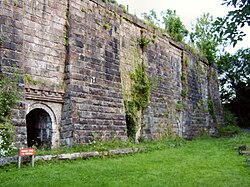
Once the limestone reached Froghall Wharf, it was either loaded onto canal narrow boats or processed in lime kilns—large furnaces used to heat limestone to create quicklime. This material was then transported to the Potteries or other distant markets.
The Role of the Caldon and Uttoxeter Canals
The development of Froghall was inextricably linked to the Caldon Canal. The basin at Froghall Wharf originally served as the canal's terminus. From this hub, a separate branch extended to Uttoxeter. The Uttoxeter Canal opened for traffic in 1811, but after suffering heavy financial losses, it was closed in 1849. Much of the canal bed was subsequently filled in to make way for a railway.
Today, the Froghall Wharf basin has transitioned from a site of heavy industry to a peaceful destination for walkers and pleasure craft, though the dormant lime kilns continue to dominate the skyline.
Key Facts
- Global Innovation: Froghall and Oakamoor produced the first transatlantic telegraph cables.
- War Effort: The copperworks manufactured wiring for Spitfire fighter planes during WWII.
- Infrastructure: Four tramways were built to move limestone from Caldon Low to Froghall.
- Canal History: The Uttoxeter Canal operated from 1811 until its closure in 1849.
- Industrial Loss: The Thomas Bolton factory closed after losing a customer that held 70% of its orders.
| Industry | Key Site/Entity | Primary Output/Purpose | Legacy/Current Status |
|---|---|---|---|
| Copper | Thomas Bolton and Sons | Telegraph cables, Spitfire wiring | Demolished 2011 (Chimney remains) |
| Limestone | Caldon Low / Froghall Wharf | Quicklime for the Potteries | Dormant kilns and Trubshaw's tunnel |
| Transport | Caldon & Uttoxeter Canals | Industrial freight transport | Pleasure craft basin; railway over Uttoxeter bed |
Frequently Asked Questions
What was the significance of the Thomas Bolton copperworks?
The works were globally significant for manufacturing the first transatlantic telegraph cables and contributed to the WWII effort by producing wiring for Spitfire planes.
Why did the Thomas Bolton business fail?
The downfall was caused by a £10m pension shortfall, an explosion, and the loss of a major customer who accounted for 70 per cent of their order book.
How was limestone transported from Caldon Low to Froghall?
Limestone was moved via a series of four inclined tramways, the most significant of which was engineered by James Trubshaw.
What happened to the Uttoxeter Canal?
Opened in 1811, the canal closed in 1849 due to heavy financial losses, and much of its bed was later used for a railway.
What remains of the industrial sites today?
Visitors can still see the original chimney of the Bolton copperworks, the dormant lime kilns at Froghall Wharf, and Trubshaw's tunnel near Windy Harbour.