
Fujiko Nakaya: The Pioneer of Atmospheric Fog Sculpture and Video Art
Fujiko Nakaya is a visionary artist whose career spans the intersection of technology, nature, and ephemeral media. From her early days as a painter to her groundbreaking work with atmospheric phenomena, Nakaya has consistently challenged the boundaries of how art is experienced. By treating nature as a collaborator rather than a subject, she creates immersive environments that shift and evolve in real-time.
Key Facts
- First Water-Based Fog Sculpture: Created for the Pepsi Pavilion at Expo '70 in Osaka.
- E.A.T. Leadership: Served as the Tokyo representative for the American collective Experiments in Art and Technology.
- Video Art Pioneer: Founded Video Gallery SCAN, Japan's first dedicated video art gallery, in 1980.
- Major Accolades: Recipient of the 2018 Praemium Imperiale award in sculpture.
- Philosophical Approach: Focuses on the behavior of medium and contingent processes over static, completed objects.
Early Career and the Shift to Technology
Nakaya began her artistic journey in painting. After studying briefly with Leonard Foujita in Europe, she returned to Japan in 1960. Her early professional milestones included a joint exhibition with her father at the Sherman Art Gallery in Chicago (1960) and her first solo show at the Tokyo Gallery in 1962, where she displayed twelve oil paintings.
Her trajectory shifted toward the intersection of art and engineering through her involvement with Experiments in Art and Technology (E.A.T.), an American collective founded in 1967. Nakaya first collaborated with E.A.T. in 1966 as a remote-control operator for Deborah Hay's performance Solo for 9 Evenings: Theatre and Engineering, eventually becoming the group's Tokyo representative in 1969.
The Birth of Fog Sculpture
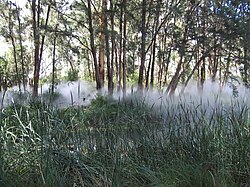
The most defining moment of Nakaya's career occurred during Expo '70 in Osaka. Invited by Billy Klüver and Robert Rauschenberg to create a work for the Pepsi Pavilion, Nakaya sought a medium that was safe and inclusive. To avoid the limitations of chemical fogs, she collaborated with engineer Thomas Mee to develop the world's first water-based atmospheric fog sculpture.
Nakaya viewed nature as a collaborator. To ensure the work responded to the environment, she and Mee conducted wind tunnel tests, analyzed site-specific wind patterns, and tested various atomizing devices. This rigorous scientific approach resulted in a patented system—Mee patented the hardware, while Nakaya patented the airflow.
Following the success of Expo '70, Nakaya continued her work with E.A.T. Tokyo, co-founding the branch with Kobayashi Hakudō and Morioka Yūji. One notable project was Utopia Q&A, 1981 (1971), a telex network connecting Tokyo, New York, Stockholm, and Ahmedabad. This project involved a diverse group of contributors, including animator Tezuka Osamu and scientist Oda Minoru, to predict the future of the world.
Advancing Video Art in Japan
Throughout the 1970s, Nakaya became a central figure in the Japanese video art scene. At the invitation of Michael Goldberg, she worked with Katsuhiro Yamaguchi to organize Video Communication: Do-It-Yourself-Kit in 1972, the first video art exhibition in Japan. This led to the formation of the Video Hiroba collective, through which she produced interactive installations like Old People's Wisdom — Cultural DNA (1973).
In 1980, Nakaya expanded her influence by opening Video Gallery SCAN in Harajuku, the first gallery of its kind in Japan. Named by collaborator Bill Viola, the gallery provided a platform for emerging artists and hosted solo exhibitions for icons such as Nam June Paik and Bill Viola. The gallery also organized the Japan International Video Television Festival (1987, 1989, 1993), introducing international artists like Marina Abramović and Gary Hill to Japanese audiences.
The Philosophy of the Ephemeral
Since closing Video Gallery SCAN in 1992, Nakaya has focused primarily on fog. She describes fog as a transducer—a device that converts one form of energy to another—which reacts to local meteorological conditions to reveal the hidden stories of a landscape.
Art critic Kenjirō Okazaki notes a strong connection between Fujiko's work and that of her father, scientist Ukichirō Nakaya. While the father used photography to document the imperfection of snow crystals, the daughter uses fog and video to explore indeterminacy. For Nakaya, the art is not the final object, but the unpredictable behavior of the medium itself.
Collaborations and Global Impact
Nakaya's fog installations often involve multidisciplinary collaborations. She has worked with musicians like Ryūichi Sakamoto and dancers such as Trisha Brown. Notable projects include:
- Showa Kinen Park (1992): A playground where dense fog periodically envelops visitors, symbolizing the cycle of life and death.
- Blur Building (2002): A consultancy role for architects Diller + Scofidio for the Swiss Expo 2002, where her expertise in irregular nozzle concentrations was critical to the project's success.
| Period/Year | Key Project/Entity | Significance |
|---|---|---|
| 1970 | Pepsi Pavilion, Expo '70 | World's first water-based atmospheric fog sculpture. |
| 1971 | Utopia Q&A, 1981 | International telex network predicting the future. |
| 1980 | Video Gallery SCAN | Japan's first dedicated video art gallery. |
| 1992 | Showa Kinen Park | Immersive fog installation evoking nature's cycles. |
| 2018 | Praemium Imperiale | Prestigious award for her contributions to sculpture. |
Frequently Asked Questions
What makes Fujiko Nakaya's fog sculptures unique?
Unlike traditional sculptures made of solid materials, Nakaya's works are atmospheric and ephemeral. She uses water-based fog that reacts to wind and temperature, making nature a co-creator of the artwork.
What was the purpose of Video Gallery SCAN?
Opened in 1980 in Harajuku, it was Japan's first video art gallery. It served as a launchpad for new artists through competitions and brought international video art pioneers to Japan.
How did Nakaya's father influence her work?
Her father, scientist Ukichirō Nakaya, documented the imperfections of snow crystals. This influenced Fujiko's interest in contingent processes and the beauty of indeterminacy rather than fixed, perfect forms.
What is the meaning behind the fog at Showa Kinen Park?
The installation is designed to make visitors feel lost as the fog develops and found as it dissipates, serving as a reminder of the cycle of life and death and evoking reverence for nature.
Which major awards has Fujiko Nakaya received?
She has received the Praemium Imperiale (2018), the Australian Cultural Award, the Laser d’Or at the Locarno International Video Festival, and the Special Achievement Prize at the 2008 Japan Media Arts Festival.