
General Anesthetics
General anesthesia is a reversible state of unconsciousness induced by the administration of specific pharmacological agents. These agents are broadly categorized into inhaled agents, which are breathed into the lungs, and intravenous agents, which are delivered directly into the bloodstream. While the goal is to ensure a safe and painless surgical experience, no single agent is completely without risk; the choice of medication depends on the patient's health and the requirements of the procedure.
Inhaled Anesthetic Agents
Inhaled anesthetics are divided into volatile agents and gases. Volatile agents are organic liquids that evaporate readily and are administered via a vaporizer. The ideal volatile agent should be non-flammable, non-explosive, lipid-soluble, and non-irritating to the respiratory tract, with low blood gas solubility and no toxicity to the heart, liver, or kidneys.
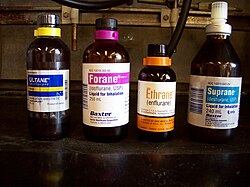
Commonly used volatile agents include isoflurane, desflurane, and sevoflurane. While older agents like halothane and enflurane were once common, they have been largely discontinued or replaced due to side effects and shortcomings. Nitrous oxide and xenon are true gases rather than volatile agents. Nitrous oxide is frequently used as an adjuvant gas; because of its low potency, it cannot produce anesthesia on its own but is combined with other agents to enhance their effect.
Induction and Maintenance
In theory, any inhaled agent can be used for induction (the transition from awake to unconscious). However, many halogenated anesthetics irritate the airway, potentially causing coughing or laryngospasm. Sevoflurane is often preferred for induction because it is less pungent, increases alveolar concentration rapidly, and has higher blood solubility than other volatile agents, allowing for a smoother transition and quicker emergence.
Potency and Pharmacokinetics
The potency of a volatile agent is inversely proportional to its minimum alveolar concentration (MAC)—the concentration required to keep most patients unconscious. According to the Meyer-Overton hypothesis, potency is directly related to lipid solubility.
Another critical measure is the blood/gas partition coefficient, which describes the agent's solubility in blood. Agents with a lower coefficient, such as desflurane, allow the provider to titrate the depth of anesthesia more rapidly and enable the patient to emerge from anesthesia more quickly once the agent is discontinued.
Intravenous (Non-Opioid) Agents
Intravenous agents are used for the rapid induction of anesthesia or for sedation. Unlike inhaled agents, these are injected directly into the vein.
Common IV Anesthetic Classes
- Barbiturates: This group includes thiopental and methohexital, which are ultra-short-acting agents used for induction and maintenance. While they produce unconsciousness, they provide no analgesia (pain relief).
- Benzodiazepines: Including midazolam, diazepam, and lorazepam, these are used for sedation before or after surgery. Midazolam is the preferred choice for inducing general anesthesia. Like barbiturates, they lack pain-relieving properties.
- Propofol: One of the most common agents used for induction and maintenance of anesthesia.
Specialized IV Agents: Etomidate and Ketamine
Etomidate is used for induction, maintenance, and ICU sedation. It is valued for causing minimal cardiopulmonary depression and reducing intracranial pressure and cerebral blood flow. However, its use has decreased in severely ill patients because it can cause adrenocortical suppression, which may increase mortality rates.
Ketamine is unique because it produces profound analgesia even at doses lower than those required for general anesthesia. Patients under ketamine often enter a cataleptic state, remaining with their eyes open and maintaining reflexes. Due to the risk of unpleasant emergence experiences—such as vivid dreams and illusions—it is often paired with a benzodiazepine like midazolam. Despite this, it is frequently used in emergency settings due to its minimal adverse physiological effects.
Key Facts
- Sevoflurane is preferred for inhaled induction due to low pungency and rapid onset.
- Blood/gas partition coefficient determines how quickly a patient wakes up from volatile anesthesia.
- Nitrous oxide is an adjuvant gas and cannot be used as a sole anesthetic agent.
- Ketamine is the only non-opioid IV agent mentioned that provides profound pain relief.
- Etomidate is favorable for cardiovascular stability but can suppress the adrenal cortex.
| Agent | Type | Primary Characteristic | Analgesia? |
|---|---|---|---|
| Sevoflurane | Inhaled (Volatile) | Low pungency, fast induction | No |
| Desflurane | Inhaled (Volatile) | Very low blood solubility, rapid emergence | No |
| Nitrous Oxide | Inhaled (Gas) | Low potency, used as adjuvant | No |
| Thiopental | Intravenous | Ultra-short-acting barbiturate | No |
| Etomidate | Intravenous | Cardiovascular stability | No |
| Ketamine | Intravenous | Cataleptic state, profound analgesia | Yes |
Frequently Asked Questions
Why is sevoflurane often used for the induction of anesthesia?
Sevoflurane is preferred for induction because it has relatively low pungency, which makes it less irritating to the airway, and it allows for a rapid increase in alveolar concentration and quick emergence.
What is the difference between a volatile agent and an anesthetic gas?
Volatile agents are organic liquids that must be evaporated into a gas to be inhaled, whereas agents like nitrous oxide and xenon are naturally gases at room temperature.
Does every intravenous anesthetic provide pain relief?
No. Most non-opioid IV agents, including barbiturates, benzodiazepines, and etomidate, produce unconsciousness without providing analgesia. Ketamine is a notable exception, as it provides profound pain relief.
How does the blood/gas partition coefficient affect the patient?
A lower blood/gas partition coefficient means the agent is less soluble in blood. This allows the anesthesia provider to adjust the depth of anesthesia more quickly and enables the patient to wake up faster after the drug is stopped.
Why is etomidate used cautiously in severely ill patients?
While etomidate is stable for the heart and lungs, it has been shown to cause adrenocortical suppression, which can lead to an increased mortality rate in critically ill patients.