
Ghetto Currency: The Forced Economic Isolation of the Holocaust
During the Holocaust, the establishment of ghettos was not only a means of physical segregation but also of economic stripping. To achieve this, occupation authorities implemented systems of surrogate currency—money created to replace legal tender—to isolate residents and seize their wealth.
Upon the creation of the ghetto, residents were forced to surrender their cash and valuable possessions. In exchange, they received the ghetto mark. This system served a dual purpose: it effectively stripped the population of their assets and created a financial barrier that prevented residents from fleeing, as the currency held no value outside the ghetto walls.
Regional Variations in Currency Control
While some ghettos issued entirely new currencies, others in Poland utilized a different method of control. In these locations, residents were permitted to use Polish zloty banknotes and small denominations of the German Reichsmark, but only if they bore unique stamps. These stamps indicated that the money was valid exclusively within the confines of the ghetto.
Outside of Poland, the Terezin Ghetto is the only other known instance where a specific surrogate currency was employed to control the population.
The Design and Production of Ghetto Money
The creation of the ghetto mark involved several artists and engineers, though their work was strictly monitored and often censored by German authorities.
Coinage and Engraving
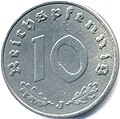
The earliest 10 pfennig coins were designed to look very similar to the Reichspfennig (the standard currency of the Third Reich). Because of this resemblance, occupation authorities demanded a new design. Subsequent coins were designed by Morduch Glazer (1890–1950), with the printing forms engraved by Pinkus Szwarc.
Banknote Artistry
The visual identity of the banknotes underwent significant changes due to political pressure. Wincenty Brauner, a member of the pre-war art group Jung Jidysz, initially proposed a design featuring a man breaking his chains. This imagery of liberation was rejected by the German authorities.
The final design was instead developed by Ignacy Gutman, who served as the head of the Ghetto's construction department. His approved design featured a Menorah and a Star of David in the corner.
Enforcement and Legal Consequences
The transition to the ghetto mark was not voluntary. On June 24, 1940, Chaim Rumkowski issued Order #70, which urged residents to exchange their existing money for ghetto marks. The enforcement of this order was absolute; the use of any other form of currency within the ghetto was punishable by death.
Key Facts
- Purpose: To strip residents of wealth and prevent escape by making currency useless outside the ghetto.
- Key Figures: Designed by Morduch Glazer (coins) and Ignacy Gutman (banknotes).
- Legal Mandate: Order #70, issued June 24, 1940, by Chaim Rumkowski.
- Penalty: Use of non-ghetto currency was punishable by death.
- Notable Locations: Used in specific Polish ghettos and the Terezin Ghetto.
| Component | Contributor | Key Design Feature/Note |
|---|---|---|
| Banknotes (Initial) | Wincenty Brauner | Man breaking chains (Rejected) |
| Banknotes (Final) | Ignacy Gutman | Menorah and Star of David |
| Coins | Morduch Glazer | Redesigned to avoid resemblance to Reichspfennig |
| Engraving | Pinkus Szwarc | Engraved printing forms for coins |
Frequently Asked Questions
Why was surrogate currency used in the ghettos?
It was used to seize the valuable possessions and cash of the residents and to ensure they could not flee, as the currency had no value outside the ghetto boundaries.
What happened to residents who used Polish zloty or Reichsmarks?
According to Order #70 issued by Chaim Rumkowski, the use of any currency other than the ghetto mark was punishable by death.
Which ghettos outside of Poland used their own currency?
The Terezin Ghetto is the only known ghetto outside of Poland to have used its own surrogate currency.
Why was Wincenty Brauner's banknote design rejected?
Brauner's design featured a man breaking apart his chains, a symbol of liberation that was unacceptable to the German occupation authorities.
How did some Polish ghettos handle currency without printing new marks?
Some ghettos allowed the use of Polish zloty and small German Reichsmark denominations, provided they were marked with unique stamps that limited their validity to the ghetto.