
Glasgow Economy: From Shipbuilding Powerhouse to Financial Hub
Glasgow has undergone a profound economic transformation, evolving from a global leader in heavy industry to a diversified modern economy. Once defined by the smoke and steel of the River Clyde, the city has successfully pivoted toward high-value services, biotechnology, and international finance, securing its position as a primary economic engine for Scotland.
Key Facts
- Historical Core: Built on the tobacco trade and world-renowned shipbuilding on the River Clyde.
- Financial Status: One of Europe's sixteen largest financial centres.
- Insurance Hub: Eight of the UK's ten largest general insurance companies maintain a base or head office in the city.
- Tech Sector: Forms the western anchor of Scotland's "Silicon Glen" high-tech corridor.
- Tourism: The second most popular foreign tourist destination in Scotland and fifth in the UK.
The Industrial Legacy of the River Clyde
Glasgow's early wealth was forged through trade and manufacturing. While the city's growth was accelerated by the tobacco trade—pioneered by figures such as John Glassford—it became globally famous for its shipbuilding industry. The River Clyde served as the birthplace for some of history's most iconic vessels, including the tea clipper Cutty Sark, the Royal Navy battlecruiser HMS Hood, and luxury transatlantic liners such as the Aquitania, RMS Queen Mary, RMS Queen Elizabeth, and RMS Queen Elizabeth II.
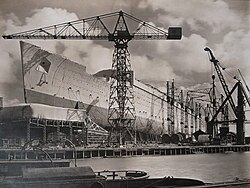
Beyond the shipyards, the 19th century saw a boom in locomotive construction, led by firms like the North British Locomotive Company. Although this sector declined by the 1960s, the spirit of maritime engineering persists today through BAE Systems Maritime - Naval Ships and Ferguson Marine.
The Shift to the Tertiary Sector
As traditional manufacturing declined, Glasgow transitioned toward the tertiary sector—the segment of the economy focused on providing services rather than producing goods. This shift has seen explosive growth in communications, biosciences, healthcare, higher education, and the creative industries.
The city has also become a retail and tourism magnet, boasting Scotland's largest retail centre and attracting a vast number of international visitors.
Modern Industry and Innovation
While the city has embraced services, manufacturing remains a vital component of the local economy. Current industrial activity spans brewing, distilling, chemicals, textiles, and engineering. However, the focus has shifted toward high-tech growth sectors such as optoelectronics (the study and application of electronic devices that source, detect, and control light), software development, and biotechnology.
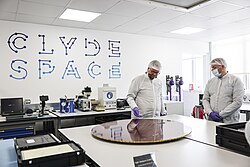
Glasgow is a key part of Silicon Glen, Scotland's high-tech cluster, and is home to innovative firms such as RHA Technologies and spacecraft manufacturers like Clyde Space.
The International Financial Services District (IFSD)
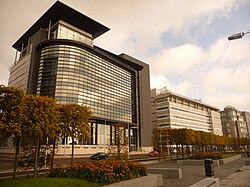
The most visible symbol of Glasgow's economic rebirth is the International Financial Services District (IFSD). Located on the western edge of the city centre across Blythswood Hill and Anderston, this area—sometimes called the "Wall Street on Clyde"—has replaced old riverside warehouses with modern high-rise office blocks.
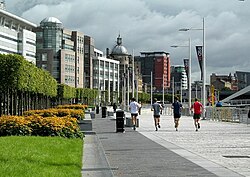
Between 1998 and 2001, the financial services sector grew by 30%, allowing Glasgow to make significant gains on Edinburgh. The district now hosts a dense concentration of Blue chip companies (large, industry-leading, financially sound companies), including:
- Insurance: Direct Line, Esure, AXA, and Norwich Union.
- Banking: JPMorgan Chase, Barclays Wealth, Morgan Stanley, HSBC, Santander, and the Royal Bank of Scotland.
- Corporate & Government: Royal Dutch Shell (Shared Business Centre), the Ministry of Defence, the Glasgow Stock Exchange, and the Scottish Government.
The Call Centre Boom
The 1990s and early 2000s saw a surge in call centres. By 2007, Glasgow employed roughly 20,000 people in this sector, representing one-third of all call centre workers in Scotland. However, this growth brought challenges; the TUC and other unions have raised concerns regarding exploitative practices, citing poor pay, long hours, and job insecurity for graduates hired as temporary workers.
Economic Summary
| Era/Sector | Key Industries | Notable Entities/Examples |
|---|---|---|
| Early Industrial | Tobacco Trade, Shipbuilding | John Glassford, RMS Queen Mary |
| 19th Century | Locomotive Construction | North British Locomotive Company |
| Modern Tech | Optoelectronics, Space, Biotech | Clyde Space, RHA Technologies |
| Financial Services | Banking, Insurance, Corporate | IFSD, JPMorgan Chase, AXA |
Frequently Asked Questions
What was the primary driver of Glasgow's early wealth?
Glasgow's early economic growth was driven by the tobacco trade and the massive shipbuilding industry based along the River Clyde.
What is the International Financial Services District (IFSD)?
The IFSD is a modern financial quarter located in the Blythswood Hill and Anderston areas of Glasgow, serving as a hub for major global banks, insurance companies, and government agencies.
What is Silicon Glen?
Silicon Glen is Scotland's high-tech sector; Glasgow forms the western part of this region, focusing on software development, biotechnology, and consumer electronics.
Which major insurance companies are based in Glasgow?
Eight of the UK's ten largest general insurance companies have a presence in Glasgow, including AXA, Direct Line, Esure, and Norwich Union.
How has the city's tourism industry performed?
Glasgow is currently the second most popular destination for foreign tourists in Scotland and the fifth most popular in the United Kingdom.