
Glasgow Motorway Network: Scotland's Primary Transport Hub
Glasgow serves as the central focal point of Scotland's motorway network. As one of the most comprehensive road systems in the United Kingdom, it provides critical connectivity between the city centre and the sprawling Greater Glasgow area. While heavily used during peak hours, this network is essential for the region's economic and social mobility.
Key Facts
- Kingston Bridge is the busiest road crossing in Europe, handling up to 150,000 vehicles daily.
- The M8 is Scotland's busiest motorway, linking Edinburgh to Bishopton.
- The M74 provides the only motorway link between Scotland and the rest of Great Britain.
- The M898 is the shortest and highest-numbered motorway in the UK.
- The Plantation junction is one of the UK's widest road stretches, featuring 16 lanes.
The M8: The Arterial Route
The M8 is the backbone of the region's transport, stretching approximately 40 miles (64 km) from Edinburgh in the east to Bishopton in western Renfrewshire. Construction began in 1964 and reached final completion in 2017. A significant milestone occurred in 2017 when a six-lane motorway was built to close a previous gap between Junctions 6 and 8 in North Lanarkshire, replacing a section of the A8.
Within Glasgow, the M8 exhibits unique characteristics, including high mast lighting, illuminated overhead gantries, and entrances and exits on both sides of the road. The route utilizes an elevated viaduct to skirt the city centre, passing through Charing Cross before crossing the River Clyde via the 10-lane Kingston Bridge.
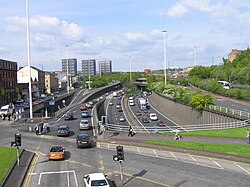
After crossing the river, the M8 reaches the Plantation junction, where it merges with the M74 and M77. This massive 16-lane intersection facilitates movement toward Ibrox, the Clyde Tunnel, Glasgow International Airport, and eventually Greenock, where the route transitions into the non-motorway A8.
Supporting Motorways: M73, M74, and M80
The M73
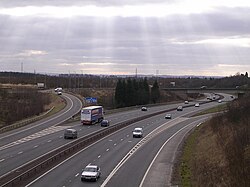
The M73 serves as a vital north-south link between the M8 and M74. Opened in 1972 and extended in 2011 to connect with the M80 and A80, it forms a motorway triangle north of the city. This relatively short route, spanning about 6.5 miles (10.5 km), was further improved in 2015 with additional lanes in its southern section, expanding to four or five lanes in each direction.
The M74
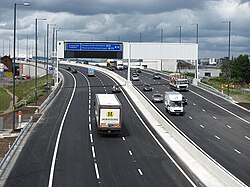
The M74 is the primary gateway for traffic traveling between Scotland and England. It runs from Glasgow's city centre through the south-east, connecting to the M73 at Uddingston. While known as the M74 within Scotland, it becomes the A74(M) and eventually the M6 upon entering England. The northern extension from Kingston to Tollcross was completed in 2011, fulfilling long-term plans for a southern city motorway.
The M80 and M77
The M80 connects north-eastern Glasgow to the M9 motorway near Stirling, passing through Robroyston, Cumbernauld, and Denny. It diverges from the M8 at Blochairn and links to the M73 at Mollinsburn. Construction occurred in phases between 1974 and 2011.
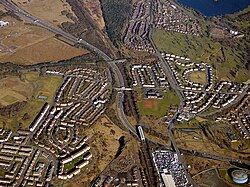
The M77 begins at the Plantation connection and travels south-west toward Kilmarnock, serving key areas such as Bellahouston, Pollok Country Park, and Newton Mearns.
Specialized Links and the M898
Located entirely in Renfrewshire, the M898 is a unique piece of infrastructure. It connects the M8 to the Erskine Bridge, allowing motorists from Clydebank and Dumbarton to bypass the city centre. Notably, it holds the record as the shortest motorway in the UK (less than one mile) and the highest numbered.
The Bruce Report and Urban Planning
The current network is the result of the Bruce Report, a mid-century blueprint designed to modernize Glasgow's transport via motorways, tunnels, and bridges. While the report's implementation was controversial due to the demolition of historic buildings and communities, it is credited with reducing inner-city congestion and improving journey times.
One major project from the report—the full Glasgow Inner Ring Road—was never completed. Instead, the 2011 M74 northern extension created a larger motorway box around the eastern part of the city. This extension successfully reduced pressure on the M8.
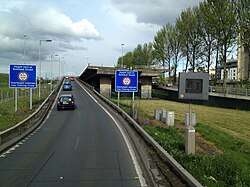
Current developments include the Glasgow East End Regeneration Route, which aims to create a second, smaller box closer to the city centre by connecting the M74 northern extension with the M8 at the M80 interchange.
Motorway Network Summary
| Motorway | Primary Connection | Key Feature |
|---|---|---|
| M8 | Edinburgh & Bishopton | Busiest motorway in Scotland; includes Kingston Bridge |
| M74 | Glasgow & England | Only motorway link to Great Britain (via M6) |
| M73 | M8 & M74 | North-south link forming a motorway triangle |
| M80 | Glasgow & Stirling | Links M8 to M9 via Cumbernauld |
| M77 | Glasgow & Kilmarnock | South-west arterial route |
| M898 | M8 & Erskine Bridge | Shortest and highest-numbered motorway in the UK |
Frequently Asked Questions
Which is the busiest road crossing in Europe?
The Kingston Bridge on the M8 is the busiest road crossing in Europe, with traffic volumes reaching up to 150,000 vehicles per day.
What was the purpose of the Bruce Report?
The Bruce Report was a proposal to create a modern, efficient transport network for Glasgow, leading to the construction of the M8, M74, M77, the Clyde Tunnel, and the Clydeside Expressway.
How does the M74 connect Scotland to England?
The M74 runs south from Glasgow; it later becomes the A74(M) and then transitions into the M6 upon crossing the border into England.
What is unique about the M898?
The M898 is unique for being both the shortest motorway in the United Kingdom (less than one mile long) and the motorway with the highest number.
Was the Glasgow Inner Ring Road ever finished?
No, the full inner ring road was abandoned. However, a similar motorway box around the eastern part of the city was completed in 2011 via the M74 northern extension.