
Grado: The History of the New Aquileia
Long before it became a renowned destination, Grado served as a strategic maritime gateway and a sanctuary for those fleeing the turbulence of the falling Roman Empire. Originally known as ad Aquae Gradatae, the city functioned as the primary port for vessels entering the Natissa (Natisone) river on their journey upstream toward the great city of Aquileia.
The Rise of a Sanctuary
As the Western Roman Empire declined, the vulnerability of mainland cities to eastern invasions prompted a migration toward more defensible locations. Grado, with its natural island protections, became a haven for those fleeing Aquileia. This transition was marked by the arrival of Nicetas, the Bishop of Aquileia, in 452. This era saw the birth of the city's earliest religious landmarks, including the first cathedral, the baptistery, and the church of Santa Maria delle Grazie.
During this period, Grado also served a military purpose, acting as the home base for the patriarchate's fleet.
The Schism of the Two Aquileias
The geopolitical landscape shifted dramatically in 568 when the Lombards invaded and captured Aquileia. Metropolitan Paulinus I of Aquileia sought refuge in Grado, which remained under the protection of Byzantine rule (the Eastern Roman Empire). Because the original city remained under Lombard control, the residence of the Aquileian metropolitans-patriarchs was formally transferred to Grado in 579, earning the city the title of the New Aquileia.
This move sparked a centuries-long ecclesiastical conflict. By the early 7th century, a rival patriarch was elected in the original Aquileia. This created two competing lines of authority: one based in New Aquileia (Grado) overseeing the Byzantine-controlled coastal regions and the Venetian Lagoon, and another in old Aquileia (which later moved to Cormons and Cividale) overseeing the Lombard-held interior.
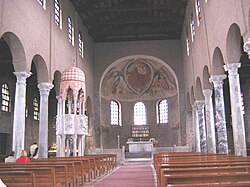
Resolution and Decline
The dispute persisted for centuries. In 993, Patriarch Popo of old Aquileia successfully conquered Grado, though his control was short-lived. The conflict was finally resolved in 1027 when the Pope confirmed the jurisdiction of the See of New Aquileia over Grado and the Venetian province. However, Grado's prominence faded in 1451 when Pope Nicholas V transferred the seat of the patriarchate to Venice.
Reduced to a minor hamlet, the city suffered significant losses in the early 19th century. It was sacked by the English in 1810, resulting in the burning of the city archives, and later sacked by the French in 1812.
Modern Transition and Connectivity
The political ownership of Grado shifted again in 1815 when it was acquired by Austria. It remained under Austrian rule until 1918, when it was ceded to Italy following the conclusion of World War I.
Historically, access to the island was limited to embarking from the Belvedere area, where the land meets the lagoon. As the area developed into a tourist destination, infrastructure improved. A road was constructed through the lagoon in 1905, and the city's isolation ended definitively in 1936 with the construction of a swing bridge connecting Grado to the mainland.
Key Facts
- Original Name: ad Aquae Gradatae.
- Strategic Role: First port for ships heading to Aquileia via the Natissa river.
- The Great Shift: Became the permanent residence of the Aquileian patriarchs in 579 after the Lombard invasion.
- Ecclesiastical Rivalry: Divided into "New Aquileia" (Byzantine coast) and "Old Aquileia" (Lombard interior).
- Administrative Change: The patriarchate moved to Venice in 1451.
- Modern Access: Connected to the mainland via a swing bridge in 1936.
| Year/Period | Event | Significance |
|---|---|---|
| 452 | Arrival of Bishop Nicetas | Earliest construction of cathedral and baptistery. |
| 568-579 | Lombard Invasion | Grado becomes the permanent seat of the patriarchs. |
| 1027 | Papal Confirmation | Jurisdiction of New Aquileia over Grado and Venice confirmed. |
| 1451 | Transfer to Venice | Seat of the patriarchate leaves Grado. |
| 1810-1812 | English and French Sacks | Destruction of city archives and urban damage. |
| 1815-1918 | Austrian Rule | Period of Austrian administration until WWI. |
Frequently Asked Questions
Why was Grado called the New Aquileia?
Grado earned this name after the Lombard invasion of 568. Because the original city of Aquileia was captured, the metropolitans-patriarchs moved their permanent residence to Grado, which remained under Byzantine rule.
What caused the dispute between the two patriarchs?
The dispute arose because two separate lines of patriarchs were elected: one in Grado (New Aquileia) and one in the original Aquileia. They clashed over jurisdiction between the Byzantine-controlled coast and the Lombard-controlled interior.
When did Grado stop being the seat of the patriarchate?
The seat of the patriarchate was transferred from Grado to Venice in 1451 by Pope Nicholas V.
How was Grado accessed before the 20th century?
Before the construction of the 1905 road and the 1936 swing bridge, people had to embark from the Belvedere area to reach the island of Grado by boat.
Which foreign powers occupied Grado in the 19th century?
Grado was sacked by the English in 1810 and the French in 1812, and was subsequently acquired by Austria in 1815.