
Grand Canal Docks: From Industrial Decay to Silicon Docks
The story of the Grand Canal Docks is one of the most dramatic urban transformations in Ireland. Once the center of global maritime trade and later a derelict industrial wasteland, the area has evolved into the "Silicon Docks," a premier global hub for technology and finance. This journey from medieval isolation to a modern economic engine reflects the broader economic shifts of Dublin over two centuries.
The Early History and Industrial Decline
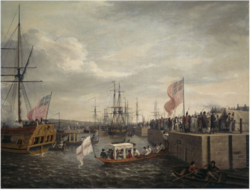
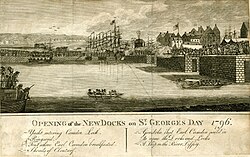
Designed by William Jessop, the Grand Canal Docks first opened in 1796. At the time of their inception, they were the largest docks in the world. However, the area's history predates its industrial success; during medieval times, the region was associated with lepers, a legacy still visible in historical street names like Lazer Lane and Misery Hill.
The docks' dominance was short-lived. Within a few decades, the rise of the railways reduced the reliance on canal transport, leading to a steady decline. By the mid-20th century, the landscape had shifted from maritime trade to heavy industry. The area became dominated by iron foundries, bottle factories, chemical plants, tar pits, and the massive coal mounds of the Dublin Gas Company. While some millers and bakers continued to operate along the southern edge of the inner basin, the docks were almost entirely derelict by the 1960s.
The Path to Regeneration
The turning point for the area began in the late 1980s, though the land presented significant challenges. By 1987, Hanover Quay was deemed too toxic for sale. Actual regeneration efforts accelerated in 1998 when the Dublin Docklands Development Authority (DDDA) purchased the former gasworks site from Bord Gáis for €19 million.
Between 2002 and 2006, under the supervision of the Environmental Protection Agency, the DDDA undertook a massive decontamination project. This involved digging out contaminated soil and constructing an underground wall eight meters deep to isolate the affected area. Despite an initial estimated return of only €40 million, the DDDA spent €52 million on this cleanup. This investment paid off handsomely; due to a property bubble and surging demand, the land was eventually sold for €300 million, with funds reinvested into civic spaces, street lighting, and seating.
The Rise of the Silicon Docks
The transition to a tech hub was catalyzed by the collapse of the dot-com bubble between 1999 and 2001. Dermot Tuohy, IDA Ireland's director of operations in California, worked to attract emerging tech giants to Dublin, including eBay, PayPal, Overture (later Yahoo!), and Google.
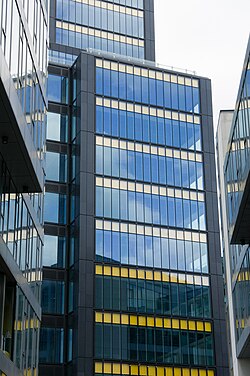
In 2004, Google moved into 60,000 square feet of Gordon House on Barrow Street. The company chose this location over the city center's Digital Hub because it offered a "college campus-style" atmosphere and was within walking distance of the city center—factors essential for attracting top talent. This move is widely regarded by the IDA as a seismic shift, acting as a magnet that drew other Silicon Valley firms, such as Facebook and Twitter, to the vicinity.
Economic Volatility and Modern Planning
The development of the docks was not without setbacks. Many high-end buildings were completed in 2007, just before the 2008 financial crisis, leaving them empty for years. It was not until 2012, during Ireland's economic recovery, that international investors began purchasing prime office spaces again.
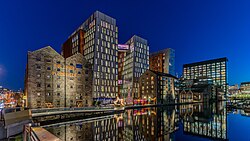
To maintain momentum, the Dublin City Council introduced the Docklands Strategic Development Zone (SDZ) Planning Scheme in November 2013. This fast-track system allowed for buildings up to 22 floors—50% taller than the city's tallest building at the time—and removed the ability to appeal decisions to An Bord Pleanála to prevent developer delays. The SDZ focused on 66 hectares across five hubs: Spencer Dock, Point Village, Grand Canal Dock, Britain Quay, and Boland's Mill.
A symbol of this recovery was the completion of the former Anglo Irish Bank building in 2017 by the Central Bank of Ireland, ending its tenure as a skeletal icon of the financial crash.
Key Facts
- Opening: The docks opened in 1796 and were once the world's largest.
- Decontamination: The DDDA spent €52 million (2002–2006) to clean toxic gasworks land.
- Tech Catalyst: Google's 2004 move to Barrow Street triggered a wave of Silicon Valley investment.
- Planning: The SDZ Planning Scheme allows buildings up to 22 stories to accelerate development.
- Development Hubs: The area is divided into five hubs, including Boland's Mill and Point Village.
| Era | Primary Characteristic | Key Driver/Event |
|---|---|---|
| Late 18th Century | Global Maritime Hub | Opening of docks (1796) |
| Mid-20th Century | Industrial Decay | Rise of railways; heavy industry |
| 1998–2006 | Environmental Recovery | DDDA decontamination project |
| 2004–Present | Tech & Finance Hub | Arrival of Google and other US tech firms |
Frequently Asked Questions
Why did the Grand Canal Docks decline after their opening?
The docks fell into decline primarily due to the arrival of the railways, which reduced the usage of canals for transporting goods.
How was the toxic land at Hanover Quay treated?
The land was decontaminated between 2002 and 2006 by digging out contaminated soil and installing an underground wall eight meters deep to contain the area.
What role did Google play in the area's development?
Google's decision to rent space on Barrow Street in 2004 created a "seismic shift" in investment, encouraging other major tech companies like Facebook and Twitter to establish offices nearby.
What is the Docklands Strategic Development Zone (SDZ)?
The SDZ is a fast-track planning scheme that allows for taller buildings (up to 22 floors) and streamlines the approval process by removing the option to appeal decisions to An Bord Pleanála.
What current challenges face the Silicon Docks area?
The Dublin housing crisis and rising cost of living have put pressure on tech firms to retain staff, leading some companies to seek more affordable office locations elsewhere in Ireland.