
Hanley: A History of Municipal Growth and Industrial Heritage
Hanley is a town with a rich legacy of industrial power and civic evolution. From its origins as a rural landscape to its role as a central hub within the City of Stoke-on-Trent, Hanley's journey reflects the broader transformation of North Staffordshire through the eras of coal mining and urban redevelopment.
Etymology and Origins
The name Hanley is derived from Old English roots. It is believed to come from either haer lea, meaning "high meadow," or heah lea, which translates to "rock meadow." This linguistic heritage hints at the natural topography of the area before it became an industrial powerhouse.
Municipal Evolution
Hanley's administrative history is marked by a steady climb in status. It was first incorporated as a municipal borough in 1857 and later became a county borough following the Local Government Act 1888. By December 31, 1894, it was established as a civil parish, formed from a portion of Stoke-upon-Trent.
The administrative heart of the borough was centered at Hanley Town Hall.
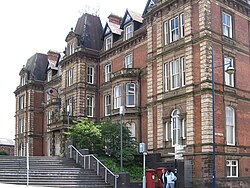
In 1910, Hanley federated with five other towns—Burslem, Tunstall, Fenton, Longton, and Stoke-upon-Trent—to form the county borough of Stoke-on-Trent. Notably, Hanley was the only one of these six towns to hold county borough status prior to the merger, a status that was subsequently transferred to the newly enlarged borough. The civil parish was eventually abolished on April 1, 1922, merging fully into Stoke-on-Trent. By the time of the 1921 census, Hanley's population stood at 67,891. Following the granting of city status in 1925, Hanley became one of the six constituent towns of the City of Stoke-on-Trent.
The Era of Coal Mining
Coal mining was a cornerstone of the North Staffordshire economy. A primary example of this industry was the Hanley Deep Pit, which opened in 1854. This site held the distinction of being the deepest pit in the North Staffordshire coalfield, reaching a depth of 1,500 feet.
During its peak in the 1930s, the pit was a massive employer, utilizing the labor of approximately 2,000 men and boys. Its productivity was immense, often yielding 9,000 long tons (approximately 9,100 tonnes) of coal per week. While the pit closed in 1962, leaving behind headgear and spoilheaps, the site underwent a significant transformation in the 1980s. The area was cleared and landscaped to create the modern Central Forest Park.
The region's industrial history was also marked by social unrest. Coal miners in the Hanley and Longton areas were instrumental in igniting the 1842 General Strike and the subsequent Pottery Riots. Additionally, the College Road drill hall was completed in 1903, marking another milestone in the town's development.
Urban Regeneration and the Garden Festival
The late 20th century brought a shift from heavy industry to reclamation. The 1986 Stoke-on-Trent Garden Festival served as a catalyst for reclaiming vast areas of land west of the city center. This included the former Shelton steelworks, which had remained derelict since 1978.
Although the land remained unused for a period after the festival concluded, it eventually provided the foundation for new public parkland, as well as modern retail and leisure developments.
Key Facts
- Deepest Pit: Hanley Deep Pit reached 1,500 feet, the deepest in the North Staffordshire coalfield.
- Peak Production: In the 1930s, Hanley Deep Pit produced up to 9,000 long tons of coal weekly.
- Population: The 1921 census recorded 67,891 residents in the parish of Hanley.
- Civic Status: Hanley was the only town among the six that federated in 1910 to already be a county borough.
- Land Reclamation: The 1986 Garden Festival helped reclaim the derelict Shelton steelworks site.
| Year | Event | Significance |
|---|---|---|
| 1842 | General Strike / Pottery Riots | Ignited by local coal miners |
| 1854 | Opening of Hanley Deep Pit | Deepest pit in North Staffordshire |
| 1857 | Municipal Incorporation | Became a municipal borough |
| 1910 | Federation | Joined five towns to form Stoke-on-Trent |
| 1925 | City Status | Became part of the City of Stoke-on-Trent |
| 1962 | Closure of Deep Pit | End of major mining operations at the site |
| 1986 | Garden Festival | Reclamation of derelict industrial land |
Frequently Asked Questions
What does the name Hanley mean?
The name is derived from either "haer lea," meaning high meadow, or "heah lea," meaning rock meadow.
What was the significance of the Hanley Deep Pit?
It was the deepest pit in the North Staffordshire coalfield, reaching 1,500 feet. At its peak in the 1930s, it employed 2,000 workers and produced 9,000 long tons of coal per week.
How did Hanley become part of Stoke-on-Trent?
Hanley federated with Burslem, Tunstall, Fenton, Longton, and Stoke-upon-Trent in 1910 to form a county borough, later becoming part of the city in 1925.
What happened to the site of the Hanley Deep Pit?
After closing in 1962, the site was cleared and landscaped during the 1980s to become Central Forest Park.
What was the impact of the 1986 Garden Festival?
The festival led to the reclamation of derelict land west of the city center, including the former Shelton steelworks, which was eventually redeveloped into retail, leisure, and parkland.