
Hemline History: The Evolution of Women's Skirt Lengths
For centuries, the length of a woman's skirt was more than just a fashion choice; it was a marker of social class and propriety. In Western fashion, the standards for upper- and middle-class women remained remarkably static for generations, with garments typically ranging from floor-length to slightly above the ankle. Shorter lengths were reserved for specific, practical, or professional purposes, creating a rigid boundary between social status and attire.
Historically, skirts that reached the mid-calf or lower-calf were associated with the practical needs of lower-class women or American pioneer women. Even shorter lengths were strictly limited to specialized contexts, such as stage costumes for ballerinas or sea-bathing attire.
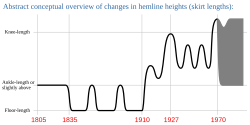
The Great Shift: 1910s to 1930s
The mid-1910s marked a pivotal turning point in fashion history as hemlines began to rise significantly. In a span of just over fifteen years—from the late 1900s to the mid-1920s—skirts transitioned from floor-length to near knee-length.
This period was characterized by rapid fluctuations. Between 1919 and 1923, hemlines shifted dramatically: they were nearly at the floor in 1919, rose to mid-calf by 1920, and dropped back to the ankles by 1923. By 1927, the iconic flapper length emerged, with skirts reaching the kneecap or higher, before lengths began to descend again during the 1930s.
Social Pressure and Modern Diversity
From the era of World War I until approximately 1970, women faced significant social pressure to adhere to the prevailing fashionable length. Deviating from the current trend often resulted in being labeled unstylish. However, the 1970s ushered in a new era of sartorial freedom. Since then, women's options have expanded, and the concept of a single, dominant fashionable skirt length has largely disappeared.
The Hemline Index Theory
Beyond social trends, some theorists suggest a correlation between fashion and economics. The hemline index is a theory stating that skirt lengths rise and fall in synchronization with the stock market. This concept was introduced in 1926 by George Taylor, a professor at the Wharton Business School.
Taylor noted this trend during the "Roaring '20s," when hemlines rose alongside the booming economy. Conversely, when the Great Depression struck, hemlines fell back to the floor, suggesting a link between economic prosperity and the boldness of fashion choices.
Key Facts
- Pre-WWI: Upper- and middle-class skirts were generally floor-length or slightly above the ankle.
- Class Distinction: Mid-calf lengths were historically linked to lower-class or pioneer women.
- Rapid Change: Hemlines moved from floor to knee-length between the late 1900s and mid-1920s.
- Flapper Era: 1927 saw skirts reach the kneecap or higher.
- Modern Era: Since the 1970s, multiple skirt lengths have been acceptable simultaneously.
- Economic Theory: The hemline index suggests a link between stock market performance and skirt length.
| Period/Year | Typical Hemline Length | Social/Economic Context |
|---|---|---|
| Pre-1910s | Floor to Ankle | Upper/Middle Class Standard |
| 1919 | Almost Floor-length | Post-WWI Transition |
| 1920 | Mid-calf | Rising Trends |
| 1923 | Ankle-length | Temporary Drop |
| 1927 | Kneecap or Higher | Flapper Era / Roaring '20s |
| 1930s | Descending/Longer | Great Depression |
| 1970s-Present | Varied | Diversified Fashion Options |
Frequently Asked Questions
Who originally wore mid-calf skirts before the 1910s?
Before the mid-1910s, mid-calf or lower-calf skirts were primarily worn by lower-class women or American pioneer women as practical working garments.
What is the flapper length?
Flapper length refers to the short skirts of 1927 that reached the kneecap or higher, characteristic of the Roaring '20s.
What is the hemline index?
The hemline index is a theory proposed by Professor George Taylor in 1926 suggesting that skirt lengths rise during economic booms and fall during economic downturns.
When did women stop being pressured to wear a single fashionable skirt length?
The social pressure to adhere to one specific fashionable length began to diminish around the 1970s, leading to the wide variety of options available today.
How quickly did hemlines change in the early 20th century?
Hemlines changed rapidly, moving from floor-length to near knee-length in just over fifteen years, between the late 1900s and the mid-1920s.