
Hispanic American Colonial Universities: The European Educational Legacy
Between the arrival of Europeans in 1492 and the Wars of Independence in the early 19th century, the Spanish Empire fundamentally reshaped the intellectual landscape of the Americas. By transplanting the European university model to its overseas colonies, Spain established a network of higher learning institutions that served as the bedrock for academic life in the New World.
Before European settlement, no institutions resembling universities existed in the Americas. These new centers of learning were not original inventions but were "implants" of the European tradition, designed to meet the growing needs of a rapidly expanding empire. The primary drivers for this educational expansion were the Christian mission to convert indigenous populations and the urgent demand for skilled administrators to manage the colonial bureaucracy.
The Foundation and Governance of Colonial Universities
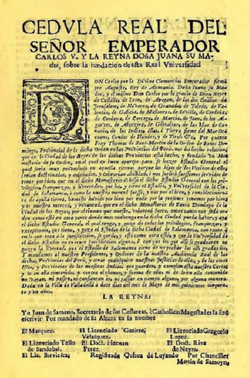
Establishing a university in the Spanish colonies was a formal process rooted in medieval tradition. To legally confer academic degrees, a foundation required either a papal bull (a formal proclamation issued by the Pope) or a royal privilege granted by the Spanish Crown. In most cases, founders sought approval from both clerical and secular authorities to ensure legitimacy.
While the Spanish King maintained strict supervision over these institutions, one notable exception existed: San Nicolas in Bogotá, which operated as a private university.
Curriculum and Academic Structure
The charters for these institutions were largely modeled after the University of Salamanca, the most prestigious university in Spain. The academic offerings generally fell into two categories:
- Basic Studies: Smaller universities focused on the artes (foundational studies) and Catholic theology, including church law.
- Full Universities: Major institutions offered a comprehensive curriculum across the four classic faculties: arts, theology, medicine, and jurisprudence (law).
The first influential universities were established in the primary viceroyalty centers of Mexico City, Lima, and Santo Domingo. As the empire grew, more universities were founded to bridge the vast geographical distances of the Spanish realm.
The Role of Religious Orders
The Catholic Church played a pivotal role in the development of higher education. The Jesuits were the most influential, though the Dominicans and Augustinians also contributed significantly. These orders often took the local initiative to found and operate campuses, though this sometimes led to open conflicts over curriculum control and campus management.
The landscape suffered a major blow in the late 18th century with the temporary dissolution of the Jesuit order. This suppression led to the closure of several universities, some of which were not reopened until decades later.
Comparative Perspectives: Spain vs. Portugal
The Spanish approach to higher education differed sharply from that of Portuguese Brazil. While Spain established a wide network of universities, Brazil had no university during the colonial period; the first, the University of Paraná in Curitiba, was not established until 1912.
In Brazil, the Portuguese preferred professional academies to train technicians and skilled professionals—including the first school of higher engineering studies in the Americas. For theological or legal degrees, Brazilian students were required to travel overseas to the University of Coimbra.
| Feature | Spanish Viceroyalties | Portuguese Brazil |
|---|---|---|
| University Presence | Numerous universities established early | No universities until 1912 |
| Primary Model | University of Salamanca | Professional Academies / Coimbra |
| Key Influencers | Jesuits, Dominicans, Augustinians | Jesuit colegios / Portuguese Crown |
| Academic Focus | Theology, Law, Medicine, Arts | Technical and Professional skills |
Key Facts
- The University of San Marcos in Lima (1551) is the oldest continuously operating university in the Americas.
- Most colonial universities required both a royal privilege and a papal bull to grant degrees.
- The "four classic faculties" consisted of arts, theology, medicine, and jurisprudence.
- The Jesuits were the primary drivers of university founding and operation.
- Portuguese Brazil focused on professional academies rather than general universities during the colonial era.
Frequently Asked Questions
What was the purpose of establishing universities in the Americas?
They were created to support the Christian mission to the indigenous people and to provide the necessary administrative and legal training for the Spanish Empire's growing colonial bureaucracy.
Which Spanish university served as the primary model for colonial institutions?
The University of Salamanca, known as the oldest and most venerable university in Spain, provided the blueprint for the charters and curricula of the new American foundations.
How did the dissolution of the Jesuits affect education?
Because the Jesuits were central to the operation of many universities, their suppression in the late 18th century caused a significant setback, leading to the closure of several institutions.
Why did Brazil not have universities during the colonial period?
The Portuguese preferred creating specialized professional academies for technical needs and required students seeking higher degrees in law or theology to study at the University of Coimbra in Portugal.
What were the "four classic faculties" taught at full universities?
The full universities offered courses in arts (basic studies), Catholic theology, medicine, and jurisprudence.