
Historical Tribes of Texas: Indigenous Peoples and Their Legacy
The land now known as Texas was once home to a diverse array of Indigenous tribes, each with unique cultural practices, social structures, and adaptations to the varied landscapes of the region. From the piney woods of the east to the arid plains of the west, these nations shaped the early history of the territory. While many were forcibly removed to Indian Territory (modern-day Oklahoma), New Mexico, or Louisiana during the 19th century, their legacy persists through living descendants and preserved cultural heritage.
In recent decades, government policies have shifted toward the protection of Native American cultural and political rights. A significant turning point occurred in 1975 with the implementation of Cultural Impact Assessments—evaluations designed to determine how state actions might affect Native cultural sites and resources. Texas further expanded these protections in 2011 through programs targeting education, healthcare, and economic development. Additionally, the passage of House Bill 3884 now requires government agencies to integrate tribal perspectives into decisions affecting the Indigenous environment, formally recognizing tribal sovereignty (the inherent right of Indigenous tribes to govern themselves).
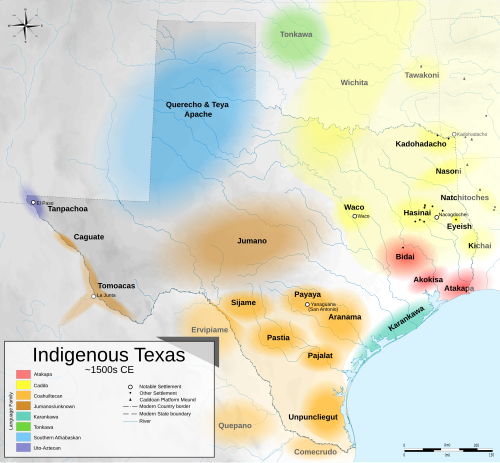
Key Facts
- Many Texas tribes were forcibly relocated to Oklahoma, Louisiana, or New Mexico in the 1800s.
- The Caddo were known for sedentary agriculture and skilled pottery in East Texas.
- The Comanche dominated the Southern Plains, utilizing horses for battle and buffalo for survival.
- The Karankawa utilized the Gulf Coast's seafood resources and were skilled basket weavers.
- The Jumano were prominent traders in West and Central Texas before their decline.
- Modern Texas law (HB 3884) requires government agencies to consider tribal perspectives on environmental issues.
Major Historical Tribes of Texas
The Caddo
Residing in East Texas, the Caddo established permanent villages and were renowned for their stability. They developed a sophisticated agricultural society, primarily planting corn, and were highly skilled potters. Known for their diplomatic nature, the Caddo formed strategic alliances with French settlers and maintained extensive trade networks. Today, the Caddo Nation is headquartered in Oklahoma.
The Comanche
The Comanche inhabited the Southern Plains of Texas. To protect their territory and people, they became formidable warriors, adopting and breeding horses acquired from Europeans to gain a tactical advantage in battle. Their economy and survival were centered on the buffalo, which provided essential food, clothing, and shelter. The Comanche Nation is now based in Oklahoma.
The Karankawa
Living along the Texas Gulf Coast, the Karankawa adapted to the coastal environment. When crops failed to grow, they relied on the abundant seafood of the coast for sustenance. They were recognized for their craftsmanship in basketry and provided assistance to early Spanish explorers attempting to settle the region.
The Jumano
The Jumano people lived across West and Central Texas and were distinguished by their unique body markings and expertise in trade. Their presence in the region eventually declined due to environmental changes and the rise of the Apache, who overthrew the Jumano tribe.
Regional Distribution of Texas Tribes
The diversity of the Texas landscape supported a wide variety of smaller tribal groups and bands. The following table summarizes the historical locations of several notable groups.
| Region | Tribes |
|---|---|
| East / Northeast | Caddo, Adai, Bidai, Kadohadacho, Neche, Nacogdoche |
| North / Panhandle | Comanche, Kiowa, Teya, Wichita, Kichai, Waco |
| West / Southwest | Apache, Jumano, Manso, La Junta, Quide, Suma |
| South / Gulf Coast | Karankawa, Atakapa, Akokisa, Coahuiltecan, Comecrudo |
| Central / South-Central | Payaya, Geier, Pastia, Xarame, Ervipiame |
Contemporary Tribes with Texas Ties
While many tribes no longer reside within the borders of Texas, their descendants maintain strong historical ties to the land. Many of these nations are now headquartered in surrounding states, primarily Oklahoma.
- Oklahoma: Absentee Shawnee, Apache Tribe of Oklahoma, Caddo Nation, Cherokee Nation, Cheyenne & Arapaho, Choctaw Nation, Comanche Nation, Delaware Nation, Kialegee Tribal Town, Kickapoo Tribe, Muscogee (Creek) Nation, Osage Nation, Quapaw Nation, Seminole Nation, Shawnee Tribe, Thlopthlocco Tribal Town, Tonkawa Tribe, United Keetoowah Band of Cherokee Indians, Wichita and Affiliated Tribes.
- Louisiana: Coushatta Tribe, Jena Band of Choctaw Indians, Tunica-Biloxi Tribe.
- New Mexico: Jicarilla Apache Nation, Mescalero Apache Tribe.
Frequently Asked Questions
Where are the historical tribes of Texas located today?
Many are now headquartered in Oklahoma (formerly Indian Territory), with others located in Louisiana and New Mexico. Some tribes no longer exist as formal political entities but have living descendants.
What was the significance of House Bill 3884 in Texas?
House Bill 3884 requires Texas government agencies to consider tribal perspectives when making decisions that impact the Indigenous environment, ensuring Native voices are included in government processes.
How did the Comanche utilize horses?
The Comanche acquired horses from Europeans and began breeding them, which allowed them to become highly effective warriors and protectors of their territory on the Southern Plains.
What were the primary resources of the Karankawa?
The Karankawa relied heavily on the Gulf Coast's seafood when agriculture was not viable, and they were known for their skill in crafting baskets.
What are Cultural Impact Assessments?
Implemented starting in 1975, these are evaluations used to determine how state actions or developments might affect Native American cultural resources and historical sites.