
Homebrewing Beer: From Mashing to Carbonation
The principles of homebrewing are remarkably similar to those used in commercial breweries. At its core, the process involves creating a hopped wort—a sweet liquid extracted from malted grains—and pitching yeast into that liquid to stimulate fermentation. While the basic goal remains the same, the complexity of the process depends largely on how the brewer chooses to manufacture the wort.
Key Facts
- Wort is the sugar-rich liquid produced by mashing grains or dissolving malt extract.
- Mashing converts grain starches into fermentable sugars using natural enzymes.
- Hops are added during the boil to provide bitterness, flavor, and aroma.
- Fermentation occurs when yeast consumes sugars to produce ethanol and carbon dioxide.
- Carbonation is achieved either through force-carbonation in kegs or priming sugar in bottles.
The Mashing Process
Mashing is the critical step where starches in grains are converted into sugars via natural enzymes. Depending on the brewer's experience level and desired control, this step varies significantly.
Beginner: Extract Brewing
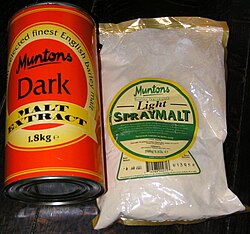
For those starting out, extract brewing is the simplest method. In this approach, the mashing has already been completed by the supplier of the malt extract, meaning the homebrewer does not need to perform any mashing.
Intermediate: Partial Mashing
Intermediate brewers may use a partial mash. Unlike "dead malts," where heat has destroyed the natural enzymes, some extracts remain enzymatically active. Diastatically active malt extracts (currently available in cans) can be used to convert starches from adjuncts—such as flaked oats, wheat flour, or torrified barley—into a fermentable syrup. These adjuncts are often used to add "body" to the finished beer.
Advanced: All Grain Brewing
Advanced brewers forgo concentrates entirely, converting starch to sugar directly from the grains. This is known as all grain brewing. While it sounds complex, it is accessible to beginners using the Brew-in-a-Bag (BIAB) method. This process requires a mash tun (an insulated vessel) where crushed malted barley or other grains (corn, rye, oats, wheat) are mixed with hot water.
A popular technique is the "Infusion Mash," where water is heated above the target enzymatic temperature to compensate for the cooler grains. To extract more sugar, brewers perform sparging (rinsing the grains). This is done via two methods:
- Fly Sparging: Adding small amounts of hot water to the top of the grain bed while draining equal amounts from the bottom.
- Batch Sparging: Adding most of the sparge water at once and then draining it.
Heating the mash to approximately 80 °C (176 °F) can end enzymatic activity before the liquid is moved to the lauter-tun.
Boiling the Wort
Regardless of the mashing method, the resulting liquid must be boiled with hops, typically for 60–90 minutes. The timing of hop additions determines the beer's profile:
- Bittering: Hops added at the start of the boil.
- Flavor: Hops added in the final 30 minutes.
- Aroma: Hops added in the last few minutes or after the boil.
To prevent haze, finings such as gelatin or Irish moss (a type of seaweed) may be added during the final 15–30 minutes of the boil.
Cooling the Wort
Rapidly cooling the wort is essential for healthy yeast propagation and prevents contamination. It also "locks in" hop aromas, reduces dimethyl sulfide (DMS) production, and encourages "cold break," where haze-producing proteins coagulate for a clearer beer.
Brewers typically use one of three cooling methods:
- Immersion Chiller: A coiled copper or stainless steel tube (usually 50 feet long) submerged in the wort with cool water pumped through it.
- Counterflow Chiller: A tube-within-a-tube design where hot wort and cool water flow in opposite directions.
- No-Chill Approach: A water-conserving method where hot wort is racked into a fermenter and left to cool naturally. Some brewers use a coolship (a broad, uncovered container) to capture wild yeast from the air.
Fermentation
Once the wort reaches the correct temperature, yeast is "pitched" (added), and the liquid officially becomes beer. Primary fermentation usually occurs in sealed glass or plastic carboys or food-grade buckets. A fermentation lock is used to vent carbon dioxide while blocking contaminants. Advanced locks, like the Sterilock, use nanotechnology to block bacteria and wild fungi.
Temperature control is vital: ales typically ferment between 18–24 °C (64–75 °F), while lagers require colder temperatures around 10 °C (50 °F). During this phase, yeast consumes sugars (maltose, glucose, and sucrose) to produce ethanol and CO2. The resulting sediment at the bottom is called lees or trub.
Some brewers move the beer to a secondary fermenter to age or clarify the brew using agents like isinglass or colloidal silicon dioxide. Alternatively, a uni-tank (a conical vessel like the FastFerment or Blichmann Fermenator) can handle both primary and secondary fermentation in one place.
Carbonation
The final step is adding carbonation. This is achieved via two primary methods:
- Force Carbonation: Using compressed CO2 in a keg.
- Bottle Carbonation: Adding priming sugar (e.g., 4 oz of corn sugar in 2 cups of water for a 5-gallon batch) to briefly reactivate the yeast in the bottle.
While filtering can improve visual clarity, most homebrewed beers remain unfiltered to simplify carbonation. It is critical to use pressure-resistant bottles (such as Grolsch flip-tops or soda bottles) and precise sugar measurements to avoid "bottle bombs" caused by excessive pressure.
| Method | Complexity | Mashing Required? | Key Equipment |
|---|---|---|---|
| Extract Brewing | Low | No | Boil kettle, Fermenter |
| Partial Mash | Medium | Partial | Active malt extract, Adjuncts |
| All Grain | High | Yes | Mash tun or BIAB bag |
Frequently Asked Questions
What is the difference between fly sparging and batch sparging?
Fly sparging involves continuously adding small amounts of hot water to the top of the grain bed while draining liquid from the bottom. Batch sparging involves adding the majority of the sparge water to the grain bed all at once before draining.
Why is it important to cool the wort quickly?
Rapid cooling ensures the wort is at a safe temperature for yeast pitching, prevents the growth of contaminating bacteria, reduces the production of dimethyl sulfide (DMS), and helps create a clearer beer through "cold break."
What are "bottle bombs" and how can they be avoided?
Bottle bombs are bottles that explode due to excessive internal pressure. They are avoided by using the correct amount of priming sugar, ensuring bottles are pressure-rated, and using proper capping methods.
What is the purpose of a fermentation lock?
A fermentation lock allows carbon dioxide produced during fermentation to escape the vessel while preventing outside air, particles, and contaminants from entering the beer.
How do hop additions affect the taste of the beer?
Hops added at the start of the boil provide bitterness; those added in the last 30 minutes provide flavor; and those added in the final minutes or after the boil contribute aroma.