
Honey Bee Development: From Egg to Emergence
The life cycle of the honey bee (Apis mellifera) is a complex biological process where the destiny of each bee is determined by its sex, age, and diet. From the moment an egg is laid, the colony employs a sophisticated system of care and feeding to ensure the survival of the hive, with different castes—queens, workers, and drones—following distinct developmental timelines.
The Three Castes of the Hive
Every bee in the colony has a specific role. Nurse bees, for example, are essential workers charged with the care and feeding of the queen and the developing larvae. The biological path a bee takes depends largely on whether the egg is fertilized and what food it receives.
- Queens: The heart of the colony. Only one queen is typically present. They are developed in enlarged cells and fed exclusively on royal jelly (a nutrient-rich secretion).
- Workers: Female bees that perform the majority of hive duties. They develop from fertilized eggs but do not receive the exclusive royal jelly diet of the queen.
- Drones: Male bees that develop from unfertilized eggs. These are haploid, meaning they contain only 50% of the queen's genes.
The Developmental Timeline
The time it takes for a bee to emerge from its cell varies significantly by type. Queens are the fastest to develop, emerging in 15–16 days. Workers follow at 21 days, and drones take the longest at 24 days.
When a colony becomes too large, or the existing queen ages or dies, the workers raise a new queen. If the hive is overcrowded, the old queen may lead a swarm—taking half the colony with her—a few days before the new queen emerges.
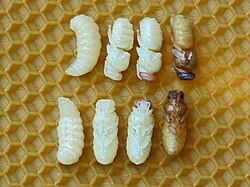
The transition from larva to adult involves a pupal stage. For drones, this process is a critical phase of physical transformation.
Queen Succession and Mating
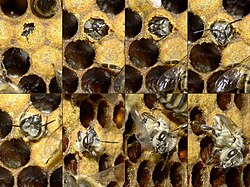
If multiple virgin queens emerge simultaneously, they engage in "piping," a high buzzing noise used to signal their location. This often leads to fights until only one queen remains. The victor then destroys other queen cells by chewing the sides and stinging the pupae inside.
To become fertile, the queen takes several nuptial flights to mate with drones from other colonies. These drones die immediately after mating. Once fertile, the queen can lay both fertilized eggs (which become workers or queens) and unfertilized eggs (which become drones).
Key Facts
- Queen Lifespan: Typically three to four years.
- Drone Lifespan: Usually die after mating or are expelled before winter.
- Worker Lifespan: A few weeks in summer; several months during extended winters.
- Genetics: Workers and queens are diploid (fertilized), while drones are haploid (unfertilized).
- Dietary Influence: Exclusive feeding of royal jelly is what transforms a fertilized egg into a queen.
Developmental Data Comparison
| Type | Egg Stage | Larva Stage | Cell Capped | Pupa Stage | Emergence (Days) | Weight at Emergence |
|---|---|---|---|---|---|---|
| Queen | Up to day 3 | Up to day 8.5 | Day 7.5 | Day 8 to emergence | 16 days | ~200 mg |
| Worker | Up to day 3 | Up to day 9 | Day 9 | Day 10 to emergence | 21 days | ~100 mg |
| Drone | Up to day 3 | Up to day 9.5 | Day 10 | Day 10 to emergence | 24 days | ~200 mg |
Worker Bee Growth Progression
The growth of a worker bee is rapid, shifting from a yolk-dependent egg to a larva fed by royal jelly and eventually bee bread (a mixture of honey and pollen).
- Days 1–3: Egg stage, relying on yolk.
- Days 4–5: Larva stage, fed royal jelly.
- Days 6–9: Larva stage, transitioning to bee bread; weight increases from 33.3 mg on day 6 to 155.2 mg by day 9.
Frequently Asked Questions
What is the difference between a diploid and a haploid bee?
Diploid bees (workers and queens) develop from fertilized eggs and have two sets of chromosomes. Haploid bees (drones) develop from unfertilized eggs and have only one set of chromosomes, containing 50% of the queen's genes.
How does a worker bee become a queen?
A worker and a queen both start as fertilized eggs, but a larva becomes a queen if it is fed exclusively royal jelly by the nurse bees in an enlarged cell.
What happens during a nuptial flight?
A virgin queen flies to mate with drones from other colonies. This ensures genetic diversity. The drones die immediately following the mating process.
Why do bees "pipe"?
Piping is a high buzzing noise made by virgin queens to signal their location to other queens, which typically leads to combat until only one queen survives to lead the hive.
What is bee bread?
Bee bread is a mixture of honey and pollen used to feed worker larvae from approximately the sixth day of development onward.