
HRSG Design, Configurations, and Operational Challenges
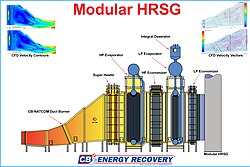
A Heat Recovery Steam Generator (HRSG) is a critical component in power generation, designed to capture waste heat from exhaust gases to produce steam. By integrating various heat exchange components, an HRSG transforms thermal energy that would otherwise be lost into usable steam for electricity production or industrial processes.
Core Components of an HRSG
To meet specific operating requirements, an HRSG integrates four primary components that work in sequence to heat water and convert it into high-temperature steam:
- Economizer: The initial stage where feedwater is preheated.
- Evaporator: The section where water is converted into saturated steam.
- Superheater: A component that raises the steam temperature beyond the saturation point to increase efficiency and protect downstream equipment.
- Water Preheater: Used to further prepare the water for the steam generation process.
Classifying Modular HRSGs
Modular HRSGs are categorized based on two primary criteria: the direction of the exhaust gas flow and the number of pressure levels utilized during steam generation.
Exhaust Gas Flow Direction
The orientation of the gas flow determines the physical layout of the tubes:
- Horizontal Type: Exhaust gases flow horizontally across vertical tubes.
- Vertical Type: Exhaust gases flow vertically across horizontal tubes.
Pressure Level Configurations
HRSGs are further distinguished by how many pressure stages they employ, which is indicated by the number of steam drums present:
- Single Pressure: Utilizes one steam drum to generate steam at a single pressure level.
- Multi-Pressure: Employs multiple drums to optimize heat recovery. This includes double pressure (two drums) and triple pressure (three drums) systems.
In a triple pressure configuration, the system is divided into three distinct sections: a Low Pressure (LP) section, an Intermediate Pressure (IP) or reheat section, and a High Pressure (HP) section. Each of these sections contains its own steam drum and evaporator to manage the specific pressure requirements of that stage.
Efficiency and Material Degradation
To enhance performance and environmental compliance, some HRSGs incorporate cold water heat exchangers. These units are designed to condense moisture within the flue gases, which serves the dual purpose of reducing emissions and increasing overall thermal efficiency.
However, the steam and water pressure parts of an HRSG operate under extreme conditions, making them susceptible to various degradation mechanisms. These include creep (permanent deformation under long-term stress), thermal fatigue (stress caused by temperature fluctuations), and Flow Accelerated Corrosion (FAC), where the movement of water accelerates the removal of the protective oxide layer from the metal.
Other significant threats to structural integrity include creep-fatigue, mechanical fatigue, general corrosion, and corrosion fatigue.
Key Facts
- HRSGs consist of an economizer, evaporator, superheater, and water preheater.
- Horizontal HRSGs use vertical tubes; vertical HRSGs use horizontal tubes.
- Triple pressure systems utilize LP, IP/reheat, and HP sections.
- Cold water heat exchangers are used to condense flue gas moisture and lower emissions.
- Common degradation risks include FAC, creep, and thermal fatigue.
| Feature | Single Pressure | Multi-Pressure (Triple) |
|---|---|---|
| Number of Steam Drums | One | Three |
| Pressure Sections | Single level | LP, IP/Reheat, and HP |
| Complexity | Lower | Higher |
Frequently Asked Questions
What is the purpose of a superheater in an HRSG?
The superheater is used to raise the temperature of the steam beyond its saturation point, which improves the efficiency of the power cycle and prevents moisture damage in turbines.
What is the difference between horizontal and vertical HRSGs?
The difference lies in the flow of exhaust gases: horizontal types move gas horizontally over vertical tubes, while vertical types move gas vertically over horizontal tubes.
What are the three sections of a triple pressure HRSG?
A triple pressure HRSG consists of a Low Pressure (LP) section, an Intermediate Pressure (IP) or reheat section, and a High Pressure (HP) section.
What is Flow Accelerated Corrosion (FAC)?
FAC is a degradation mechanism where the flow of water leads to the accelerated corrosion of the metal pressure parts within the HRSG.
How do cold water heat exchangers improve an HRSG?
They condense moisture in the flue gases, which helps in reducing emissions and increasing the overall efficiency of the system.