
Hungarian Parliament: The Re-establishment and Structure of the 1867 Diet
The political landscape of 19th-century Hungary was defined by a tumultuous struggle for autonomy against the Habsburg Monarchy. Following the suppressed revolution of 1848 and years of tension, the Austro-Hungarian Compromise of 1867 marked a pivotal turning point, re-establishing a national assembly that would shape the region's governance for decades.
The path to this restoration was fraught with conflict. After the 1848 revolution was crushed by Austrian troops under General Julius Jacob von Haynau, Hungary faced a period of strict imperial control. However, following the Austrian defeat at the 1859 Battle of Solferino and the subsequent loss of Lombardy, Emperor Franz Joseph attempted to integrate the crown lands through the October Diploma of 1860 and the February Patent of 1861. These measures proposed a bicameral legislature governed from Vienna, but Hungarian magnates rejected this arrangement, demanding comprehensive autonomy in Hungarian affairs.
The deadlock finally broke in 1867. With the appointment of Gyula Andrássy as Hungarian minister-president, the national assembly officially reconvened on February 27, 1867.
Key Facts
- Re-establishment: The national assembly was restored on February 27, 1867, following the Austro-Hungarian Compromise.
- Structure: A bicameral system consisting of the House of Magnates (upper house) and the House of Representatives (lower house).
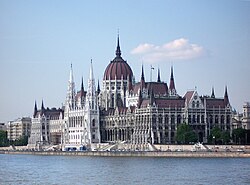
- Location: The parliament has been based in the Hungarian Parliament Building in Budapest since 1902.
- Franchise: Voting rights were highly restrictive, enjoyed by only 6% of the population in 1874.
- Executive Power: Vested in a cabinet of ten ministers responsible to the parliament.
The House of Magnates (Főrendiház)
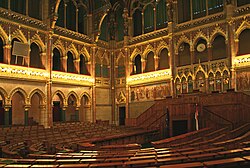
The Főrendiház, or House of Magnates, served as the upper house of the legislature. Similar to the British House of Lords, it was composed of hereditary peers and ecclesiastics, though it also included representatives from autonomous regions.
Membership in the House of Magnates was not fixed; anyone meeting the specific qualifications could hold a seat. The composition typically included:
- Princes of the royal house who had reached their majority (16 years old as of 1904).
- Hereditary peers paying at least 3,000 florins in annual land tax (237 members in 1904).
- High dignitaries of the Catholic and Eastern Orthodox churches (42 in 1904).
- Representatives of Protestant confessions (13 in 1904).
- Life peers appointed by the Crown or elected by the house (73 total in 1904).
- State dignitaries and high judges (19 in 1904).
- Three delegates from Croatia-Slavonia.
The House of Representatives (Képviselőház)
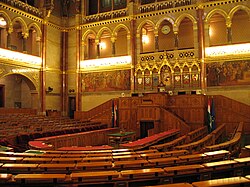
The Képviselőház, or House of Representatives, functioned as the lower house. Under the Electoral Law of 1874, membership was determined by a complex franchise based on profession, taxation, property, official position, and ancestral privilege.
The house consisted of 453 members: 413 deputies elected within Hungary and 40 delegates from Croatia-Slavonia. These members served five-year remunerated terms. However, the system was criticized for being highly illiberal; the working classes were almost entirely excluded, with only 6% of the total population possessing the right to vote.
Legislative and Executive Balance
While the parliament held the power to legislate on Hungarian matters, the Emperor-King retained significant authority. He held the power to veto legislation, dissolve the Diet, and call new elections. Furthermore, no bill could be presented to the Diet without the Emperor-King's Royal Assent.
The executive branch consisted of a cabinet of ten ministers, including the president of the council, the minister for Croatia-Slavonia, a minister ad latum, and ministers overseeing finance, justice, interior, national defence, education and public worship, agriculture, and industry and commerce.
Political Dynamics and Ethnic Representation
The political environment was marked by a disconnect between the electorate and the representatives. By 1910, despite a population that was 54.5% Magyar, 16.1% Romanian, and 10.6% Slovak, the House was overwhelmingly dominated by those of Hungarian descent (405 out of 413 representatives).
Interestingly, pro-compromise liberal parties—which were often unpopular among ethnic Hungarian voters—maintained power by securing the votes of ethnic minorities. Conversely, Hungarian nationalist parties, supported by the majority of ethnic Hungarians, remained in the opposition for most of this period, except between 1906 and 1910.
Summary of Parliamentary Structure
| Feature | House of Magnates (Főrendiház) | House of Representatives (Képviselőház) |
|---|---|---|
| Role | Upper House | Lower House |
| Membership | Hereditary, Ecclesiastics, Life Peers | Elected Deputies and Delegates |
| Selection Basis | Birth, Rank, and Appointment | Property, Tax, and Profession |
| Size | Variable (No fixed limit) | 453 Members |
| Term | Life/Permanent (mostly) | 5 Years |
Frequently Asked Questions
When was the Hungarian national assembly re-established?
The national assembly was re-established on February 27, 1867, as a result of the Austro-Hungarian Compromise.
Who was eligible to vote for the House of Representatives?
Voting was restricted to a small fraction of the population (approximately 6% in 1874) based on property ownership, taxation, profession, official position, and ancestral privileges.
What was the role of the Emperor-King in the legislative process?
The Emperor-King held substantial power, including the ability to grant Royal Assent before a bill reached the Diet, the power to veto passed legislation, and the authority to dissolve the Diet and call for new elections.
How were the ethnic minorities represented in the parliament?
Representation was very low; by 1910, only 5 Romanians and 3 Slovaks were among the 413 representatives from Hungary, despite those groups making up significant portions of the population.
What was the difference between the two houses of parliament?
The House of Magnates was an upper house composed of hereditary peers, high church officials, and appointed life peers. The House of Representatives was a lower house consisting of elected deputies and delegates from Croatia-Slavonia.