
Imperial War Museums: A History of Preservation and Remembrance
The Imperial War Museums (IWM) stands as a global beacon for the study of conflict, dedicated to documenting the human experience of war. From its inception during the First World War to its current status as a multi-site institution, the museum has evolved from a collection of military relics into a sophisticated narrative of toil, sacrifice, and resilience.
Key Facts
- Founded: Proposed in February 1917; opened June 9, 1920.
- Original Purpose: To record the sacrifice of all who took part in the First World War.
- Key Sites: IWM London (Southwark), IWM Duxford, HMS Belfast, the Cabinet War Rooms, and IWM North.
- Major Milestones: Establishment of the first permanent Holocaust exhibition in the UK (2000) and a major £40 million redevelopment for the WWI centenary (2014).
- Governance: Established by the Imperial War Museum Act 1920 to include representation from across the British Empire.
Establishment and Early Years (1917–1921)
The vision for a National War Museum began on February 27, 1917, when Sir Alfred Mond, a Liberal MP and First Commissioner of Works, proposed the idea to Prime Minister David Lloyd George. The War Cabinet accepted the proposal shortly after, and a committee led by Mond began gathering materials to illustrate Britain's war effort. This effort was divided into subcommittees focusing on the Army, Navy, munitions production, and the vital contributions of women.
From the start, the museum sought to avoid becoming a collection of "dead relics." First Director-General Sir Martin Conway emphasized that exhibits should be vitalized by the personal experiences, valour, and endurance of individuals. Charles ffoulkes, former curator of the Royal Armouries, served as the first curator and secretary.
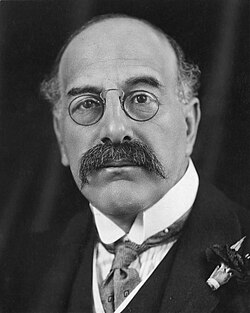
In December 1917, the institution was renamed the Imperial War Museum to reflect its broader remit. It officially opened on June 9, 1920, at the Crystal Palace, inaugurated by King George V. Sir Alfred Mond noted that the museum was intended not as a monument to military glory, but as a record of sacrifice. To ensure formal governance, the Imperial War Museum Act 1920 was passed, creating a board of trustees that included representatives from India, South Africa, Canada, Australia, and New Zealand.
Relocation and the Southwark Site (1924–1936)
The museum first moved to the Imperial Institute in South Kensington in 1924. However, the space proved inadequate for the growing collection. In 1936, the museum found a permanent home in Southwark, occupying the former Bethlem Royal Hospital building designed by James Lewis.
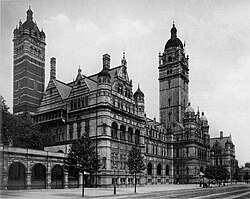
The site was owned by Lord Rothermere, who had considered demolishing the structure for a public park. Instead, the central portion of the hospital was retained, while the wings were removed to create Geraldine Mary Harmsworth Park. The building's distinguishing dome, added by Sydney Smirke in 1846, was preserved. The Duke of York (later King George VI) reopened the museum at this location on July 7, 1936.
The Second World War and Post-War Recovery
As the Second World War erupted in 1939, the museum began documenting the new conflict. The museum's role became unexpectedly practical; following the Dunkirk evacuation in 1940, eighteen of the museum's artillery pieces were returned to active military service due to equipment shortages. Other items, such as trench clubs, were utilized by the Home Guard.
The museum closed to the public in September 1940 during the Blitz. On January 31, 1941, a Luftwaffe bomb struck the naval gallery, destroying a Short Type 184 seaplane and damaging various ship models. During the war, the building served as a government vehicle repair garage and a training center for civil defence and firefighting.
Post-war, the museum reopened in stages between 1946 and 1949. In 1953, the IWM expanded its remit to collect material from all modern conflicts involving British or Commonwealth forces. Despite this, the 1950s were a period of physical decline, with Director Noble Frankland later describing the galleries as being in a "dismal state of decay" by 1955.
Expansion and Modernization (1966–2012)
The late 20th century saw a massive expansion of the museum's footprint. In 1966, the Southwark building was extended to include a cinema and better storage. In 1967, the museum acquired two 15-inch naval guns from HMS Ramillies and HMS Resolution, which were placed on permanent display in 1968.
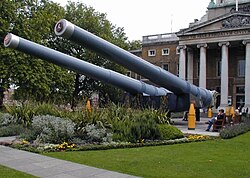
This acquisition sparked an interest in larger naval assets, eventually leading to the preservation of the light cruiser HMS Belfast, which became a branch of the museum in 1978. Other major additions included RAF Duxford (acquired in 1976) and the historic Cabinet War Rooms (acquired in 1982).
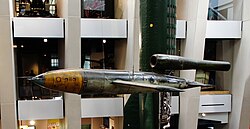
A major redevelopment of the Southwark site took place between 1986 and 1989, creating the Large Exhibits Gallery. This atrium, which houses tanks and aircraft from the First World War to the Falklands War, is often described as "the biggest boys' bedroom in London."
Further milestones include the opening of IWM North in Trafford, Greater Manchester, in 2002, and the 2000 opening of the Holocaust Exhibition—the first permanent exhibition of its kind in a UK museum. In 2011, the institution rebranded as Imperial War Museums to reflect its multi-site nature.
The First World War Centenary and Beyond
To mark the centenary of the First World War in 2014, the museum underwent a £40 million redevelopment designed by Foster and Partners. This project, supported by the Imperial War Museum Foundation and government funding, created new gallery spaces and improved visitor circulation. The renovated IWM London was formally reopened by Prince William, Duke of Cambridge, on July 17, 2014.
More recently, the museums faced challenges during the COVID-19 pandemic, resulting in two significant closures between March 2020 and May 2021.
| Period/Date | Key Event/Development | Significance |
|---|---|---|
| 1917–1920 | Establishment & Opening | Founded to record WWI sacrifice; opened at Crystal Palace. |
| 1936 | Move to Southwark | Permanent home established in former Bethlem Royal Hospital. |
| 1940–1945 | WWII Impact | Exhibits returned to service; building damaged by the Blitz. |
| 1976–1984 | Branch Expansion | Acquisition of Duxford, HMS Belfast, and Cabinet War Rooms. |
| 2000–2002 | Modern Growth | Holocaust Exhibition opens; IWM North established. |
| 2014 | Centenary Redevelopment | £40m upgrade to WWI galleries and facilities. |
Frequently Asked Questions
Why was the Imperial War Museum established?
It was proposed by Sir Alfred Mond in 1917 to create a national record of the toil and sacrifice of everyone who participated in the First World War, ensuring the experience was not forgotten as a mere military monument.
What happened to the museum's exhibits during World War II?
Due to equipment shortages after the Dunkirk evacuation, eighteen artillery pieces were returned to military service, and trench clubs were used by the Home Guard. However, the museum refused to return items of high historical significance, such as the gun from HMS Lance.
Where are the different branches of the Imperial War Museums located?
The main sites include IWM London in Southwark, IWM Duxford in Cambridgeshire, the HMS Belfast moored on the Thames, the Cabinet War Rooms in Whitehall, and IWM North in Trafford, Greater Manchester.
What is the significance of the Large Exhibits Gallery in London?
Created during the 1986–1989 redevelopment, this gallery converted the former hospital courtyard into a massive space capable of supporting heavy military hardware, including tanks and aircraft from various 20th-century conflicts.
When did the museum start collecting material from conflicts other than the World Wars?
In 1953, the museum adopted a policy of collecting material from all modern conflicts in which British or Commonwealth forces were involved, expanding its remit beyond the two World Wars.