
Indigenous History and Presence in Washington, D.C.
While often viewed primarily as a center of federal governance, Washington, D.C. is built upon a deep Indigenous legacy. Today, approximately 4,000 Indigenous people reside in the District, and there is a growing movement to revitalize the awareness and education surrounding the region's original inhabitants. From the ancestral lands of the Nacotchtank (also known as the Anacostans) to the modern-day advocacy groups shaping federal policy, the Indigenous presence in the capital is both historical and ongoing.
Recent initiatives, such as the DC Native History Project, work alongside tribal members to recognize Anacostan heritage through the creation of interactive maps identifying original village sites and artifact excavations. Educational efforts continue through the DC Public Library's special collections and annual cultural celebrations hosted by communities like the Rappahannock tribe in national parks. In a significant symbolic shift, the Council of the District of Columbia voted in 2019 to replace Columbus Day with Indigenous Peoples' Day.
Key Facts
- The Nacotchtank (Anacostans) are the primary ancestral inhabitants of the D.C. area, with neighboring ties to the Piscataway and Pamunkey peoples.
- Archaeological evidence of Indigenous life has been found in diverse locations, including the site of the White House swimming pool.
- The Bureau of Indian Affairs (BIA), established in 1824, manages over 55.7 million acres of trust land for Indian Tribes.
- The National Museum of the American Indian (est. 2004) and the National Native American Veterans Memorial (est. 2020) serve as major cultural landmarks.
- D.C. serves as the primary hub for tribal delegations, federal regulatory agencies, and Native American advocacy organizations.
Archaeological Discoveries in the Capital
Excavations across the city have provided tangible evidence of the Nacotchtank people's sophisticated use of the landscape. While river proximity was essential, Indigenous settlements extended further inland than previously thought.
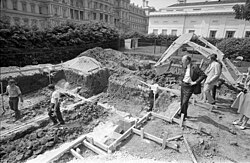
During the 1975 construction of the White House swimming pool, analysis of the excavated terrain revealed quartzite points, fragments of pottery, and a broken biface (a prehistoric hand axe), proving Indigenous existence on the site.
Further evidence was uncovered in 1997 near the Whitehurst Freeway in Georgetown. This area is identified as the site of Tohoga, a trading village situated along the Potomac River to facilitate easy access for merchants. Findings there included pendants, a hammer stone, and a hair comb.
Another significant settlement existed north of Garfield Park on what is now Capitol Hill. The Nacotchtank utilized this flat terrain—now home to the Library of Congress and the Supreme Court—for agriculture, growing staples such as squash, beans, and corn. These large corn stores were later highly attractive to European colonists.
Federal Regulation and Governance
Since the early 1800s, Washington, D.C. has been the focal point for Indigenous peoples seeking legislative change and petitioning the federal government. This has led to the establishment of various regulatory bodies over two centuries.
In 1789, Native American relations were first placed under the War Department. By 1806, the Office of Indian Trade was created to manage the fur trade's factory network, a post held by Thomas L. McKenney until 1822. In 1824, the Bureau of Indian Affairs (BIA) was formed within the Department of the Interior. Today, the BIA administers services to roughly 2 million Indigenous Americans across 574 federally recognized tribes.
Other notable historical entities include the Board of Indian Commissioners (est. 1869), which monitored treaty obligations, and the National Council on Indian Opportunity (1968–1974), which oversaw federal programs benefiting Native populations. More recently, the 2009 opening of the Embassy of Tribal Nations provided a permanent gathering space for sovereign tribal governments near Embassy Row.
Advocacy and Legal Representation
D.C. is the headquarters for numerous organizations dedicated to protecting tribal sovereignty and civil rights. The Society of American Indians (1911–1923) was the first national rights organization run by and for Indigenous people, while the Indian Rights Association (1882–1994) acted as a powerful legislative lobby through the 1930s.
Founded in 1944, the National Congress of American Indians (NCAI) continues to represent federally and state-recognized tribes, resisting assimilation and protecting treaty rights. Other specialized organizations include the Native American Bar Association of D.C. (est. 1997), the Tribal Supreme Court Project (est. 2001), and the Center for Native American Youth (est. 2011), which focuses on health and teen suicide prevention.
Monuments, Museums, and Cultural Legacy
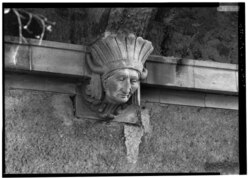
The legacy of the Nacotchtank survives in the city's geography; the name "Anacostia" is a Latinized version of Nacotchtank. Physical tributes also dot the landscape, such as the Dumbarton Bridge (1910), which features 56 busts of Kicking Bear, a spiritual leader and warrior who represented tribal interests in the capital.
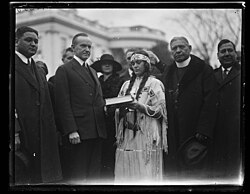
The U.S. Capitol's National Statuary Hall Collection honors several Indigenous leaders, including Standing Bear, the first Native American granted civil rights by a court, and Charles Curtis, the first Native American elected to the federal executive branch. Other figures honored include Sakakawea, King Kamehameha I, Chief Washakie, Po'pay, and Sarah Winnemucca.
The most comprehensive cultural institution is the National Museum of the American Indian, part of the Smithsonian, which opened in 2004. Its grounds now include the National Native American Veterans Memorial (2020), recognizing the service of Indigenous people across all branches of the U.S. military.
| Entity/Site | Type | Significance |
|---|---|---|
| Nacotchtank/Anacostan | Ancestral People | Original inhabitants of the D.C. region. |
| Tohoga Village | Archaeological Site | Ancient trading village located in modern Georgetown. |
| Bureau of Indian Affairs | Federal Agency | Manages trust lands and federal policy for 574 tribes. |
| NCAI | Advocacy Group | Protects tribal sovereignty and treaty rights. |
| National Museum of the American Indian | Museum | Smithsonian institution devoted to Indigenous cultures. |
Frequently Asked Questions
Who were the original Indigenous people of Washington, D.C.?
The primary ancestral inhabitants were the Nacotchtank, also known as the Anacostans. They were closely linked to the neighboring Pamunkey and Piscataway peoples.
Where has archaeological evidence of Indigenous life been found in D.C.?
Evidence has been found at the site of the White House swimming pool (pottery and hand axes), near the Whitehurst Freeway in Georgetown (Tohoga trading village), and on Capitol Hill (agricultural sites).
What is the significance of the National Museum of the American Indian?
Established in 2004 as part of the Smithsonian, it is dedicated to the culture of the Indigenous peoples of the Americas and houses the National Native American Veterans Memorial.
Which Indigenous leaders are honored in the U.S. Capitol?
The National Statuary Hall Collection includes figures such as Standing Bear, Charles Curtis, Sakakawea, King Kamehameha I, Chief Washakie, Po'pay, and Sarah Winnemucca.
What is the role of the Bureau of Indian Affairs (BIA) in D.C.?
Headquartered in the Main Interior Building, the BIA implements federal laws and policies for American Indians and Alaska Natives and manages over 55.7 million acres of trust land.