
ISSN: The Global Standard for Periodical Identification
In the vast world of publishing, distinguishing between thousands of magazines, journals, and newspapers can be a challenge—especially when different publications share the same title. This is where the International Standard Serial Number (ISSN) becomes essential. An ISSN is a unique eight-digit code used to identify periodical publications, ensuring that librarians, researchers, and distributors can accurately order, catalog, and locate serial literature.
First drafted as an International Organization for Standardization (ISO) standard in 1971 and officially published as ISO 3297 in 1975, the system is now maintained by ISO subcommittee TC 46/SC 9. Today, it serves as the backbone for serial identification worldwide.
Key Facts
- Purpose: Uniquely identifies periodical publications (serials).
- Format: An 8-digit code divided by a hyphen (NNNN-NNNC).
- Governance: Coordinated by the ISSN International Centre in Paris.
- Scale: Over 2,500,000 numbers have been issued.
- Scope: Different codes are assigned for different media types (e.g., print vs. electronic).
The Structure and Calculation of an ISSN
An ISSN consists of eight digits, split into two four-digit groups. The final character is a check digit, which can be a number from 0 to 9 or the letter "X" (representing the number 10). This digit is used to verify the validity of the code.
To calculate the check digit, each of the first seven digits is multiplied by a weight based on its position (counting from right to left: 8, 7, 6, 5, 4, 3, and 2). These products are summed, and the remainder of the sum modulo 11 is calculated. If the remainder is 0, the check digit is 0. Otherwise, the remainder is subtracted from 11. If the result is 10, the check digit is denoted as "X".
For example, the journal Hearing Research uses the ISSN 0378-5955, where the final 5 is the calculated check digit.

Media-Specific Identifiers: p-ISSN, e-ISSN, and ISSN-L
Because the ISSN system is media-oriented, a publication that exists in multiple formats requires a separate number for each medium. This ensures precision in cataloging and distribution.
- p-ISSN (Print ISSN): The identifier for the paper version of a serial.
- e-ISSN (Electronic ISSN): The identifier for the online or digital version.
To prevent fragmentation, ISO 3297:2007 introduced the Linking ISSN (ISSN-L). The ISSN-L acts as a umbrella identifier that links all media versions of the same content. It is typically based on the ISSN of the first published medium. This allows search engines, library catalogs, and services like OpenURL to group all versions of a journal together regardless of format.
Encoding ISSNs in Barcodes and URNs
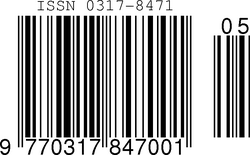
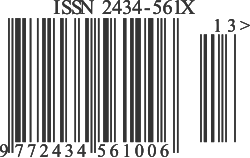
For commercial and digital utility, ISSNs can be converted into other formats. In retail, they are often encoded into EAN-13 barcodes. This is done by using the "country code" 977, followed by the first seven digits of the ISSN, two publisher-defined digits, and a final EAN check digit.
In digital environments, an ISSN can be represented as a Uniform Resource Name (URN) by adding the prefix urn:ISSN:. For instance, the publication Rail is referred to as urn:ISSN:0953-4563. Note that URN namespaces are case-sensitive and must be in all caps.
Administration and the ISSN Register
The assignment of these codes is managed by a global network of National Centres, usually housed within national libraries. These centers are coordinated by the ISSN International Centre (CIEPS) in Paris, an intergovernmental organization established in 1974 via an agreement between UNESCO and the French government.
The International Centre maintains the ISDS Register (International Serials Data System), a comprehensive database of all assigned ISSNs. As of the end of 2016, this register contained records for 1,943,572 items. While not freely available for general web interrogation, it is accessible via subscription.
ISSN vs. Other Identifiers
It is common to confuse the ISSN with the ISBN, but they serve different purposes. While an ISBN identifies a specific book, an ISSN identifies the entire serial title. An ISSN is an anonymous identifier; it contains no embedded information about the publisher or location. Consequently, if a serial undergoes a major title change, a new ISSN must be assigned.
For more granular identification, other systems are built upon the ISSN, such as the Publisher Item Identifier (PII) and the Serial Item and Contribution Identifier (SICI), which allow references to specific articles or volumes.
In the modern era, the Digital Object Identifier (DOI) has become the standard for identifying individual articles, providing a resolution mechanism (a clickable link) that the ISSN does not natively offer.
| Feature | ISSN | ISBN | DOI |
|---|---|---|---|
| Full Name | International Standard Serial Number | International Standard Book Number | Digital Object Identifier |
| Primary Target | Periodicals (Magazines, Journals) | Individual Books | Digital Objects (Articles, Datasets) |
| Scope | Entire Publication Title | Specific Edition/Book | Specific Content Item |
| Media Sensitivity | Different codes for Print/Electronic | Specific to the edition format | Content-oriented (Media independent) |
Frequently Asked Questions
What is the difference between p-ISSN and e-ISSN?
A p-ISSN is assigned specifically to the print (paper) version of a periodical, while an e-ISSN is assigned to the electronic (online) version of the same publication.
What happens if a magazine changes its name?
Because the ISSN is associated with the title of the serial, a new ISSN must be assigned whenever a publication undergoes a major title change.
How does an ISSN-L differ from a standard ISSN?
While a standard ISSN identifies a specific medium (like print), the ISSN-L (Linking ISSN) is a unique identifier that groups all media versions of the same content together, facilitating easier searching and retrieval.
Can an ISSN be used to find a specific article?
No, the ISSN identifies the entire serial publication. To identify a specific article, identifiers like the DOI (Digital Object Identifier) or SICI (Serial Item and Contribution Identifier) are used.
Who is responsible for issuing ISSNs?
ISSNs are assigned by a network of National Centres, typically located in national libraries, and are coordinated globally by the ISSN International Centre in Paris.