
Italian Colonial Troops: Uniforms and Rank Structures of the Ascari
The military forces of the Italian colonies were characterized by a complex blend of European military tradition and local cultural identity. From the highlands of Eritrea to the deserts of Libya and the coasts of Somalia, the Ascari (indigenous colonial soldiers) wore uniforms that served as both functional gear and visual markers of their specific unit, specialty, and rank.
The Visual Identity of Colonial Uniforms
Uniforms varied across different specialties and time periods, but a unifying element across all regular colonial departments was the system of distinctive sashes. Known as the etagà, these wide woollen sashes were wrapped around the waist and, in the case of AOI (Africa Orientale Italiana) and Eritrean cavalry, around the headgear. The colors and motifs of the etagà identified the specific unit; for example, the 17th Eritrean Battalion utilized black and white tassels and vertically striped sashes, whereas the 64th Eritrean Battalion wore scarlet and purple.
Italian officers leading these units mirrored this identity by incorporating the same battalion colors into the edging thread of their shoulder straps.
Headgear and Clothing
The most iconic element of the Ascari uniform was the tarbush, a high red felt fez. Depending on the specialty, the tarbush featured different bows and friezes. Over time, the height of the tarbush increased from approximately 180mm (7.08 inches) to 20cm (7.87 inches) or more. For camouflage during campaigns, khaki covers were often worn over the tarbush.
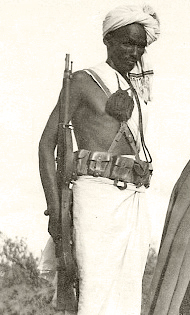
In Libya, soldiers and savari (cavalry) wore the tachia (ṭaqīyā), a form-fitting garnet red felt fez with a blue bow and white sub-tachia. Muslim Ascari in East Africa wore turbans featuring a diagonal band in the colors of their battalion.
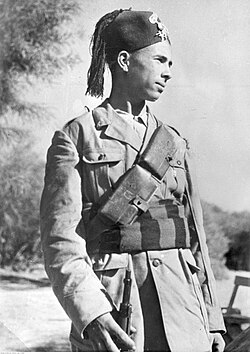
Clothing materials shifted from white cloth, which became reserved for parades, to khaki for active duty. The tunic styles evolved through three main versions: the M1929 giubba with a low standing collar, and the pre-1940 and M1940 camicotta Sahariano per Coloniali, which featured stand-and-fall collars. Lower body attire varied by region: Libyans, Ethiopians, and Eritreans wore baggy trousers, while Somalis wore baggy knee-length shorts.
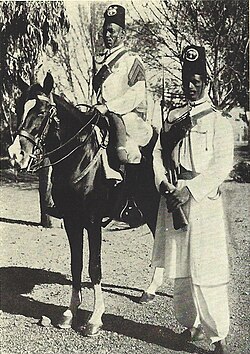
Footwear was optional to respect local traditions, meaning puttees were frequently worn with bare feet. When footwear was used, it consisted of sandals, boots, or marching boots.
Specialized Units
The zaptié (colonial police) were distinguished by their scarlet bands and the collar frogs and headdress flames associated with the Carabinieri. In contrast, irregular units—such as the dubat, basci-buzuk, spahis, and bande—did not follow a standard uniform code, although the bande maintained a rudimentary rank system.
Key Facts
- Etagà: A wide woollen sash used to identify specific units and branches.
- Tarbush: The signature high red fez, which grew in height over time and could be covered in khaki for camouflage.
- Footwear: Optional for Ascari, who often wore puttees with bare feet.
- Officer Corps: All commissioned officers in the Eritrean Ascari and other colonial corps were Italian.
- Zaptié: Colonial police identified by Carabinieri-style collar frogs and scarlet bands.
Rank Hierarchy and Insignia
The indigenous personnel operated under a hierarchy distinct from the Royal Italian Army. The highest rank achievable for native soldiers was that of a non-commissioned officer (NCO). Rank badges typically consisted of red and yellow wool chevrons mounted on a pentagonal cloth brassard (initially blue, later black), similar to the Ottoman Army style.
The NCO Progression
- Ascaro / Savari / Zaptié: Basic soldier; no insignia.
- Uachil: Chosen soldier (Private First Class); blue triangle with a red star.
- Muntaz: Corporal; one red chevron on the brassard and one star on the tarbush.
- Bulucbasci: Sergeant; two red chevrons on the brassard and two stars on the tarbush. The term buluc refers to a company (equivalent to a platoon), and basci means head or chief.
- Bulucbasci Capo: Sergeant Major; two red and one yellow chevron on the brassard; two stars surmounted by a chevron on the tarbush.
- Sciumbasci: Marshal; three red chevrons on the shoulder and three stars on the tarbush. These officers were assigned to every half-company and carried a curbasc (hippopotamus hide whip) as a symbol of authority.
- Sciumbasci Capo: Adjutant Marshal (introduced 1936); three red and one yellow chevron on the shoulder; three stars and a chevron on the tarbush.
The jusbasci rank, equivalent to sub-lieutenant, was abolished in 1902 but continued to be used as a synonym for Sciumbasci in Libya and Somalia.
Seniority and Merit
Additional markers were placed on the black cloth triangle of the badge to indicate seniority, war merit (the Savoy crown), and specialties (such as musicians, machine gunners, or farriers).
| Insignia | Years of Service |
|---|---|
| 1 Red Star | 2 Years |
| 2 Red Stars | 6 Years |
| 3 Red Stars | 10 Years |
| 1 Silver Star | 12 Years |
| 2 Silver Stars | 14 Years |
| 3 Silver Stars | 15 Years |
| 1 Gold Star | 20 Years |
| 2 Gold Stars | 24 Years |
| 3 Gold Stars | 28 Years |
Frequently Asked Questions
Could indigenous soldiers become commissioned officers?
No. The highest rank achievable for native personnel was that of a non-commissioned officer; all commissioned officers in the colonial corps were Italian.
What was the purpose of the curbasc?
The curbasc was a whip made of hippopotamus hide carried by the Sciumbasci. It served as a symbol of authority and was used to administer physical sanctions to the troops.
How did the uniforms of Somalis differ from those of Eritreans?
While both wore colonial uniforms and tarbushes, Somalis wore baggy knee-length shorts, whereas Eritreans (along with Libyans and Ethiopians) wore baggy trousers.
What was the significance of the etagà?
The etagà was a wide woollen sash whose specific colors and motifs allowed observers to identify the soldier's unit or branch of service.
How were the Zaptié distinguished from regular Ascari?
The Zaptié were identified by their scarlet bands and the use of collar frogs and headdress flames similar to those of the Carabinieri.