
James Turrell: Sculpting Light and Space
James Turrell is a visionary artist who treats light not as a tool to illuminate other objects, but as the medium itself. By manipulating perception, Turrell creates immersive environments that challenge how we perceive depth, color, and the sky. His work often encourages a "slow-art" approach, urging viewers to linger and experience the subtle shifts of light over time rather than rushing through a gallery.
Early Experiments in Perception
Turrell's journey began in 1966 in his Santa Monica studio at the Mendota Hotel. During this period, he was part of the Light and Space group—a collective of Los Angeles artists including Robert Irwin, Mary Corse, and Doug Wheeler who focused on perceptual phenomena. Turrell began by controlling the amount of street light entering his studio through specific openings, creating his first light projections.
In 1968, he developed Shallow Space Constructions, using screened partitions to create a radiant effect that made the space appear artificially flattened. That same year, he collaborated with psychologist Edward Wortz and artist Robert Irwin through the Los Angeles County Museum's Art and Technology Program. Between 1969 and 1974, he created The Mendota Stoppages, where he sealed off rooms in the Mendota Hotel to precisely control the entry of natural and artificial light.
The Roden Crater Project
In 1979, Turrell embarked on his most ambitious project: the transformation of an extinct cinder cone volcano outside Flagstaff, Arizona. Known as Roden Crater, this site is being converted into a massive naked-eye observatory designed for experiencing celestial phenomena.
For decades, Turrell has moved tons of earth to carve tunnels and apertures into the volcano. While completion dates have been pushed back since the 1990s, the project remains a lifelong endeavor. Long shrouded in secrecy, the site was historically accessible only to friends, though a "Turrell Tour" was later established for devoted fans who have seen his work in 23 different countries.
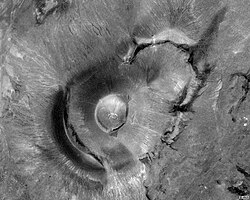
Turrell distinguishes his work from traditional earthworks artists like Robert Smithson. He describes himself as a "mound builder," stating that his goal is not to focus on landforms, but to bring celestial objects like the sun and moon into human-inhabited spaces. In 2019, the project became the ASU-Roden Crater Project through a partnership with Arizona State University's Herberger Institute for Design and the Arts, integrating the site into academic curricula such as "Indigenous Stories and Sky Science."
The Skyspaces Series
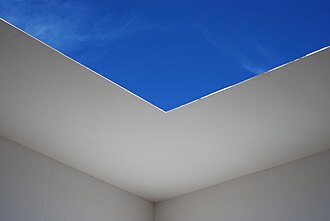
Beginning in the 1970s, Turrell developed Skyspaces—specially designed rooms open to the sky through a precise aperture in the roof. These spaces typically accommodate about 15 people who sit on benches and observe the sky, which often appears as a flat canvas of color stretched across the ceiling.
Spiritual and Architectural Variations
As a lifelong Quaker, Turrell has integrated these concepts into religious architecture. He designed the Live Oak Meeting House and the Greet the Light installation at the Chestnut Hill Friends Meeting in Philadelphia. His work Meeting (1986) at P.S. 1 is a recreation of these meeting house concepts.
Global Installations
- Irish Sky Garden: Located at the Liss Ard Estate, this work uses a central plinth and a crater rim to shift the relationship between the landscape and the sky.
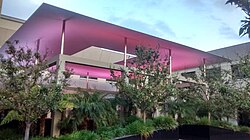
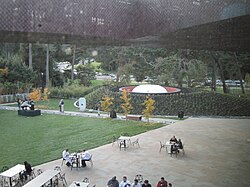
- Three Gems: Located at the de Young Museum, this is Turrell's first Skyspace to utilize the stupa form, accessed via a tunnel.
- Dividing the Light: A pavilion at Pomona College that mirrors a 16-square-foot canopy aperture with a continuous pool of water below.
- Third Breath: A camera obscura (a darkened chamber with a small hole that projects an external image) at the Centre for International Light Art in Germany.
Other Notable Works and Installations
Beyond Skyspaces, Turrell creates light tunnels and projections that give light the appearance of physical mass. At the Mattress Factory in Pittsburgh, he has permanent installations including Danaë, Catso Red, and Pleiades. Another famous piece, Acton at the Indianapolis Museum of Art, features a rectangular hole in a wall illuminated to look like a blank canvas, often tricking visitors into trying to touch it.
In 2009, the first museum dedicated entirely to Turrell opened in Salta, Argentina, as part of the Hess Collection at Colome. This 1,700-square-meter space features nine rooms that act as a time tunnel of his five-decade career, culminating in a Skyspace that captures the Andean sky.
Key Facts
- Medium: Light and space, rather than traditional physical materials.
- Roden Crater: An extinct volcano in Arizona being converted into a celestial observatory.
- Skyspaces: Enclosed rooms with roof apertures that frame the sky as a canvas.
- ASU Partnership: Since 2019, Roden Crater has been collaborated on by Arizona State University.
- Philosophy: Advocates for a "slow-art" movement to counter accelerated viewing habits.
| Work/Project | Location | Key Feature |
|---|---|---|
| Roden Crater | Flagstaff, Arizona | Extinct volcano converted to naked-eye observatory |
| Three Gems | de Young Museum, USA | Stupa-form Skyspace accessed via tunnel |
| Third Breath | Unna, Germany | Camera obscura reflecting the sky |
| Hess Collection | Salta, Argentina | First museum dedicated to Turrell's work |
| Dividing the Light | Pomona College, USA | Open-air pavilion with mirroring pool |
Frequently Asked Questions
What is a Skyspace?
A Skyspace is an enclosed room, typically large enough for 15 people, featuring an aperture in the roof. This design creates the illusion that the sky is a flat canvas within reach, allowing viewers to contemplate the changing colors and light of the atmosphere.
What is the purpose of Roden Crater?
Roden Crater is designed as a massive naked-eye observatory. Turrell uses the extinct volcano's geography to create tunnels and apertures that allow visitors to experience specific celestial phenomena, such as the movement of the sun and moon.
How does Turrell differ from earthworks artists?
Unlike artists who focus on the landforms themselves, Turrell views himself as a "mound builder." He uses the earth primarily as a means to elevate the viewer and bring celestial objects into the spaces we inhabit.
What is the "slow-art" movement mentioned by Turrell?
Turrell suggests a "slow-art" approach—similar to the slow-food movement—where viewers spend significant time (potentially an hour or more) with a single piece of art to fully appreciate its nuances, rather than spending only a few seconds.
What is a camera obscura in the context of Turrell's work?
In works like Third Breath, a camera obscura is a darkened room where an image of the outside world (in this case, the sky) is projected into the space through a lens or small hole.