
JKT48: The History and Evolution of Indonesia's Premier Idol Group
JKT48 represents a unique cultural bridge between Japanese idol entertainment and the Indonesian music scene. As the first overseas sister group of the legendary AKB48, JKT48 adopted a revolutionary business model centered on accessibility and daily interaction, creating a dedicated fanbase through a blend of rigorous performance and personal growth.
Key Facts
- Founded: Announced September 11, 2011.
- Core Model: Based on the AKB48 "Idol You Can Meet" concept.
- Home Base: A dedicated theater located in fX Sudirman, Jakarta.
- Biggest Hit: "Rapsodi," the group's first original song.
- Membership: Has evolved through multiple generations, including a major restructuring in 2021.
2011–2012: The Foundation and Early Growth
The journey of JKT48 began on September 11, 2011, during an AKB48 event at Makuhari Messe in Chiba, Japan. To build the group, management held auditions in October, attracting approximately 1,200 applicants. While citizenship was not a requirement, all candidates had to be residents of Indonesia. After a rigorous selection process involving dance performances of "Heavy Rotation" and vocal tests, 28 first-generation members aged 12 to 21 were chosen on November 2.
The group made its public debut on December 17 via Global TV's 100% Ampuh, performing an Indonesian version of "Heavy Rotation." To replicate the AKB48 experience, JKT48 established its own theater in the fX Sudirman shopping mall. After temporary performances in May 2012, the permanent theater opened on September 8, 2012. The venue was designed as a replica of the AKB48 Theater, initially seating 180 people with standing room for 30, though it now accommodates around 350 attendees.
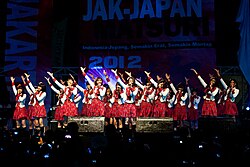
International collaboration was a hallmark of the early years. JKT48 performed in Japan as surprise guests at the 2011 AKB48 Kōhaku Taikō Uta Gassen and later participated in the 62nd NHK Kōhaku Uta Gassen alongside 210 other members. By November 2012, the group expanded with a second generation of 31 members and welcomed transfers from AKB48, including Aki Takajō and Haruka Nakagawa.
2013–2017: Musical Expansion and Challenges
The group's early discography was marked by both success and environmental hurdles. The debut album, Heavy Rotation, faced production delays due to severe flooding in Jakarta, leading the group to distribute 100,000 free CD singles and hold fundraisers for city relief. The album eventually saw a limited theater release on February 16, 2013, and a nationwide release on March 2.
Between 2013 and 2015, JKT48 released several hit singles, including "Fortune Cookie yang Mencinta," which was released concurrently with the AKB48 version. The group also introduced the senbatsu election—a fan-driven voting process to determine which members would feature in the primary lineup of upcoming singles. In the second election on May 2, 2015, Jessica Veranda won the top spot, displacing Melody Laksani.
Summary of Early Milestones
| Year | Key Event | Significance |
|---|---|---|
| 2011 | Formation Announcement | Establishment of the first overseas AKB48 sister group. |
| 2012 | Theater Opening | Created a permanent venue for daily performances in Jakarta. |
| 2013 | Debut Album Release | Heavy Rotation launched the group's commercial music career. |
| 2014 | 1st Senbatsu Election | Introduced fan-driven member selection for singles. |
2018–2021: Rebranding, Originality, and Restructuring
In April 2018, under the leadership of General Manager Melody Nurramdhani Laksani, the group launched the "JKT48 RE:BOOST" campaign. This shift included a new motto: "Idol Who Will Come to Meet You," signaling a more proactive approach to fan engagement.
A historic milestone occurred on January 9, 2020, with the release of "Rapsodi," JKT48's first original song. Centered by Shani Indira Natio, "Rapsodi" became the most popular and streamed song in the group's history, proving their ability to produce original hits beyond translated Japanese tracks.
However, the COVID-19 pandemic brought unprecedented challenges. In late 2020, several members tested positive for the virus, leading to a drastic restructuring in early 2021. The group announced the graduation of 26 members, dissolved its three existing teams, and ceased academy operations, reducing the membership to 33. Despite these losses, JKT48 continued to evolve, releasing "Cara Ceroboh Untuk Mencinta" in March 2021 and re-introducing members of the tenth generation by December.
Frequently Asked Questions
What is the relationship between JKT48 and AKB48?
JKT48 is a sister group of AKB48, the Japanese idol group that provided the original business model, theater concept, and many of the songs that JKT48 translated into Indonesian.
What is a senbatsu election?
A senbatsu election is a competitive event where fans vote for their favorite members. The top-ranked members (the senbatsu) are selected to perform and appear in the group's next single.
What was the significance of the song "Rapsodi"?
"Rapsodi" was JKT48's first original song, moving away from the model of translating AKB48 tracks. It became the most streamed and popular song in the group's history.
How did the pandemic affect JKT48?
The pandemic led to a major restructuring in 2021, resulting in the graduation of 26 members, the dissolution of all three teams, and the temporary closure of the academy.
Where is the JKT48 Theater located?
The JKT48 Theater is located in the fX Sudirman shopping mall in Jakarta, designed as a replica of the original AKB48 Theater in Akihabara.