
Kabul Evacuation: The UK's Military Operation to Rescue Nationals and Allies
In August 2021, the United Kingdom launched a high-stakes military operation to evacuate British nationals, embassy staff, and eligible Afghans from Kabul. This mission was triggered by the rapid collapse of the Afghan government and the subsequent takeover of the capital by the Taliban. The operation aimed to protect those eligible under the Afghan Relocation and Assistance Policy (ARAP), a program designed to relocate Afghans who had supported UK forces.
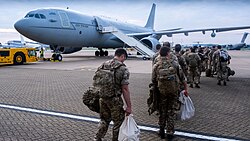
Authorized by Prime Minister Boris Johnson on 13 August 2021, the mission was coordinated by the Permanent Joint Headquarters in Northwood, London, under the leadership of Sir Ben Key. The UK established a strategic airbridge between the UK and Afghanistan, utilizing stop-overs in the United Arab Emirates to maintain a steady flow of transport aircraft.
Key Facts
- Total Evacuated: Over 15,000 people (5,000 British nationals and 8,000 Afghans, including 2,200 children).
- RAF Effort: Over 100 flights covering 261,000 miles.
- Peak Capacity: One C-17 flight carried 436 people, the highest capacity flight in RAF history.
- Personnel: Over 1,000 military personnel involved, including the 16 Air Assault Brigade and 2nd Battalion, The Parachute Regiment.
- Timeline: The primary operation spanned approximately 14 days in August 2021.
The Arrival and Establishment of Control
British forces began arriving at Hamid Karzai International Airport on 15 August via Boeing C-17 Globemaster III aircraft. The mission required immediate coordination to secure the airport and establish a processing center at the Baron Hotel. This coincided with the Fall of Kabul, as President Ashraf Ghani fled the country and the Taliban took control of the city.
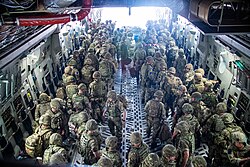
The environment was volatile; the airport faced gunfire and mortar rounds, including attacks near an RAF A400M Atlas C1. By 16 August, the first group of 370 evacuees arrived at RAF Brize Norton. The RAF deployed a diverse fleet, including Voyagers, C-17s, Atlas C1s, and Lockheed C-130J Hercules aircraft, to maintain the airlift.
Managing the Chaos
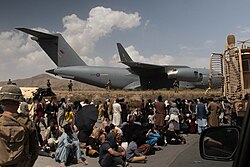
As commercial flights were suspended, thousands of desperate Afghans crowded the runways. While British forces operated on the military side of the airport, tragic incidents occurred on the commercial side, where some individuals fell to their deaths attempting to board departing aircraft. Defence Secretary Ben Wallace noted that while the operation was open-ended, some individuals outside of Kabul would inevitably be left behind.
Mass Airlifts and Security Challenges
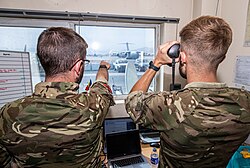
By 17 August, US and allied forces secured the airport, enabling mass airlifts. Despite this, the Taliban controlled the city's access points. Reports emerged of Taliban checkpoints refusing entry to some Afghans and conducting door-to-door searches for those who had assisted coalition forces.
Processing was conducted in a high-pressure environment. Paratroopers with riot shields held back crowds of tens of thousands, while soldiers atop shipping containers called forward eligible evacuees. The RAF Police and the Royal Logistics Corps managed safety checks and logistics, shuttling passengers to aircraft via buses.
The Growing Threat of ISIL-KP
As the operation progressed, security concerns shifted toward ISIL-KP (Islamic State of Iraq and the Levant - Khorasan Province). This group, following extreme Wahhabi-Salafist traditions, was in direct conflict with the Taliban's Deobandi traditions. The threat became critical on 26 August, when a suicide bombing near the airport killed at least 182 people, including 13 US service members and two British nationals.
Despite the attack, British forces provided medical aid and bomb disposal support. The operation faced further complications, including a power failure at the airport and a near-miss where an RAF C-17 narrowly avoided colliding with vehicles on the runway during takeoff.
The Final Stage and Withdrawal
The UK government entered the final stage of the drawdown on 27 August. The Baron Hotel processing center was closed, and the focus shifted to those already processed. To maximize space for people, some military equipment was destroyed or left behind.
The operation officially concluded on 28 August. While the mission was a massive logistical feat, it ended with the heartbreaking reality that between 800 and 1,100 eligible Afghans and 100 to 150 British nationals remained in the country. The UK government subsequently entered talks with the Taliban to ensure the safe passage of those left behind.
Operation Summary
| Category | Details |
|---|---|
| Total Evacuated | 15,000+ (5,000 British, 8,000+ Afghans) |
| Total Distance Flown | 261,000 miles |
| Aircraft Types Used | C-17, A400M Atlas, A330 Voyager, C-130J Hercules |
| Key Military Units | 16 Air Assault Brigade, 2nd Bn Parachute Regiment, 2 YORKS |
| Primary Threat | ISIL-KP |
Frequently Asked Questions
Who was eligible for evacuation under the ARAP?
The Afghan Relocation and Assistance Policy (ARAP) was designed for Afghan nationals who had provided support to UK forces and were eligible for relocation due to the risks they faced.
How many people did the UK successfully evacuate?
The UK evacuated over 15,000 people in total, which included approximately 5,000 British nationals and 8,000 Afghans, including 2,200 children.
What was the role of the RAF during the operation?
The Royal Air Force provided the essential airbridge, conducting over 100 flights. They utilized various transport aircraft to move thousands of people from Kabul to the UK via stop-overs in the UAE.
What caused the security crisis on 26 August?
A suicide bombing carried out by ISIL-KP occurred on the outskirts of the airport, resulting in at least 182 deaths and numerous injuries.
Were any British nationals left behind?
Yes, it is estimated that between 100 and 150 British nationals, along with 800 to 1,100 eligible Afghans, remained in Afghanistan after the final flight departed.