
Kiowa Culture: History, Society, and Traditions of the Southern Plains
The Kiowa are a distinguished Indigenous people of the Southern Plains, known for their sophisticated social structures, exceptional horsemanship, and a deep spiritual connection to the land. Originally migrating from the Northern Plains, the Kiowa established a powerful presence in the region encompassing southeastern Colorado, western Kansas, the Texas Panhandle, and western Oklahoma.
Their society is built upon bilateral descent, a kinship system where both maternal and paternal lineages are held in equal significance. Unlike many of their neighbors, the Kiowa do not utilize clans, instead organizing their community through complex kinship ties and societies defined by age and gender.
Key Facts
- Primary Food Source: The American bison (buffalo) was the cornerstone of their diet and economy.
- Housing: Portable, conical tipis made from bison hides or canvas.
- Social Structure: Organized by kinship and specialized warrior and religious societies.
- Horse Culture: Acquired from Spanish rancherias, horses revolutionized their hunting, warfare, and wealth.
- Unique Record Keeping: Developed a distinct calendar system recording two events per year.
The Impact of Horse Culture
The acquisition of horses from Spanish rancherias south of the Rio Grande fundamentally transformed Kiowa lifeways. Before this era, the Kiowa relied on domestic dogs to pull travois—frame structures used to transport tipis and belongings. Hunting bison required stealth, often involving hunters wearing wolf or coyote skins to approach herds on foot.
With the introduction of the horse, the Kiowa expanded their seasonal hunting ranges and became some of the most skilled horsemen on the Plains. Horses became the primary measure of a man's wealth, with some individuals owning hundreds. Capturing horses from enemies was not only a source of wealth but served as a vital rite of passage for young warriors.
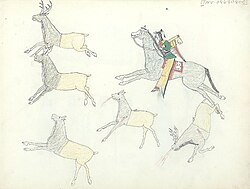
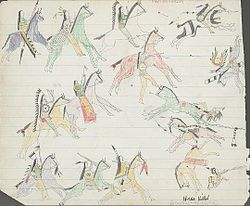
Warfare and Ritual
As mounted warriors, the Kiowa conducted long-distance raids extending from the Northern Plains down into Mexico. They utilized a mix of traditional weapons, such as long lances and bows, and later adopted rifles and cavalry swords. To ensure protection and good fortune in battle, medicine men adorned horses with ritual body paint, beaded masks, and feathers.
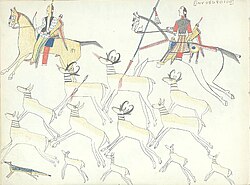
Diet and Subsistence
The Kiowa maintained a nomadic hunter-gatherer economy. While men primarily hunted bison, deer, elk, pronghorn, and wild turkey, women gathered essential wild edibles including pecans, prickly pear, mulberries, persimmons, and wild onions. They also traded for cultivated crops like maize, squash, and pumpkin from tribes such as the Pawnee.
A critical innovation for survival was pemmican, a high-energy sustenance made by mixing powdered dried lean meat with melted fat (tallow) and occasionally berries. This was shaped into bars and stored in pouches for use during migrations.
Before the adoption of European metal pots, the Kiowa used a unique cooking method: lining an earth pit with animal hides, filling it with water, and heating the contents with fire-heated rocks.
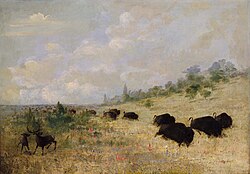
Sociopolitical Organization
Kiowa government was highly structured, featuring an elected head-chief who served as the symbolic leader of the nation. Leadership was based on a combination of bravery in battle, intelligence, generosity, and communication skills.
The Sun Dance and Tribal Bands
The annual Sun Dance (K’áu:d̶ó) was the central gathering of the tribe, where different bands held specific traditional obligations:
- Kâtá (Biters): The largest and most powerful band, responsible for supplying food for the gathering.
- Kogui (Elks Band): Tasked with conducting war ceremonies.
- Kaigwu (Kiowa Proper): Guardians of the holy lance and the Sacred Medicine bundle (Tai-mé).
- Kinep/Khe-ate (Big Shields): Acted as the security and police force during the dance.
- Semat: Allies (Kiowa Apache) who participated without specific duties.
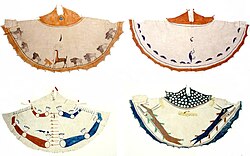
Warrior Societies
Six warrior societies existed to maintain camp order and honor bravery. These ranged from the Po-Lanh-Yope (Little Rabbits) for boys to the elite Koitsenko (Principal Dogs), which consisted of the ten most distinguished warriors elected by their peers.
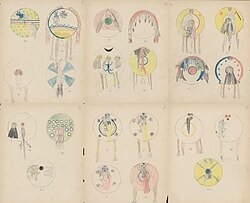
Art, Records, and Spirituality
The Kiowa are noted for their unique approach to history. While other Plains tribes used "winter counts," the Kiowa developed a calendar system that recorded two events per year. Notable calendar keepers included Little Bluff (Tohausan) and Anko.
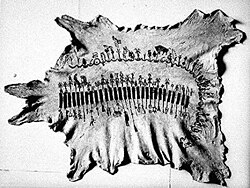
Their artistic expression was evident in the geometric designs painted on parfleche (rawhide containers) and the intricate hide paintings found inside and outside their tipis.
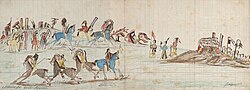
Death and Funeral Rites
Death was viewed as a traumatic event associated with negative spiritual forces. To prevent spirits from lingering, burials occurred promptly—usually the same day. Following the burial, the deceased's belongings and their tipi were often burned to sever the connection between the living and the dead.
| Category | Key Details |
|---|---|
| Housing | Conical tipis made of bison hide; portable and seasonal. |
| Diet | Bison, game animals, wild berries, and traded maize/squash. |
| Transport | Dogs (pre-horse), then horses and travois. |
| Governance | Elected head-chief and specialized warrior societies. |
| Record Keeping | Unique dual-event annual calendar system. |
Frequently Asked Questions
What was pemmican and why was it important?
Pemmican was a concentrated food source made from powdered dried lean meat mixed with melted fat and sometimes berries. It was essential for the Kiowa because it provided long-lasting sustenance while they were on the move.
How did the horse change Kiowa society?
Horses revolutionized their ability to hunt bison, expanded their territorial range, and changed their economy, as horse herds became the primary measure of individual wealth and status.
What was the role of the Sun Dance?
The Sun Dance was a yearly gathering that served as a spiritual and political focal point, where different tribal bands performed specific duties, such as providing food or maintaining security.
How did the Kiowa record their history?
The Kiowa used a unique calendar system, distinct from the "winter counts" of other tribes, by recording two significant events for every year on skins.
What were the roles of women in Kiowa culture?
Women were responsible for gathering wild plants, processing foods, tanning hides, and creating art through beading and painting. They gained prestige through their own artistic achievements or the successes of their male relatives.