
Kriging Methods for Spatial Interpolation and Geostatistics
Kriging is a sophisticated geostatistical method used to interpolate values at unsampled locations based on a set of observed data points. Unlike simple averaging, kriging leverages the spatial correlation between points to provide the Best Linear Unbiased Estimator (BLUE). By treating the unknown value as a random variable, kriging minimizes the estimation error while ensuring the model remains unbiased.
Key Facts
- Core Objective: To minimize the mean square error of the estimation while maintaining a lack of bias.
- Spatial Dependence: The accuracy of kriging depends heavily on the variogram or covariance model, which describes how spatial correlation decreases with distance.
- Unbiasedness: In ordinary kriging, weights must sum to 1 to ensure the estimator is unbiased.
- Exact Interpolation: Kriging honors observed values, meaning the predicted value at a sampled location equals the actual measurement (assuming no measurement error).
- Precision Measure: It provides a kriging variance (σk²), offering a quantitative measure of estimation precision.
Types of Kriging Methods
Depending on the stochastic properties of the random field and the assumed level of stationarity—the property where statistical characteristics are constant across the domain—different kriging methods are applied.
Linear and Polynomial Models
- Ordinary Kriging: Assumes a constant but unknown mean within the search neighborhood of the target point.
- Simple Kriging: The most basic form; it assumes the mean is known and constant across the entire domain.
- Universal Kriging: Assumes the mean follows a general polynomial trend model, such as a linear trend.
- IRF-kriging: Treats the expectation as an unknown polynomial in the spatial coordinates.
Specialized and Nonlinear Approaches
- Indicator Kriging: Uses indicator functions to estimate transition probabilities rather than direct values.
- Multiple-Indicator Kriging (MIK): A version of indicator kriging using a family of indicators. While once promising for mineral deposit estimation, it has largely been replaced by conditional simulation due to resolution and practicality issues.
- Disjunctive Kriging: A nonlinear generalization of the standard kriging process.
- Log-normal Kriging: Specifically designed for positive data by interpolating the logarithms of the values.
- Latent Kriging: Used for spatial functional data, applying kriging at the latent level of a nonlinear mixed-effects model.
Advanced Integration Methods
- Co-kriging: Performs joint kriging using data from multiple sources that share a known relationship.
- Bayesian Kriging: Instead of maximum likelihood estimates for coefficients and hyperparameters, this method uses expectation values. It allows for the quantification of evidence and uncertainty within the kriging emulator.
| Method | Mean Assumption | Primary Use Case |
|---|---|---|
| Simple | Known and Constant | Theoretical models with known expectations |
| Ordinary | Unknown and Constant (Local) | General purpose spatial interpolation |
| Universal | Polynomial Trend | Data with clear structural gradients |
| Co-kriging | Multi-source relationship | Integrating primary and secondary data |
| Indicator | Probability-based | Estimating threshold exceedance |
Deep Dive: Ordinary Kriging
Ordinary kriging treats the unknown value at a location (x₀) and its neighbors as random variables. The goal is to find a linear combination of these neighbors that minimizes the variance of the estimation error.
To achieve a lack of bias, the weights assigned to the neighboring samples must sum to exactly 1. If this condition is met, the expected error is zero. To ensure minimum variance, the system minimizes the dispersion around the mean, which is calculated using a covariance matrix containing the variances of the samples and the covariances between the samples and the target point.
The resulting estimation variance is influenced by several factors: it increases as samples move further from the target point and grows with the a priori variance of the variable. Notably, the variance depends on the spatial configuration of the samples, not the actual values of the samples themselves.
Deep Dive: Simple Kriging
Simple kriging is mathematically the most straightforward but least flexible method. It requires the expectation of the random field to be known and relies on a specific covariance function to define the Gaussian process.
The choice of covariance function is critical. For example, a squared exponential function favors smooth estimates, which may lead to poor results if the real-world data contains rapid changes or discontinuities.
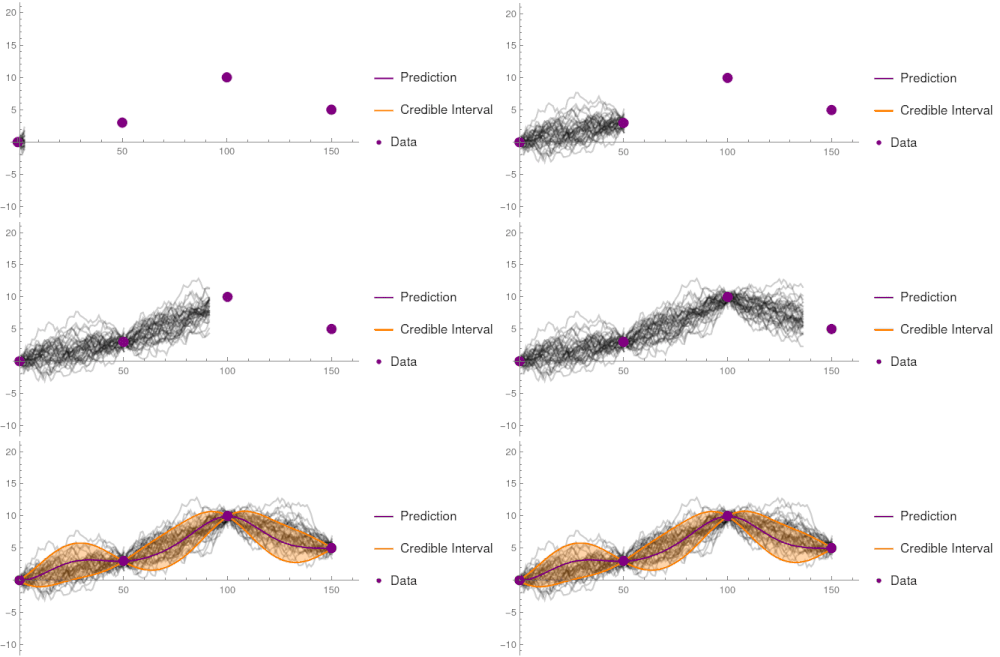
Unlike ordinary kriging, simple kriging does not require an unbiasedness condition for its weights. The process is analogous to a linear regression of the target value on the observed neighboring values.
Frequently Asked Questions
What happens if the wrong variogram is used in kriging?
While a "good" interpolation may still be achieved, no specific statistical properties are guaranteed if the variogram is incorrect. The precision measure (kriging variance) relies entirely on the correctness of the variogram.
Is kriging always the best interpolation method?
Kriging is the best linear unbiased estimator, but it may not be the absolute best method. Nonlinear or biased methods might outperform it in certain scenarios. Furthermore, if there is no spatial dependence, kriging is no more effective than a simple arithmetic mean.
What is the difference between Simple and Ordinary Kriging?
Simple kriging assumes the mean of the entire domain is known and constant. Ordinary kriging assumes the mean is unknown but constant within a local search neighborhood, requiring the weights to sum to 1 to remain unbiased.
How does Bayesian Kriging differ from standard approaches?
Standard kriging typically uses maximum likelihood estimates for hyperparameters. Bayesian kriging uses expectation values, which allows researchers to quantify the uncertainty of the kriging emulator itself.