
LADEE Mission: Mapping the Moon's Exosphere and Testing Laser Communications
The Lunar Atmosphere and Dust Environment Explorer, known as LADEE, was a specialized NASA mission designed to study the Moon's tenuous exosphere—the extremely thin layer of gases surrounding the lunar surface—and the environment of lunar dust. Launched in 2013, the mission combined critical planetary science with a groundbreaking experiment in deep-space communication.
Key Facts
- Launch Date: September 7, 2013
- Launch Vehicle: Minotaur V carrier rocket
- Launch Site: Wallops Flight Facility, Mid-Atlantic Regional Spaceport
- Primary Goal: Study the lunar exosphere and dust environment
- Communication Milestone: First two-way optical laser communication between Earth and a spacecraft
- Mission End: Impacted the lunar far side on April 18, 2014
Launch and Ascent
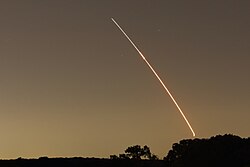
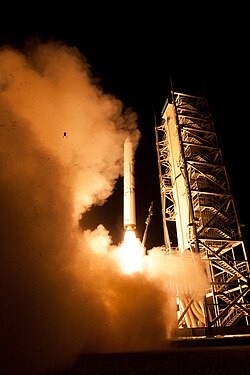
LADEE lifted off on September 7, 2013, at 03:27 UTC from the Wallops Flight Facility. This marked the first time a lunar mission was launched from this specific facility. The ascent was visible across much of the U.S. eastern seaboard, with observers from New York City to Virginia witnessing the first stage cutoff and second stage ignition.
The mission utilized a Minotaur V, a solid-propellant rocket. Unlike liquid-fueled rockets that use continuous closed-loop feedback for attitude control, the first three stages of the Minotaur V followed a pre-programmed attitude profile to gain velocity. The fourth stage modified the flight profile to place LADEE into perigee (the point in orbit closest to Earth), and a spin-stabilized fifth stage finally pushed the spacecraft into a highly elliptical Earth orbit.
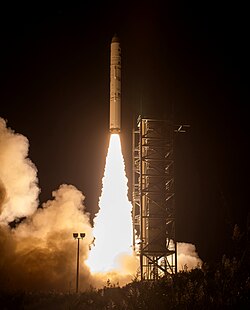
While the fourth and fifth stages eventually became space debris, they successfully delivered the spacecraft to begin its journey. Interestingly, a photo of a frog launched into the air by the rocket's pressure wave became a viral social media moment, though the frog's ultimate fate remains unknown.
The Journey to the Moon
LADEE employed an unconventional lunar transit. Instead of a direct injection, the spacecraft performed three increasingly larger "phasing orbits" around Earth over the course of approximately one month. This strategy was chosen for several technical reasons:
- Delta-v Limitations: The Minotaur V lacked sufficient delta-v (the change in velocity required to perform a maneuver) to send the 383 kg spacecraft directly to the Moon.
- Precision Management: The solid-rocket stages of the Minotaur V are less precise than liquid rockets; phasing loops allowed NASA to correct launch dispersions efficiently.
- Launch Window: The approach widened the launch window to five days.
- Robustness: The method provided a safety buffer in case of missed or anomalous orbital maneuvers.
During the early transit, engineers detected high electrical currents in the reaction wheels (devices used to control the spacecraft's orientation). After adjusting protection limits, normal operations resumed the following day.
Lunar Orbit and Systems Checkout
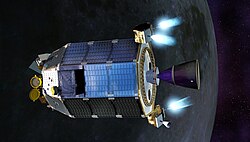
LADEE achieved Lunar Orbit Insertion (LOI) on October 6, 2013, via a three-minute engine burn. The spacecraft initially entered a 24-hour elliptical capture orbit, which was lowered to a four-hour orbit on October 9. By October 12, LADEE reached a circular orbit at an altitude of approximately 250 kilometers.
Following a 30-day commissioning phase to verify all systems, the orbit was further lowered to 75 kilometers to begin final instrument checkouts.
Lunar Laser Communication Demonstration (LLCD)
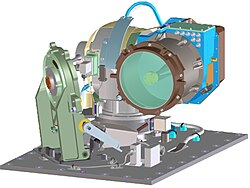
One of the mission's most significant technical achievements was the Lunar Laser Communication Demonstration (LLCD). This free-space optical communication system replaced traditional radio waves with pulsed lasers to transmit data.
On October 18, 2013, the LLCD successfully transmitted data across 385,000 kilometers. This test established a record-breaking downlink speed of 622 megabits per second (Mbps) from the spacecraft to Earth and an error-free upload rate of 20 Mbps from Earth to the spacecraft.
Science Phase and Mission Conclusion
For its primary science operations, LADEE was maneuvered into a low-altitude orbit with a periselene (closest point to the Moon) of 20 km and an aposelene (farthest point) of 60 km. The science phase lasted 128 days, including a 28-day extension that allowed researchers to collect a full lunar cycle of data on the Moon's exosphere.
The mission concluded in April 2014. On April 11, a final burn lowered the spacecraft's altitude to within 2 km of the surface. Despite facing a four-hour lunar eclipse on April 15—which tested the spacecraft's thermal limits and caused minor pressure sensor malfunctions—LADEE remained operational.
On April 18, 2014, LADEE struck the far side of the Moon at a speed of 5,800 km/h. The far side was specifically chosen to protect historic Apollo and Luna landing sites. The Lunar Reconnaissance Orbiter later confirmed the impact occurred near the eastern rim of the Sundman V crater.
| Parameter | Detail |
|---|---|
| Spacecraft Mass | 383 kg (844 lb) |
| Launch Vehicle | Minotaur V |
| Transit Duration | Approximately 1 month |
| Max Downlink Speed | 622 Mbps |
| Final Impact Site | Sundman V crater (Far side) |
| Impact Speed | 5,800 km/h (3,600 mph) |
Frequently Asked Questions
Why did LADEE orbit Earth three times before heading to the Moon?
LADEE used phasing orbits because the Minotaur V rocket did not have enough delta-v to send the spacecraft directly to the Moon. This method also allowed NASA to correct for launch inaccuracies and provided a more flexible launch window.
What is the significance of the LLCD?
The Lunar Laser Communication Demonstration was NASA's first attempt at two-way optical laser communication in deep space. It proved that lasers could transmit data much faster than traditional radio waves, paving the way for future high-speed satellite communications.
How did the lunar eclipse affect the spacecraft?
During the eclipse on April 15, 2014, LADEE was in Earth's shadow for four hours and could not generate solar power. Engineers turned off instruments and cycled heaters to conserve energy. The spacecraft survived with only a few minor pressure sensor malfunctions.
Why was the far side of the Moon chosen for the final impact?
NASA directed LADEE to impact the far side of the Moon to ensure that the crash would not damage historically significant sites, such as the landing locations of the Apollo and Luna missions.