
Las Últimas Noticias: A History of Chile's Leading Daily
The landscape of the Chilean press was forever altered at the turn of the 20th century. Driven by a vision of modernization and a desire to implement international standards of journalism, Las Últimas Noticias (LUN) emerged as a pivotal force in the country's media evolution, transitioning from a supplementary afternoon edition to one of the most widely read newspapers in Chile.
The Foundation and Early Vision
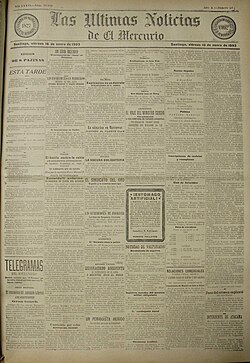
Las Últimas Noticias was founded on November 15, 1902, by Agustín Edwards Mac Clure, the owner of El Mercurio. The inspiration for the new publication came after Edwards traveled to the United States, where he observed the rapid progress of the American press. Upon his return, he implemented a series of structural reforms within his company.
These changes included transforming El Mercurio into a morning newspaper and establishing Las Últimas Noticias de El Mercurio (The Latest News of El Mercurio) to serve as an afternoon publication. The leadership of the new venture was entrusted to the writer Joaquín Díaz Garcés, who served as its first director.
Evolution of Format and the Birth of La Segunda
As the publication grew, it adapted its physical presence to meet reader demands. In 1928, the newspaper transitioned from a broadsheet—a large-format page—to a tabloid format, which is smaller and more portable.
A significant turning point occurred in 1931 during the political instability surrounding the fall of President Carlos Ibáñez del Campo. The sheer volume of news generated by these events required a second edition of Las Últimas Noticias. This temporary expansion eventually evolved into a separate entity: the evening newspaper known today as La Segunda.
Shifting Demographics and Cultural Impact
Over the following decades, Las Últimas Noticias shifted its schedule to become a morning edition. It targeted the middle class and placed a heavy editorial emphasis on law enforcement issues. This strategic focus led to significant success that lasted until the 1980s.
During this era, the paper became a cultural staple by publishing popular comics, including Condorito, Calvin and Hobbes, and Ñoñobañez. However, the return of democracy in Chile brought a shift in public consumption habits, and the traditional reporting style began to lose its previous appeal among the population.
The Digital Revolution and Modern Era
In 1994, Las Últimas Noticias solidified its role as a pioneer by becoming the first Chilean newspaper to be produced entirely in digital format. A milestone in this transition occurred on July 19, 1994, at 18:42 hours, when the first electronic test page was received via fiber optics at the offices located at 0112 Bellavista Street.
By the late 1990s and early 2000s, the publication pivoted its content strategy toward entertainment media. By discarding most of its supplements and adopting a style similar to the British Daily Mirror and the American New York Post, it became the best-selling newspaper in Chile. Since the mid-1990s, LUN has also maintained an online edition, providing free daily news to the public via the internet.
Key Facts
- Founded: November 15, 1902, by Agustín Edwards Mac Clure.
- Digital Pioneer: First Chilean newspaper produced entirely digitally in 1994.
- Format Change: Switched from broadsheet to tabloid in 1928.
- Legacy: The 1931 second edition led to the creation of La Segunda.
- Market Position: Became Chile's best-selling newspaper after pivoting to entertainment-focused content.
Summary of Institutional Evolution
| Year | Event/Change | Impact |
|---|---|---|
| 1902 | Foundation | Established as an afternoon edition of El Mercurio. |
| 1928 | Format Shift | Transitioned from broadsheet to tabloid. |
| 1931 | Second Edition | Led to the emergence of La Segunda. |
| 1994 | Digitalization | First fully digital production in Chile. |
| Late 90s | Editorial Pivot | Shifted to entertainment media style. |
Frequently Asked Questions
Who founded Las Últimas Noticias?
The newspaper was founded by Agustín Edwards Mac Clure, the owner of El Mercurio, following a trip to the United States to study press advancements.
How did La Segunda originate?
La Segunda emerged from a second edition of Las Últimas Noticias created in 1931 to handle the overflow of information during the fall of President Carlos Ibáñez del Campo.
When did the newspaper go digital?
Las Últimas Noticias became the first Chilean newspaper produced entirely in digital in 1994, receiving its first electronic test page via fiber optics on July 19 of that year.
What editorial style does the newspaper currently follow?
In the late 1990s and early 2000s, the paper adapted its style to resemble entertainment-focused publications like the New York Post and the Daily Mirror.
Which famous comics were published in LUN during the 1980s?
During the 1980s, the newspaper published popular comics such as Condorito, Calvin and Hobbes, and Ñoñobañez.