
Lone Star Tick: Identification, Life Cycle, and Health Risks
The lone star tick (Amblyomma americanum) is a highly aggressive tick species indigenous to Mexico and much of the eastern United States. Known by several regional names—including the turkey tick, cricker tick, and northeastern water tick—this parasite is notorious for its painless bite, which often allows it to remain attached to a host for up to seven days until it is fully engorged with blood.
Unlike some tick species that passively wait for a host, the lone star tick is an active hunter. Its larvae are particularly opportunistic and can transfer to human skin from discarded clothing that is put back on. The species is sexually dimorphic, meaning males and females look different. The adult female is easily identified by a distinctive silvery-white, star-shaped spot on the posterior portion of her dorsal shield (scutum). Adult males, by contrast, feature various white streaks or spots around the margins of their shields.
Key Facts
- Identification: Adult females possess a signature white spot on their back; males have white marginal streaks.
- Primary Host: White-tailed deer are the main hosts for mature ticks and drive population dispersal.
- Behavior: They use "questing" (climbing vegetation) to find hosts via heat, vibration, and carbon dioxide.
- Health Risks: Vectors for ehrlichiosis, tularemia, and the heartland virus.
- Unique Effect: Can trigger alpha-gal syndrome, causing a delayed allergy to red meat.
Range and Habitat
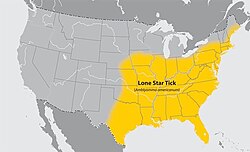
Lone star ticks are widely distributed across the Midwest, Southeast, and East of the United States. They prefer wooded areas, specifically second-growth forests with thick underbrush. They are also common in ecotonal areas—the transition zones between different biomes, such as where forests meet grasslands.
To find a host, the tick engages in questing. This involves climbing a blade of grass or leaf edge and extending its front legs. When the tick detects biochemical stimuli like carbon dioxide, heat, or vibrations from movement, it mounts the passing host. While primarily found in the U.S. and Mexico, they have also been reported in parts of Southern Ontario, Canada, including London and the Region of Waterloo.
Life Cycle and Development
The lone star tick is a three-host tick, meaning it requires a blood meal from a separate host at each of its three mobile life stages before molting or reproducing. The full cycle consists of four stages: egg, six-legged larva, eight-legged nymph, and adult.
- Larva: After hatching and a resting period, larvae quest for their first host (often birds or small mammals), feed for one to three days, and then molt into nymphs.
- Nymph: Nymphs seek a second host (birds, small mammals, or rodents), feed, and then molt into adults.
- Adult: Adults typically feed on medium to large mammals, most frequently white-tailed deer. Mating occurs on the host animal. After the final blood meal, the fertilized female drops to the ground to lay a single egg mass containing several thousand eggs before dying.
Under ideal conditions, the life cycle can be completed in less than a year, though it typically takes up to two years in the wild due to overwintering and diapause (a period of suspended development). In the region south of New York, adults are most active from mid-March to late June, nymphs from mid-May to late July, and larvae from July to September.
Disease Transmission and Vector Capabilities
The lone star tick is a primary vector for several bacterial and viral pathogens. It is the main transmitter of Ehrlichia chaffeensis (causing human monocytic ehrlichiosis) and Ehrlichia ewingii (causing human and canine granulocytic ehrlichiosis). Other isolated agents include Francisella tularensis (tularemia), Rickettsia amblyommii, and Coxiella burnetti.
Additionally, the tick is linked to Southern Tick-Associated Rash Illness (STARI). STARI produces an expanding rash similar to the erythema migrans seen in Lyme disease, but it is not caused by Borrelia burgdorferi. In fact, research suggests that lone star tick saliva may actually inactivate B. burgdorferi, making this species an unlikely vector for Lyme disease. More recently, the heartland virus has been linked to A. americanum following cases in Missouri and Tennessee.
Alpha-Gal Syndrome: The Meat Allergy
One of the most unusual effects of a lone star tick bite is the development of alpha-gal syndrome. This is a delayed allergic reaction to non-catarrhine mammalian meat (red meat) and meat products. The reaction is triggered by an IgE antibody to a mammalian oligosaccharide called galactose-alpha-1,3-galactose (alpha-gal), which has been discovered in the tick's saliva.
Unlike typical food allergies that occur immediately, alpha-gal reactions usually manifest 3 to 6 hours after consumption, often resulting in anaphylaxis—a life-threatening drop in blood pressure and constriction of airways. Because of this delay, the cause can be difficult to identify. Standard skin tests are often unreliable; however, tests using raw meat or pork kidney are more sensitive.
| Feature | Details |
|---|---|
| Scientific Name | Amblyomma americanum |
| Distinguishing Mark | White spot on adult female's back |
| Primary Host | White-tailed deer |
| Key Pathogens | Ehrlichia, Heartland virus, F. tularensis |
| Unique Condition | Alpha-gal syndrome (red meat allergy) |
| Geographic Range | Eastern US, Mexico, Southern Ontario |
Frequently Asked Questions
Does the lone star tick transmit Lyme disease?
No. While the bacteria responsible for Lyme disease have occasionally been found in these ticks, vector competency tests show they are extremely unlikely to transmit it. Their saliva may even inactivate the Lyme bacteria.
What is alpha-gal syndrome?
It is a delayed allergy to red meat (non-primate mammals) caused by the body producing IgE antibodies to alpha-gal, a sugar molecule found in the saliva of the lone star tick.
How can I identify a lone star tick?
Look for a small, hard tick where the adult female has a single, silvery-white spot near the center of her back. Adult males have white streaks or spots around the edges of their shields.
Where are lone star ticks most commonly found?
They thrive in wooded areas with thick underbrush and in transition zones between forests and grasslands, particularly in the Eastern, Southeastern, and Midwestern United States.
Why is it called the "turkey tick"?
It earned this name because wild turkeys are a common host for the tick during its immature (larval and nymphal) stages in several Midwestern states.