
Louis-Jean-Marie Daubenton: Pioneer of Comparative Anatomy
Louis-Jean-Marie Daubenton was a distinguished 18th-century scientist whose meticulous approach to anatomy helped shape the foundations of natural history. While often remembered for his collaboration with the famous naturalist Georges-Louis Leclerc de Buffon, Daubenton was a polymath in his own right, contributing significantly to botany, mineralogy, and agriculture.
Early Life and Education
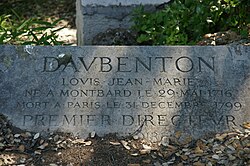
Born in Montbard, Côte-d'Or, Daubenton's early path was charted by his father, Jean Daubenton, a notary who desired for his son to enter the church. Consequently, Louis-Jean-Marie was sent to Paris to study theology. However, his true passion lay in the biological sciences. Following his father's death in 1736, Daubenton gained the freedom to pursue his own interests. He graduated in medicine from Reims in 1741 and returned to Montbard to begin his practice as a physician.
Collaboration with Buffon and the Jardin du Roi
The trajectory of Daubenton's career changed in 1742 when he was invited by fellow Montbard native Georges-Louis Leclerc de Buffon to assist with the Histoire naturelle, générale et particulière, a massive multi-volume work on natural history. Buffon required precise anatomical descriptions to complement his narrative, and despite their contrasting personalities, the two formed a highly productive partnership.
In 1744, Daubenton's expertise was formally recognized when he became an adjunct botanist for the French Academy of Sciences. Around the same time, Buffon appointed him as the keeper and demonstrator of the king's cabinet at the Jardin du Roi (the King's Garden), a premier center for botanical and zoological research in Paris.
For the first section of the Histoire naturelle, Daubenton performed dissections and provided detailed descriptions of 182 species of quadrupeds. This work established him as a leading figure in comparative anatomy—the study of similarities and differences in the anatomy of different species. Although Buffon later removed these detailed descriptions from subsequent editions and the series on birds to improve readability and profitability, Daubenton remained a core collaborator at the Jardin du Roi.
Academic Contributions and Diverse Research
Beyond his work with Buffon, Daubenton was a prolific researcher. He published numerous articles in the memoirs of the Parisian Académie Royale des Sciences, covering a vast array of scientific disciplines:
- Comparative Anatomy: Research on both extant (living) and fossil animals.
- Botany and Physiology: Studies on vegetable physiology.
- Earth Sciences: Contributions to mineralogy.
- Agriculture: Research into rural economy and the successful introduction of merino sheep into France.
His international reputation grew over time, leading to his election as a member of the American Philosophical Society in 1775. He also became a highly respected educator, lecturing on natural history at the College of Medicine starting in 1775, teaching rural economy at the Alfort school in 1783, and serving as a professor of mineralogy at the Jardin du Roi.
Final Years and Legacy
In December 1799, Daubenton was appointed to the senate. Tragically, during his first meeting, he suffered an apoplectic fit (a stroke) after falling from his seat. He passed away shortly thereafter in Paris. He is survived in history not only by his scientific papers but also by his wife, Marguerite Daubenton (1720-1818), a novelist who wrote Zelie dans le Desert in 1786.
Daubenton's contributions to science are immortalized in the binomial nomenclature of several species, including the aye-aye lemur (Daubentonia madagascariensis), Daubenton's bat (Myotis daubentoni), and a specific variety of kale.
Key Facts
- Specialization: Expert in comparative anatomy, mineralogy, and botany.
- Major Work: Provided anatomical descriptions for 182 quadruped species in Buffon's Histoire naturelle.
- Academic Roles: Professor at the Jardin du Roi and lecturer at the College of Medicine and Alfort school.
- Agricultural Impact: Successfully introduced merino sheep to France.
- Honors: Member of the French Academy of Sciences and the American Philosophical Society.
| Category | Details |
|---|---|
| Education | Theology (Paris), Medicine (Reims, 1741) |
| Key Partnership | Georges-Louis Leclerc de Buffon |
| Primary Institution | Jardin du Roi |
| Scientific Focus | Comparative anatomy, mineralogy, vegetable physiology |
| Commemorated Species | Aye-aye, Daubenton's bat, Daubenton's kale |
Frequently Asked Questions
What was Daubenton's primary contribution to the Histoire naturelle?
Daubenton provided the detailed anatomical descriptions and dissection data for 182 species of quadrupeds in the first section of the work.
Why were Daubenton's descriptions removed from later editions of Buffon's work?
Buffon removed the anatomical details to make the Histoire naturelle more readable and more profitable for a wider audience.
Which animals are named after Louis-Jean-Marie Daubenton?
The aye-aye lemur (Daubentonia madagascariensis) and Daubenton's bat (Myotis daubentoni) are named in his honor.
What role did Daubenton play in French agriculture?
He conducted research on rural economy and was responsible for the successful introduction of merino sheep into France.
How did Daubenton die?
He died in Paris following a short illness that began with an apoplectic fit suffered during his first meeting as a member of the senate in December 1799.