
Lumberjack History: The Life and Labor of the Forest Industry
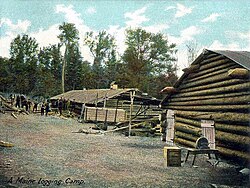
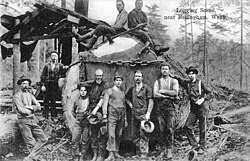
The image of the lumberjack is deeply embedded in the folklore of the North American wilderness. Historically, these men lived a migratory and seasonal existence, following the demand for timber across vast forests. From the early camps of Maine to the dense woods of the Pacific Northwest, the lumberjack's life was defined by grueling physical labor, specialized skills, and a unique social structure.
In the United States, the industry began in the northeast, particularly in Maine, before moving westward through the Upper Midwest and eventually reaching the Pacific Northwest. Many of these workers were of Scandinavian descent, bringing long-standing family traditions of forestry to the New World. This migration and the romanticized image of the hard-working, hard-drinking woodsman were later documented by author Stewart Holbrook in his work, Holy Old Mackinaw: A Natural History of the American Lumberjack.
Key Facts
- Demographics: Historically, lumberjacks were exclusively men who lived in bunkhouses or tents.
- Geography: Primary operations were centered in Scandinavia, Canada, and the United States.
- Evolution: Traditional logging camps were phased out between World War II and the early 1960s due to the advent of motor vehicles.
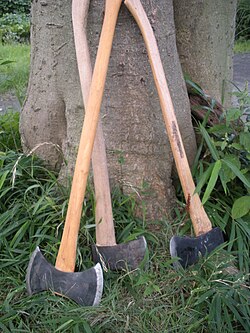
- Equipment: Early tools relied heavily on axes, cross-cut saws, and steam-powered machinery.
- Terminology: The phrase "skid row" originates from the practice of skidding logs down hills or along corduroy roads.
The Division of Labor in Logging Camps
While popular culture often views all loggers as tree-cutters, the work was actually highly specialized. The process of felling (cutting down the tree) and bucking (cutting the felled tree into logs) was handled by fallers and buckers. While these were once distinct roles, they have since been combined into a single position.
Specialized Crew Roles
Beyond the initial cut, a complex hierarchy of roles ensured the efficient movement of timber:
- Whistle Punk: Acted as a safety lookout and signaled the yarder operator using a whistle, typically located at the steam donkey (a steam-powered winch).
- High Climber: Also known as a tree topper, this specialist ascended tall trees using rope and climbing gaffs to create a spar tree. They removed limbs and the top of the tree to attach pulleys and rigging for the yarder.
- Choker Setter: An entry-level role responsible for attaching steel cables, or chokers, to downed logs.
- Chaser: Another entry-level position focused on removing chokers once logs reached the landing.
- Hook Tender: A supervisory position that experienced loggers aspired to reach.
By the 1960s and 70s, the roles of the high climber and whistle punk declined as portable steel towers replaced spar trees and radios replaced whistles.
Machinery and Transportation
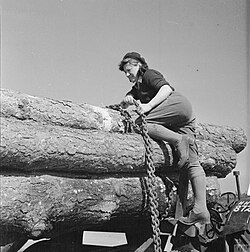
Before the transition to diesel and gasoline engines, the industry relied on steam power and animal labor. Skidders—either animal or steam-powered—hauled logs to railroads. In some regions, horse-driven logging wheels were used to move timber out of the woods.
Water played a critical role in transport. Logs were often floated down rivers or through specially constructed log flumes to reach sawmills. This gave rise to log rolling, the skilled art of walking across floating logs. To maintain grip on the wet timber, lumberjacks wore spiked boots known as caulks or corks.
The Origin of "Skid Row"
The modern term "skid row," referring to impoverished urban neighborhoods, has its roots in forestry. Logs were "skidded" down hills or along corduroy roads (roads made of logs laid side-by-side). A street in Seattle known as Skid Road became a gathering place for people facing hard times, eventually evolving into the general term used today.
Summary of Logging Roles and Tools
| Role/Tool | Primary Function | Key Characteristic |
|---|---|---|
| Faller/Bucker | Cutting and sectioning trees | Specialized felling skills |
| High Climber | Establishing spar trees | Used climbing gaffs and rigging |
| Whistle Punk | Communication and safety | Signaled the yarder operator |
| Choker Setter | Securing logs for transport | Entry-level position |
| Caulks | Footwear for stability | Spiked boots for log rolling |
| Steam Donkey | Log movement | Steam-powered winch system |
Preserving Logging History
Several museums across North America preserve the legacy of the forest industry, including the BC Forest Discovery Centre (Duncan), the Camp Five Museum (Wisconsin), the Central New Brunswick Woodsmen's Museum, and the Maine Forest & Logging Museum. Other notable sites include the Forest History Center in Minnesota and the Cradle of Forestry in America in North Carolina.
Frequently Asked Questions
Who were the primary workers in early logging camps?
Lumberjacks were exclusively men, many of whom were of Scandinavian ancestry in the United States, following family traditions of timber harvesting.
What is a spar tree and who created it?
A spar tree was a tall tree used as a central point for pulleys and rigging to skid logs into a landing. It was established by a high climber, who climbed the tree to remove limbs and the top before installing the equipment.
How did logs get to the sawmills before modern trucks?
Logs were transported using animal or steam-powered skidders, horse-driven logging wheels, or by floating them down bodies of water and log flumes.
Why did traditional logging camps disappear?
Logging camps were phased out between World War II and the early 1960s because motor vehicles allowed crews to be transported directly to remote logging sites, eliminating the need for permanent camp housing.
What is the connection between logging and the term "skid row"?
The term comes from the practice of "skidding" logs along corduroy roads or down hills. A specific "Skid Road" in Seattle became a place for people down on their luck, leading to the modern meaning of the phrase.