
Makapansgat Valley: A Chronology of Human Evolution and History
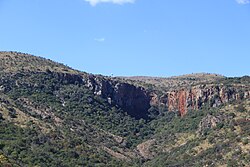
The Makapansgat Valley in South Africa serves as a profound geological and archaeological archive, preserving millions of years of biological and cultural evolution. From the earliest ancestors of humanity to the complex social conflicts of the 19th century, the valley's network of caves provides a rare, continuous glimpse into the history of life on Earth.
The region is characterized by its limestone formations, which have created a variety of cave systems. These sites have attracted global research efforts, including collaborations between the University of the Witwatersrand, Arizona State University, and the University of Liverpool, to uncover the secrets of the Middle Pleistocene and beyond.
Key Facts
- Oldest Site: The Makapansgat limeworks date back over 4.0 million years.
- Hominid Finds: Remains of Australopithecus africanus (a gracile australopithecine) were found at the limeworks.
- Human Timeline: The Cave of Hearths contains a record spanning from the Early Stone Age (Acheulian) to the Iron Age.
- Climate Data: Cold Air Cave provides stable isotope records of climate change from 4,400 years ago to the present.
- Historical Significance: The Historic Cave is the site of a famous 1854 siege involving Chief Makapan.
Paleontological Foundations: The Ancient Caves
Makapansgat Limeworks
As the oldest site in the valley, the limeworks span a period from more than 4.0 million years ago to approximately 1.6 million years ago. This site is globally significant for yielding thousands of fossil bones, most notably those of Australopithecus africanus. Using palaeomagnetism—the study of the record of the Earth's magnetic field in rocks—researcher Andy Herries suggests these fossils date between 2.85 and 2.58 million years ago.
Buffalo Cave
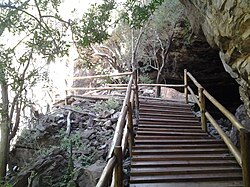
Named after the extinct "pygmy buffalo" (Bos makapania) collected by Dr. Robert Broom in 1937, Buffalo Cave offers a window into the Cornelian Land Mammal Age. Excavations have revealed a diverse fauna including horses, pigs, monkeys, antelope, and carnivores. The main fossil layers are estimated to be between 990,000 and 780,000 years old, while basal flowstone deposits date back 2 million years, showing evidence of the Walker circulation (a large-scale atmospheric circulation pattern) starting around 1.7 million years ago.
Archaeological Records of Human Occupation
Cave of Hearths and Hyaena Mandible Cave
The Cave of Hearths provides a remarkably complete sequence of human activity. It transitions from the Acheulian (Early Stone Age) through the Middle and Later Stone Ages, ending in the Iron Age. While 19th-century European relics like musket balls were found on the surface, deeper layers yielded a Homo mandible that may represent one of the earliest Homo sapiens. Notably, research by the University of Liverpool (1996–2001) determined that colored sediment horizons previously thought to be from fire were not actually caused by fire use.
Rainbow Cave and Gutentight Cave
Rainbow Cave contains Middle Stone Age artifacts from the Pietersburg Culture, dating between 100,000 and 50,000 years ago. Although putative hearths were once identified here, recent studies suggest these colored horizons are actually ancient pool deposits. In contrast, Gutentight Cave, explored in 2000, features a large chamber floor covered in actual hearths, though a 19th-century inscription indicates the original entrance collapsed shortly after that time.
Iron Age and Colonial History
Ficus Cave and Surrounding Sites
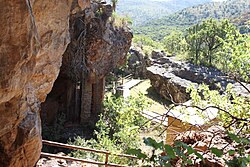
Named for the Ficus ingens (fig tree) roots that curtain its entrance, Ficus Cave contains Iron Age and 19th-century relics. An adjacent site shows occupational debris from the Early Iron Age (550 AD), 870 AD, and the Late Iron Age (1560 AD). Evidence of early industry is prominent here, with artificial terracing and finds including potsherds, grindstones, and iron smelting remnants such as slag and tuyeres (nozzles used to blow air into a furnace).
The Historic Cave (Makapansgat)
The Historic Cave is renowned for its role in the 1854 conflict between a Boer Commando and the Langa and Kekana people. Chief Makapan (Mokopane) and his people were besieged here from October 25 to November 21, 1854, resulting in hundreds of deaths due to hunger and thirst. This event led to the naming of the town Pieter Potgietersrust (after Piet Potgieter, who was shot during the siege), which has since been renamed Mokopane in honor of the Chief. The cave was declared a National Monument in 1936.
Specialized Cave Systems
- Peppercorn's Cave: Contains an underground lake and a colony of migratory long-fingered bats (Miniopterus schreibersii).
- Cold Air Cave: Used for uranium-series dating of stalagmites to track climate changes 4,400–4,000 years ago and within the last 800 years.
- Murzel's Cave: Explored in 1998, featuring decorated lower chambers.
- Katzenjammer Cave (Herries' Hole): A network of passages formed by the collapse of fossil-bearing deposits, including the Giant Dasie.
Below is a summary of the primary sites within the Makapansgat Valley:
| Site Name | Primary Significance | Estimated Age/Period |
|---|---|---|
| Makapansgat Limeworks | A. africanus fossils | >4.0 Ma to 1.6 Ma |
| Buffalo Cave | Pygmy buffalo & Cornelian fauna | 990,000 – 780,000 years |
| Cave of Hearths | Continuous human occupation record | Early Stone Age to Iron Age |
| Rainbow Cave | Pietersburg Culture artifacts | 100,000 – 50,000 years |
| Ficus Cave Site | Iron smelting & occupational debris | 550 AD – 1560 AD |
| Historic Cave | 1854 Siege of Chief Makapan | 19th Century |
Frequently Asked Questions
What is the significance of the Australopithecus africanus fossils?
These fossils, found in the Makapansgat limeworks, represent an early hominid species. Their presence helps scientists understand the evolutionary timeline of human ancestors in Africa between 2.85 and 2.58 million years ago.
What was the "Walker circulation" evidence in Buffalo Cave?
Basal flowstone deposits in Buffalo Cave provide geological evidence that the Walker circulation—a major atmospheric circulation pattern in the tropics—began approximately 1.7 million years ago.
Why was the town of Potgietersrus renamed Mokopane?
Following the transition from Apartheid to majority rule in the early 2000s, the town was renamed Mokopane to honor Chief Mokopane, who was besieged in the Historic Cave in 1854.
Are the colored layers in the Cave of Hearths evidence of ancient fires?
No. While previously thought to be hearths, research conducted by the University of Liverpool between 1996 and 2001 showed that these colored sediment horizons in the Early Stone Age levels were not caused by fire.
What evidence of industry was found near Ficus Cave?
Archaeologists found evidence of iron smelting operations, including ore, slag, and fragments of tuyeres, as well as grindstones and hammer stones on artificially terraced slopes.