
Manaus–Eduardo Gomes International Airport
Located in the heart of the Amazon, Manaus–Eduardo Gomes International Airport (MAO/SBEG) serves as the primary aerial gateway to Manaus, Brazil. From its inception as a facility designed for supersonic travel to its current role as a critical logistics hub, the airport connects the remote rainforest region with major domestic cities and international destinations.
The airport is currently operated by Vinci Airports, following a 30-year concession won on April 7, 2021, transitioning from the previous operator, Infraero.
Key Facts
- IATA Code: MAO | ICAO Code: SBEG
- Opened: March 31, 1976
- Operator: Vinci Airports (since 2021)
- Passenger Volume: 3,181,366 (2025 statistics)
- Cargo Status: Third-busiest cargo hub in Brazil (2024)
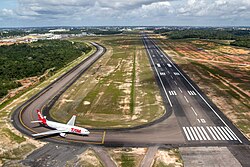
- Runway: Single asphalt runway (11/29) measuring 2,700 meters (8,858 ft)
History and Evolution
Construction of the airport began in 1972. Interestingly, it was originally named the Supersonic Airport of Manaus because its design was intended to accommodate the Concorde. However, on December 11, 1973, the name was changed to honor Air Marshal Eduardo Gomes, a prominent Brazilian military and political figure.
The airport officially opened on March 31, 1976, with a domestic flight operated by a Boeing 727-100. At the time, it was Brazil's most modern airport and the first to implement jet bridges (movable connectors that allow passengers to board aircraft directly from the terminal). Its opening allowed the previous Ponta Pelada Airport to be converted exclusively into the Manaus Air Force Base.
To prepare for the 2014 FIFA World Cup, Infraero invested BRL 793.5 million to expand the runway, enlarge the apron, and renovate the passenger terminal to handle increased global traffic.
Infrastructure and Operations
The airport is divided into specialized terminals to manage different types of air traffic efficiently:
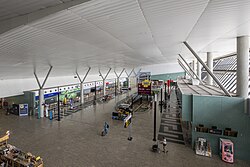
- Passenger Terminal 1: The primary hub for all domestic and international commercial flights.
- Passenger Terminal 2: Opened in 1985, this facility is dedicated to general aviation.
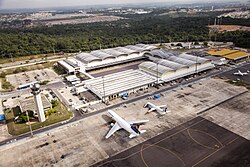
- Cargo Terminals: Three terminals (opened in 1976, 1980, and 2004) covering 49,000 square meters. Terminals 1 and 2 manage exports, while Terminal 3 handles imports, with a total processing capacity of 12,000 tonnes per month.
Airport Technical Summary
| Feature | Detail |
|---|---|
| Elevation (AMSL) | 81 m (266 ft) |
| Time Zone | BRT−1 (UTC−04:00) |
| Runway Surface | Asphalt |
| Location | 14 km north of downtown Manaus |
Airlines and Connectivity
Manaus serves as a hub for Apuí Táxi Aéreo, Azul Conecta, and Manaus Aerotáxi, and is a focus city for Azul Brazilian Airlines.
Passenger Destinations
- Domestic: Extensive connections to Brasília, São Paulo (Guarulhos), Rio de Janeiro (Galeão), Belém, Fortaleza, and remote Amazonian locations like Tabatinga and São Gabriel da Cachoeira.
- International: Direct flights to Bogotá (Avianca), Panama City (Copa Airlines), and Lisbon (TAP Air Portugal).
Cargo Logistics
As the third-busiest cargo airport in Brazil, it is a vital link for the region's economy. Major cargo operators include LATAM Cargo Brasil and Total Express Linhas Aéreas, primarily connecting Manaus with São Paulo-Guarulhos.
Safety and Incidents
The airport's history includes several notable events. In 1983, Libyan Air Force aircraft landed in Manaus with a cargo of Aero L-39 Albatros jets and weapons destined for Nicaragua, which were subsequently impounded. The airport also saw two hijackings of TABA Embraer EMB 110 aircraft in 1991 and 1994.
The most serious accident occurred on May 14, 2004, when Rico Linhas Aéreas Flight 4815 crashed in the forest approximately 18 nautical miles from the airport, resulting in the loss of all 33 people on board.
Frequently Asked Questions
Who currently operates the Manaus International Airport?
The airport is operated by Vinci Airports, which won a 30-year concession for the facility on April 7, 2021.
Why was the airport originally called the Supersonic Airport of Manaus?
It was given this name during construction because its design was specifically engineered to enable operations for the Concorde supersonic aircraft.
How significant is the airport for cargo in Brazil?
It is highly significant, ranking as the third-busiest airport in Brazil for cargo handled as of 2024, trailing only São Paulo-Guarulhos and Campinas.
What is the distance from the airport to the city center?
The airport is located approximately 14 kilometers (9 miles) north of downtown Manaus.
Which international cities can be reached directly from MAO?
Passengers can fly directly to Lisbon, Bogotá, and Panama City.