
Marsh Harvester: The Evolution of Agricultural Binding
The transition from manual labor to mechanized farming was marked by several pivotal inventions. Among these was the Marsh Harvester, a machine that bridged the gap between the early reaper and the eventual self-binder. Developed in the mid-19th century, this innovation sought to optimize how grain was cut and collected, significantly increasing the efficiency of the harvest.
The Origins of Marsh, Steward & Company
The story began in August 1858, when brothers Charles Wesley Marsh and W. W. Marsh of De Kalb, Illinois, patented a reaper-harvester. By 1863, an improved version of this machine was being manufactured in Plano, Illinois. This production was led by C. W. Marsh and George Steward under the firm name Steward and Marsh. As the business grew during the 1860s, W. W. Marsh and Lewis Steward joined the company. The enterprise, known variously as Marsh, Steward & Company or Marsh Brothers, operated until October 1875, when it was sold to Gannon and Deering of Chicago, Illinois.
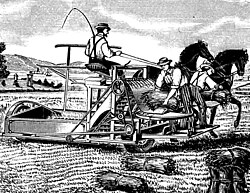
Design and Mechanical Theory
The Marsh Harvester functioned as both a reaper—a machine that cuts grain—and a hand-binder. It was designed to be operated by two men who rode on the machine and bound the sheaves (bundles of cut grain) by hand. In the timeline of agricultural engineering, it is considered the "child of the reaper and the parent of the self-binder."
The inventors based their design on the theory that two men could bind grain cut by a five-foot sickle if the material was delivered to them in the optimal position. To achieve this, the Marsh brothers focused on providing the operators with maximum freedom of action. They specifically engineered the following components to ensure a free swing and open access to the grain:
- Elevated delivery systems
- Specialized receptacles
- Optimized tables
- A dedicated operator platform
The primary goal of this design was productivity; the Marsh brothers believed that two men riding and binding could perform the work of four men walking and binding.
Key Facts
- Inventors: Charles Wesley Marsh and W. W. Marsh.
- Patent Date: August 1858.
- Manufacturing Hub: Plano, Illinois.
- Core Function: A reaper and hand-binder utilizing a five-foot sickle.
- Efficiency Claim: Two riding operators could replace four walking operators.
- Exit: Sold to Gannon and Deering in October 1875.
Growth and Sales Performance
The adoption of the Marsh Harvester grew steadily over more than a decade, reflecting the increasing demand for mechanized harvesting solutions in the American Midwest.
| Year | Total Units Sold |
|---|---|
| 1864 | 26 |
| 1865 | 24 |
| 1866 | 100 |
| 1867 | 300 |
| 1868 | 300 |
| 1869 | 750 |
| 1870 | 1,000 |
| 1871 | 1,400 |
| 1872 | 1,400 |
| 1873 | 2,750 |
| 1874 | 5,000 |
| 1875 | 5,000 |
| 1876 | 5,000 |
Frequently Asked Questions
Who invented the Marsh Harvester?
The machine was invented and patented in August 1858 by brothers Charles Wesley Marsh and W. W. Marsh of De Kalb, Illinois.
How did the Marsh Harvester differ from a standard reaper?
While a standard reaper only cut the grain, the Marsh Harvester was a reaper and hand-binder. It featured a platform and delivery system that allowed two men to ride the machine and bind the sheaves by hand as they moved.
What was the mechanical advantage of the Marsh design?
The design utilized a five-foot sickle and an elevated delivery system. This allowed two riding operators to be as productive as four men who had to walk and bind the grain manually.
When was the company sold and to whom?
The business was sold in October 1875 to Gannon and Deering of Chicago, Illinois.
Where was the Marsh Harvester manufactured?
The improved machines were manufactured in Plano, Illinois, by the firm of Steward and Marsh.