
Martial Law in Ukraine: Legal History and Implementation
Martial law is a legal mechanism that allows a government to suspend certain civil liberties and centralize authority to address national emergencies. In Ukraine, the application of martial law has been a critical tool for national defense, utilized during periods of heightened tension and full-scale conflict to secure borders and mobilize resources.
Key Facts
- 2018 Implementation: A limited 30-day martial law was applied to 10 regions following the Kerch Strait incident.
- 2022 Implementation: Full-scale martial law was declared on February 24, 2022, in response to the Russian invasion.
- Mobilization: Since 2022, able-bodied men aged 18–60 have been prohibited from leaving the country.
- Governance: The Verkhovna Rada (Ukraine's parliament) must approve and periodically extend martial law decrees.
- Media Consolidation: National television channels were merged into a single platform in March 2022.
The 2018 Period of Martial Law
The precedent for recent emergency measures began on May 28, 2015, when President Petro Poroshenko stated that martial law would be signed if a truce were violated or if the Armed Forces of Ukraine faced an offensive. This possibility became a reality on November 26, 2018.
Following the incident in the Kerch Strait, President Poroshenko initially proposed a 60-day martial law covering the entire country. However, after five hours of deliberation, the Verkhovna Rada passed a less restrictive version. This decree implemented martial law for 30 days across 10 specific regions to strengthen national defense.
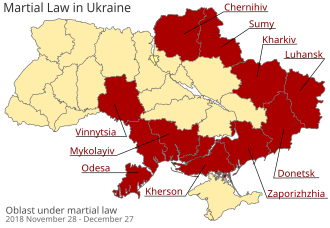
Affected Territories and Border Restrictions
The 2018 martial law focused on strategic zones, including the Russia–Ukraine border, the coasts of the Black Sea and Sea of Azov, and the internal waters of the Azov–Kerch aquatory. It also covered the Moldova–Ukraine border adjacent to Transnistria, an unrecognized state where Russian peacekeeping troops are stationed.
Starting November 30, 2018, Ukraine banned Russian men between the ages of 16 and 60 from entering the country, except for humanitarian reasons. The government cited security concerns, aiming to prevent the formation of private armies on Ukrainian soil. The State Border Guard Service reported that 1,650 Russian citizens were denied entry between November 26 and December 26, 2018.
Political Criticism and Controversy
The 2018 decree faced criticism from multiple angles. Some argued the move was politically motivated, suggesting it was timed to influence the 2019 presidential election by restricting constitutional norms. Others criticized the timing as being too late, noting that more severe military incidents had occurred since the 2014 Russian military intervention. There were also concerns that these measures might jeopardize international aid payments.
The 2022 Full-Scale Martial Law
On February 24, 2022, President Volodymyr Zelenskyy announced the commencement of martial law following the Russian invasion of Ukraine. This declaration, approved by the Verkhovna Rada, triggered a general mobilization of all reserve forces.
A primary condition of this decree was the prohibition of border-crossing for all able-bodied men aged 18–60. According to the State Border Guard Service, this restriction remained in effect as of July 19, 2023.
Civil and Political Restrictions
The 2022 martial law introduced several significant changes to civil administration and political activity:
- Curfews: In Kyiv, Mayor Vitali Klitschko implemented a daily curfew from 5 p.m. to 8 a.m. between February 26 and February 28, 2022, to identify Russian subversives.
- Media Control: On March 20, 2022, a decree merged all national television channels into a single platform.
- Political Parties: Eleven opposition political parties, including the pro-Russian Opposition Platform — For Life, were suspended due to alleged ties to the Russian government.
Legal Extensions and International Review
The Ukrainian parliament extended martial law on May 22, 2022, for 90 days, after which it began to renew automatically. Since mid-2024, the Verkhovna Rada has transitioned to holding quarterly votes to extend the period in 90-day increments.
In 2023, the European Commission reviewed these measures, concluding that while martial law reduced certain fundamental rights, the restrictions were temporary and proportional to the emergency situation.
Summary of Martial Law Implementations
| Feature | 2018 Martial Law | 2022 Martial Law |
|---|---|---|
| Trigger Event | Kerch Strait incident | Russian invasion of Ukraine |
| Scope | 10 specific regions | Nationwide |
| Duration | 30 days | Ongoing (90-day renewals) |
| Border Restrictions | Russian men (16–60) entry ban | Ukrainian men (18–60) exit ban |
| Political Impact | Constitutional restrictions | Suspension of 11 political parties |
Frequently Asked Questions
Who is affected by the current travel restrictions in Ukraine?
Since February 24, 2022, all able-bodied men between the ages of 18 and 60 are prohibited from leaving the country as part of the general mobilization of reserve forces.
How is martial law extended in Ukraine since 2024?
The Verkhovna Rada holds quarterly votes to extend the period of martial law in 90-day increments, which are then signed into law by President Zelenskyy.
What happened to opposition political parties under the 2022 decree?
Eleven opposition political parties, including the Opposition Platform — For Life, had their activities suspended due to claimed ties to the Russian government.
Was the 2018 martial law applied to the entire country?
No. While President Poroshenko initially proposed a nationwide decree, the Verkhovna Rada passed a version that limited martial law to 10 regions for a period of 30 days.
How did the European Commission view the restrictions on fundamental rights?
The European Commission found that the reduction of certain fundamental rights under martial law was temporary and proportional to the situation in 2023.