
Maternity of the Blessed Virgin Mary: History and Liturgical Evolution
The veneration of Mary as the Mother of God is a cornerstone of early Christian tradition. From the earliest eras of the Church, this title has been used to honor the Blessed Virgin, reflecting a deep theological conviction regarding her role in the mystery of salvation. Over centuries, the celebration of this maternity has evolved through various liturgical calendars, regional customs, and papal decrees.
The Evolution of the January 1st Celebration
In the early Roman Church, January 1 was observed as the anniversary (Natale) of the Mother of God. However, as the feasts of the Annunciation and the Assumption—adopted from Constantinople in the early 7th century—gained prominence, the January 1 date shifted in focus. It became known as the Octave Day of Christmas, the "eighth day" marking the circumcision of Jesus and the bestowal of his name, as recorded in Luke 2:21.
By the 13th or 14th century, regions such as Spain, Gaul, and Rome celebrated January 1 as both the feast of the Circumcision of the Lord and the Octave of the Nativity. Despite the focus on the infant Christ, the liturgy remained oriented toward Mary, utilizing prayers and responsories that glorified her maternity. In 1960, Pope John XXIII's General Roman Calendar simplified the day, removing the mention of circumcision and designating it simply as the "Octave of the Nativity."
The Feast of the Maternity of the Blessed Virgin Mary
While January 1 remained a central date, a specific feast dedicated to the Maternity of the Blessed Virgin Mary emerged later. In 1751, at the request of King Joseph I of Portugal, this feast (along with the feast of the Purity of Mary) was granted to the dioceses of Portugal, Brazil, and Algeria, assigned to the first Sunday in May.
The feast gradually spread to other regions: Venice in 1752, the kingdom of Naples in 1778, and Tuscany in 1807. In the Roman Breviary, the Maternity was commemorated on the second Sunday of October. Some local traditions developed unique dates, such as in Mesagne, Apulia, where it was observed on February 20 to commemorate a 1743 earthquake. It was not until 1931 that Pope Pius XI extended the feast—then celebrated on October 11 in Portugal—to the entire Church.
Regional Devotions and Special Titles
Madonna del Parto
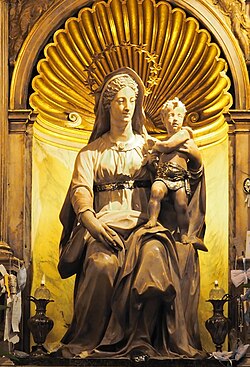
In Rome, the Basilica of Saint Augustine celebrated the Maternity of the Blessed Virgin Mary with an octave. This devotion centers on the Madonna del Parto, a miraculous statue sculpted by Jacopo Sansovino. For centuries, the faithful have prayed before this image for safe childbirth and healthy infants. The statue is traditionally adorned with flowers, candles, and ex-votos (offerings given in gratitude for a granted prayer), including photographs of children as evidence of faith in holy intercession.
Our Lady of Good Remedy
The Trinitarians also held this feast as their titular celebration. In 1198, John of Matha founded the Order of the Most Holy Trinity to ransom captive Christians. He placed the order's fundraising efforts under Mary's patronage and, in gratitude, gave her the title Our Lady of Good Remedy (Nuestra Señora de los Remedios). This specific feast is now observed on October 8.
Modern Liturgical Revisions
The 1969 revision of the Roman Rite calendar brought significant changes. The separate October 11 feast was deleted, even for Portugal, as the Church determined that the Maternity of the Blessed Virgin Mary is fully celebrated on January 1 during the Solemnity of Mary, the Holy Mother of God. This day also commemorates the conferral of the Most Holy Name of Jesus. Despite this change, Traditionalist Catholic groups continuing to use the 1960 General Roman Calendar still observe the October 11 date.
In his Apostolic Letter Marialis Cultus, Pope Paul VI explained that the January 1 celebration commemorates Mary's role in the mystery of salvation and exalts her singular dignity. He noted that the day serves as an occasion to adore the newborn Prince of Peace and implore the gift of peace through the Queen of Peace.
Key Facts
- Primary Date: The Maternity of the Blessed Virgin Mary is currently celebrated on January 1.
- Historical Shift: January 1 evolved from the Natale of the Mother of God to the Octave of the Nativity, and finally to the Solemnity of Mary, the Holy Mother of God.
- Global Spread: The specific feast of Maternity began in Portugal, Brazil, and Algeria in 1751 before becoming universal in 1931.
- Artistic Devotion: The Madonna del Parto statue by Jacopo Sansovino in Rome is a focal point for those seeking safe delivery of children.
- Trinitarian Link: The title "Our Lady of Good Remedy" was established by John of Matha for the ransoming of captives.
| Date | Title/Event | Significance |
|---|---|---|
| January 1 | Solemnity of Mary, Mother of God | Current universal celebration of Mary's maternity and the Name of Jesus. |
| October 8 | Our Lady of Good Remedy | Titular feast of the Trinitarians. |
| October 11 | Maternity of the Blessed Virgin Mary | Former universal date (1931-1969); still used by some traditionalists. |
| February 20 | Local Feast (Mesagne) | Commemoration of a 1743 earthquake. |
Frequently Asked Questions
When is the Maternity of the Blessed Virgin Mary celebrated today?
In the current Roman Rite, it is celebrated on January 1 as part of the Solemnity of Mary, the Holy Mother of God.
What is the significance of the Madonna del Parto?
Located in the Basilica of Saint Augustine in Rome, this statue by Jacopo Sansovino is invoked by the faithful to ask for safe deliveries and healthy babies.
Who is Our Lady of Good Remedy?
This is a title given to Mary by John of Matha, founder of the Order of the Most Holy Trinity, in gratitude for her assistance in ransoming captive Christians.
Why was the October 11 feast removed in 1969?
The liturgical revision determined that the Maternity of the Blessed Virgin Mary is sufficiently celebrated on January 1 during the Solemnity of Mary, the Mother of God.
What does the term "Octave of the Nativity" mean?
It refers to the eight-day period following Christmas, with the eighth day (January 1) serving as the concluding solemnity.