
Medicine Branches and Specializations
Modern healthcare is a complex, interdisciplinary effort. While physicians are the primary focus of medical practice, the delivery of care relies on a vast team of highly trained professionals. This team includes nurses, emergency medical technicians (EMTs), paramedics, laboratory scientists, pharmacists, podiatrists, physiotherapists, respiratory therapists, speech therapists, occupational therapists, radiographers, dietitians, bioengineers, medical physicists, surgeons, surgical assistants, and surgical technologists.
In a clinical setting, such as a hospital, patients are typically assigned to a specific team based on their primary presenting problem. For example, a patient with heart issues will be managed by a cardiology team, who may then collaborate with other specialties like radiology or surgery to diagnose and treat the condition or manage subsequent complications.

Key Facts
- Interdisciplinary Nature: Medicine overlaps with physics, chemistry, biology, and engineering.
- Core Division: Medical specialties are broadly categorized into "Medicine" (non-operative) and "Surgery" (operative).
- Foundational Knowledge: All physicians are educated in the basic sciences of medicine.
- Training Variance: Surgical training is generally more time-consuming than internal medicine training, often requiring a decade of study after medical school in the U.S.
- Diagnostic Role: Pathologists and laboratory scientists provide the evidence-based data necessary for accurate diagnosis.
Basic Sciences of Medicine
The basic sciences provide the theoretical and scientific foundation for all medical practice. Some physicians specialize in these areas through biomedical research.
- Anatomy: The study of physical structures. This includes gross anatomy (macroscopic) and cytology and histology (microscopic).
- Biophysics: An interdisciplinary science applying physics and physical chemistry to biological systems.
- Biostatistics: The application of statistics to biological fields, essential for epidemiology and evidence-based medicine.
- Cytology: The microscopic study of individual cells.
- Embryology: The study of early organism development.
- Gynecology: The study of the female reproductive system.
- Lifestyle Medicine: The study of preventing, treating, and reversing chronic conditions.
- Medical Physics: The application of physics principles to medicine.
- Neuroscience: The study of the nervous system, focusing on the brain and spinal cord.
- Pharmacology: The study of drugs and their actions.

Medical Specialties
Medical specialties are often organized by professional bodies. In the UK, these are known as the Royal Colleges. Most specialties fall into two broad categories: Medicine and Surgery.
Internal Medicine
Internal medicine focuses on the prevention, diagnosis, and treatment of adult diseases. Specialists, known as internists in North America or physicians in Commonwealth nations, often work in hospitals due to the complexity of their cases. While generalists once existed, most modern urban internists are subspecialists focusing on specific organ systems.
Common subspecialties of internal medicine include:
- Cardiology: Heart and blood vessels.
- Gastroenterology: The gut.
- Nephrology: The kidneys.
- Pulmonology: The lungs (also known as pneumology or respirology).
- Endocrinology, Hematology, Oncology, and Rheumatology.
Surgical Specialties
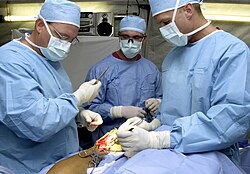
Surgery involves operative medicine. In the U.S., surgical training requires at least five years of residency, with subspecialties often requiring seven or more years, plus optional fellowships. This can extend training to over a decade post-medical school.
Surgical fields are divided into those following a general surgery residency and those with separate residency tracks:
- Post-General Surgery: Bariatric, Colorectal, Endocrine, Hepato-pancreato-biliary, Minimally Invasive, Pediatric, Surgical Oncology, and Transplant surgery.
- Separate Residency Tracks: Neurosurgery, Ophthalmology, Orthopedic surgery, Urology, and Otorhinolaryngology.
Diagnostic Specialties
Diagnostic specialties provide the critical data used to manage patients. Pathology is the study of diseases and the morphologic and physiologic changes they produce, serving as the basis for evidence-based medicine.
- Clinical Laboratory Sciences: Supervised by pathologists, these services use techniques like PCR and flow cytometry to analyze samples.
- Clinical Neurophysiology: Tests the function of the nervous system via electroencephalography (EEG) and electromyography (EMG).
- Nuclear Medicine: Uses radiopharmaceuticals (tracers and radionuclides) and imaging like PET scanners to study organ systems.

Other Major and Interdisciplinary Fields
Some specialties do not fit neatly into the medicine/surgery binary. These include Anesthesiology (perioperative management), Emergency Medicine (acute/life-threatening conditions), and Family Medicine (primary care).
Additionally, interdisciplinary fields merge medicine with other sciences or specific contexts:
- Biomedical Engineering: Applying engineering principles to medical practice.
- Forensic Medicine: Applying medical knowledge to legal contexts.
- Aerospace and Diving Medicine: Addressing health issues related to extreme environments.
- Palliative Medicine: Focusing on symptom relief for terminal illnesses.
- Public Health: Analyzing population health to mitigate community threats.

| Category | Primary Focus | Examples |
|---|---|---|
| Basic Sciences | Foundational biological/physical laws | Anatomy, Pharmacology, Biophysics |
| Internal Medicine | Non-operative adult disease management | Cardiology, Endocrinology, Nephrology |
| Surgery | Operative treatment of disease/injury | Neurosurgery, Orthopedics, Urology |
| Diagnostic | Identification of disease via testing | Pathology, Nuclear Medicine, Radiology |
| Interdisciplinary | Cross-field application of medicine | Forensic Medicine, Biomedical Engineering |
Frequently Asked Questions
What is the difference between an internist and a physician?
In North America, an internist is a specialist in internal medicine. In Commonwealth nations, the term physician is used in a narrow sense to describe these same specialists, generally excluding surgeons, psychiatrists, and obstetricians/gynecologists.
How long does surgical training take in the United States?
Surgical training requires a minimum of five years of residency after medical school. Subspecialties often require seven or more years, and additional fellowships can last one to three years, meaning some surgeons train for over a decade after graduating medical school.
What is the role of a pathologist in diagnostic medicine?
Pathologists study the morphologic and physiologic changes produced by diseases. They supervise clinical laboratory services and use molecular tests (such as PCR and immunohistochemistry) to provide the scientific basis for patient diagnosis.
What are interdisciplinary medical fields?
Interdisciplinary fields are areas where different medical specialties or external sciences overlap. Examples include Forensic Medicine (law and medicine), Biomedical Engineering (engineering and medicine), and Aerospace Medicine (aviation and medicine).
What is the difference between gross anatomy and histology?
Gross anatomy refers to the study of physical structures that are visible to the naked eye (macroscopic), whereas histology is the study of microscopic structures of tissues.