
Mi Teleférico: The World's Longest Urban Cable Car System
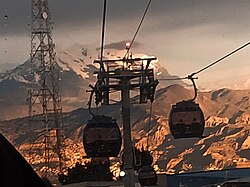
In the dramatic landscape of Bolivia, where the administrative center of La Paz sits deep within a canyon and the growing city of El Alto rests upon the high Altiplano plateau, traditional transit has long been a struggle. To bridge this 400-meter (1,300 ft) elevation gap, Bolivia implemented Mi Teleférico (My Cable Car), a revolutionary aerial cable car urban transit system. Unlike other global examples that serve as supplements to trains or buses, Mi Teleférico serves as the primary backbone of the metropolitan transit network.
Operated by the Empresa Estatal de Transporte por Cable "Mi Teleférico" and built by the Doppelmayr Garaventa Group, the system is recognized as the longest aerial cable car network in the world. Its innovative approach to sustainable urban development earned it a Latam Smart City Award in 2018.
Key Facts
- World Record: The longest aerial cable car system globally.
- Network Scale: 10 operational lines with 36 stations.
- Capacity: 1,398 gondola cars, each accommodating 10 passengers.
- Efficiency: High-frequency service with cars departing every 12 seconds.
- Reach: Total system length of 19.0 miles (30.6 km).
- Speed: Average speed of 11.2 mph (18.0 km/h) with a top speed of 13.4 mph (21.6 km/h).
Overcoming Geographic Challenges
The necessity for Mi Teleférico stemmed from the extreme topography of the region. Before its inception, commuters relied on winding, crowded streets and minibuses that were frequently paralyzed by traffic. While the idea of a cable car had been proposed since the 1970s, it faced various hurdles, including political opposition and concerns over passenger capacity and privacy.
A 2011 ridership study revealed the immense demand, with 1.7 million daily trips in the city, including 350,000 specifically between La Paz and El Alto. This data paved the way for the system's official launch on May 30, 2014.
System Expansion and Evolution
The network was developed in phases to gradually integrate the metropolitan area. Phase One established the initial connectivity, while Phase Two, authorized by Law 652 in 2015, expanded the system by over 20 km (12 mi) with a budget that eventually reached US $506 million.
The expansion introduced a variety of color-coded lines to simplify navigation. The Blue Line, which opened in March 2017, significantly boosted ridership on the existing Red Line by 15%.
The Network Layout
The system utilizes monocable aerial cable cars—systems where a single cable provides both support and propulsion. Most lines handle 3,000 passengers per hour (pphpd), though the Sky Blue and Purple lines offer a higher capacity of 4,000 pphpd.
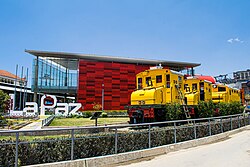
The Red and Yellow lines are critical arteries, linking the plateau of El Alto with the valley of La Paz, accounting for approximately 70,000 of the 80,000 to 90,000 daily rides on the original three-line core.
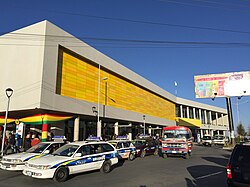
Line-by-Line Overview
The network is categorized by colors, each serving specific corridors of the city:
- Red, Yellow, and Green: The foundational lines connecting the two cities.
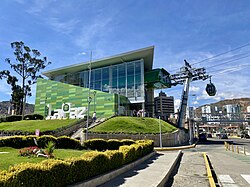
/Irpavi station on the green line - Blue and Silver: Key connectors within El Alto.
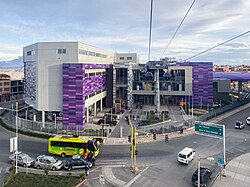
Tiquira Station terminus on the purple line in El Alto - Orange, White, and Sky Blue: Primary transit routes within La Paz.
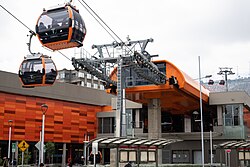
Central station on the orange line - Purple, Brown, and Gold: Specialized and expanding routes.
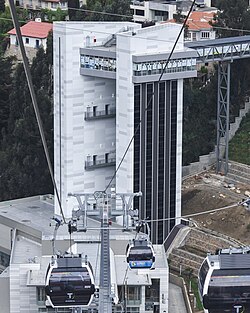
San Jorge Station on the white line
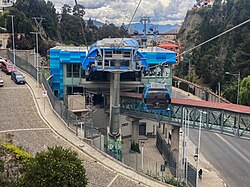
Technical Specifications Summary
| Line | Length | Stations | Cabins | Capacity (pphpd) | Speed |
|---|---|---|---|---|---|
| Red | 2.4 km | 3 | 109 | 3,000 | 5 m/s |
| Yellow | 3.9 km | 4 | 169 | 3,000 | 5 m/s |
| Green | 3.7 km | 4 | 165 | 3,000 | 5 m/s |
| Blue | 4.7 km | 5 | 208 | 3,000 | 5 m/s |
| Orange | 2.6 km | 4 | 127 | 3,000 | 5 m/s |
| White | 2.9 km | 4 | 131 | 3,000 | 5 m/s |
| Sky Blue | 2.6 km | 4 | 155 | 4,000 | 6 m/s |
| Purple | 4.3 km | 3 | 190 | 4,000 | 6 m/s |
| Brown | 0.7 km | 2 | 27 | 2,000 | 5 m/s |
| Silver | 2.6 km | 3 | 117 | 3,000 | 5 m/s |
Beyond La Paz and El Alto
The success of the metropolitan system led to contributions in other Bolivian cities. In Oruro, Mi Teleférico helped construct the Teleférico Turístico "Virgen del Socavón". Opened on February 7, 2018, this 800-meter line connects the city center to the Virgen del Socavón shrine on Santa Bárbara hill, facilitating transport during the city's famous carnival celebrations.
Frequently Asked Questions
How many people can fit in one gondola car?
Each gondola car in the Mi Teleférico system is designed to seat 10 passengers.
What is the frequency of the cable cars?
The system is highly efficient, with cars departing every 12 seconds.
Which line has the highest passenger capacity?
The Sky Blue and Purple lines have the highest capacity, both capable of transporting 4,000 passengers per hour per direction (pphpd).
Is Mi Teleférico used for more than just tourism?
Yes. Unlike many cable cars worldwide, Mi Teleférico is the primary backbone of the urban transit network for the La Paz and El Alto metropolitan area, serving as a daily commute tool for thousands of residents.
Who built the Mi Teleférico system?
The system was constructed by the Doppelmayr Garaventa Group.