
Model European Union Strasbourg: Simulating EU Politics and Legislation
The Model European Union Strasbourg (MEUS) is a comprehensive simulation designed to immerse participants in the complexities of European Union politics and legislative procedures. By recreating the authentic environment of the European Parliament, MEUS provides a practical platform for individuals to engage with the mechanisms of EU governance.
The simulation typically centers on two legislative proposals: a Directive (a legislative act that sets out a goal that all EU countries must achieve) and a Regulation (a legislative act that applies directly and uniformly across all EU member states). These topics are carefully selected by the Organising Team based on their current relevance and importance. For the upcoming MEUS 2026, Directors General Michael and Maddalena are currently preparing to build upon the success of previous editions.
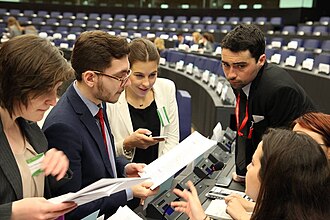
The Simulation Process and Roles
To mirror the real-world functioning of the EU, participants are assigned specific roles that represent the diverse stakeholders involved in the legislative process:
- Members of Parliament (MEPs) and Ministers: These participants represent the two legislative chambers. They discuss the proposed Directive and Regulation, proposing amendments to align with their interests while striving to reach a consensus.
- Lobbyists: These individuals work to influence the final legislative decisions to advance specific agendas.
- Interpreters: To ensure accessibility and accuracy, interpreters provide simultaneous interpretation of the proceedings in approximately 10 different languages.
- Journalists: The press team documents the event visually and verbally. They produce a daily newspaper—with a name chosen by the team—that features interviews, background information, and coverage of the legal procedures.
The simulation strictly follows the Ordinary Legislative Procedure, the same process used by actual MEPs. To enhance authenticity, the event takes place in the exact setting and location of the European Parliament. Additionally, daily press conferences allow journalists to question MEPs and Ministers, helping all stakeholders stay informed about the progress of negotiations.
MEUS Activities and Social Programme
Usually held in April over a period of approximately seven days, MEUS combines rigorous educational simulation with a vibrant social calendar. The experience begins with the "Eurofeast," a cultural exchange where participants and organisers share traditional food, drinks, and music from their home countries at dedicated booths.
Educational and Professional Development
Before the simulation begins, participants engage in preparatory activities to build their knowledge base:
- Workshops Day: Dedicated sessions to develop necessary skills.
- Panel Discussions: Expert-led talks focusing on the two chosen legislative topics.
- Partners' Fair: An opportunity to connect with NGOs, youth organisations, and MEUS partner organisations.
- Networking Night: Events designed for professional connection; for example, the 2019 edition featured a European Elections Night with rising political stars.
Cultural and Institutional Visits
Participants explore Strasbourg through organized excursions, including a boat tour of the city, a formal reception at the City Hall, and a visit to the Hemicycle (the debating chamber) of the European Parliament.
MEUS: Behind the Scenes
Following the simulation, an event called "MEUS: Behind the Scenes" (known as "MEU Best Practices" in 2018) is held. This session consists of workshops and presentations by the Organising Team, providing insight into the logistics and effort required to coordinate a large-scale EU simulation for those interested in joining the team.
Key Facts
- Location: Held in the actual setting of the European Parliament in Strasbourg.
- Legislative Focus: Simulates one Directive and one Regulation.
- Procedure: Utilizes the official Ordinary Legislative Procedure.
- Multilingualism: Simultaneous interpretation provided in roughly 10 languages.
- Timing: Typically occurs in April and lasts about seven days.
| Day | Events |
|---|---|
| 1 | Arrival, Strasbourg city quest, "Eurofeast" |
| 2 | Workshops day, Panel discussions, Boat tour, Social event |
| 3 | Simulation start, Opening ceremony, Hemicycle visit, City Hall reception, Kick-off party |
| 4 | Simulation sessions, All-you-can-eat dinner |
| 5 | Simulation sessions, Free evening |
| 6 | Simulation sessions, Partners' fair, Networking night |
| 7 | Final simulation sessions, Closing ceremony, Photos, Goodbye party |
| 8 | MEUS: Behind the Scenes, Departure |
Frequently Asked Questions
What is the difference between the Directive and Regulation simulated at MEUS?
A Regulation is a legislative act that applies directly and uniformly across all EU member states, whereas a Directive sets a goal that member states must achieve, allowing them some flexibility in how they implement it into national law.
Who can participate in the simulation?
Participants take on various roles, including Members of Parliament (MEPs), Ministers in the Council of the European Union, Interpreters, Journalists, and Lobbyists.
How do the journalists contribute to the event?
Journalists document the proceedings, conduct interviews, and produce a daily newspaper. They also host daily press conferences to keep all participants updated on the negotiations.
What happens during the "Eurofeast"?
The Eurofeast is a social event where participants and organisers set up booths to share food, drinks, and music from their home countries to promote cultural exchange.
What is the purpose of the "MEUS: Behind the Scenes" event?
This event informs participants about the work of the Organising Team through workshops and presentations, targeting those who wish to help organize future simulations.