
Modern Stonemasonry Systems: From Massive Precut to Tensioned Stone
For much of the modern era, stone has been relegated to a cosmetic role, serving primarily as decorative cladding over steel-reinforced concrete. This shift ignores a rich history of stone as a primary structural material, seen in Roman bridges and colosseums, medieval cathedrals reaching 65 meters, and 17th-century apartment buildings. However, a resurgence in innovative masonry is bringing stone back into the structural spotlight, blending ancient compressive strength with cutting-edge engineering.
Key Facts
- Carbon Reduction: Load-bearing stone construction emits approximately one-tenth of the carbon compared to equivalent concrete buildings.
- Structural Efficiency: Massive precut stone utilizes DFMA (Design for Manufacture and Assembly) to accelerate build speeds and reduce labor.
- Enhanced Strength: Post-tensioning allows stone to overcome its natural weakness in flexural strength, enabling wider spans and cantilevered designs.
- Sustainability: Stone blocks are highly reusable at the end of a building's lifecycle, unlike poured concrete.
Modern Stonemasonry Techniques
Contemporary masonry encompasses a wide range of applications, from purely aesthetic finishes to high-performance structural systems.
Surface and Composite Methods
Stone veneer is a decorative covering typically 1 inch (25.4 mm) thick, weighing less than 15 lb per square foot to avoid the need for extra structural support. It is mortared to a structural wall using metal tabs to prevent separation.
Cyclopean concrete combines boulders or rubble with poured concrete. A variation known as slipform stonemasonry uses temporary formwork to keep walls straight, resulting in a structure that is roughly half reinforced concrete and half stonework.
Formwork stone (or pierre banchée) uses stone tiles as the actual shuttering for pouring concrete; the stone remains in place after the concrete sets, a method developed by Fernand Pouillon to speed up construction.
Advanced Engineering and Digital Design
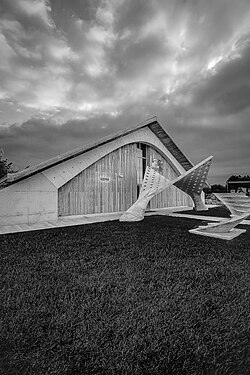
Digital stereotomy utilizes CAD and computer load models to create complex vaults and arches from precisely cut ashlars (squared stones). This field, led by figures such as Giuseppe Fallacara and Philippe Block, transforms traditional compression structures into complex geometric forms.
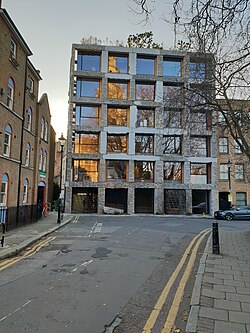
Trabeated stone exoskeletons adapt post-and-lintel construction for modern high-rises. In this system, posts and lintels are precisely precut offsite and assembled via crane. This method has been implemented at 15 Clerkenwell Close in London, with further projects underway in London and Bristol.
Standardized Stone Components
Stone bricks are small ashlars cut to standard brick sizes. They offer a carbon-neutral alternative to clay bricks and, because they do not shrink during production, they do not require expansion joints.
Massive Precut Stone
Massive precut (MP) stone, also known as pré-taille, is a load-bearing construction method using large, machine-cut blocks. Developed by Fernand Pouillon and masonry engineer Paul Marcerou, this system adapted high-precision timber saws for stone quarrying.
The core of the MP system is the use of precisely dimensioned blocks that are numbered and dropped into place by crane. This reduces the need for onsite adjustments and minimizes the amount of mortar required.
Design Attributes of MP Stone
- Load-bearing: Unlike cladding, these blocks support the building's weight, ensuring maximum durability.
- Massive Scale: Blocks are sized to be too heavy for manual lifting, which increases thermal mass for temperature regulation and reduces the number of necessary cuts.
- Offsite Precision: Precutting at the quarry transforms construction into an assembly process, significantly lowering labor costs.
Types of MP Construction
- Massive Precut Ashlars: Blocks cut on four to six sides for walls and flat arches.
- End-shaped Posts and Lintels: Blocks with precisely shaped ends for framework assembly.
- Massive Cyclopean Concrete Blocks: Rough stones saturated with concrete in a mold, then sawn into massive ashlars.
Benefits of Modern Stone Systems
| Feature | Massive Precut Stone | Conventional Concrete/Brick |
|---|---|---|
| Build Speed | Fast (No setting time, crane assembly) | Slower (Curing/setting wait times) |
| Carbon Footprint | Very Low (~1/10th of concrete) | High (Coal-burning production) |
| Labor | Efficient (Reduced manual masonry) | High (Intensive manual labor) |
| Durability | Extreme (Inherent stone longevity) | Variable (Subject to degradation) |
| End-of-Life | Highly Reusable | Difficult to recycle |
Beyond efficiency, MP stone offers significant seismic resilience. Studies of a 20-storey unreinforced MP-stone tower (Diar Es Saada) indicate that the system can meet structural safety conditions for earthquake resistance.
Tensioned Stone
While stone is exceptional in compression, it is naturally weak in flexure (bending). Post-tensioned (PT) stone solves this by creating a composite material where stone is held in compression by tension elements, such as steel tendons threaded through internal ducts.
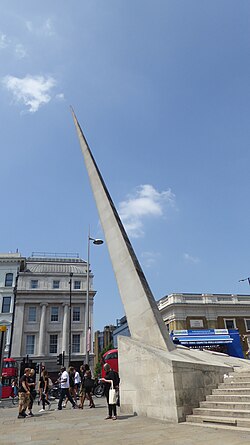
Once the stone components are positioned, hydraulic jacks tension the tendons, transferring force through anchorages. This prevents joint cracking and increases the failure load, allowing stone to be used in wide spans, flexible footbridges, and cantilevered sculptures.
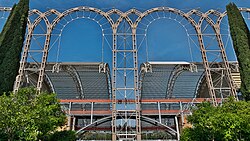
A related experimental method is pre-tensioned stone, which uses epoxy shear connectors to maintain tendon tension while liquid epoxy sets.
Frequently Asked Questions
How does post-tensioned stone differ from reinforced concrete?
While both use tension elements to improve strength, post-tensioned stone uses natural stone as the compressive medium. Because stone is a "natural precast," it requires significantly less energy to produce than concrete, which requires carbon-intensive chemical processing.
Is massive precut stone more expensive than traditional masonry?
While the initial machine cutting is specialized, the overall cost is often reduced by minimizing the number of cuts, reducing the amount of mortar needed, and drastically lowering manual labor through crane-assisted assembly.
What is the environmental impact of using stone instead of concrete?
Load-bearing stone construction is far more sustainable, emitting roughly 10% of the carbon associated with comparable concrete buildings. This is primarily because it avoids the high-energy, fossil-fuel-dependent process of cement production.
Can modern stone buildings withstand earthquakes?
Yes. Research into modern massive precut stone towers has shown that they can fulfill structural safety conditions and exhibit good seismic resilience regarding storey drifts and displacements.
What is the difference between stone veneer and load-bearing stone?
Stone veneer is a thin (1 inch) decorative layer attached to a structural wall for aesthetics. Load-bearing stone, such as massive precut stone, serves as the primary structural support for the building.