
Moon's Sodium Tail: The Comet-Like Feature of Our Natural Satellite
While the Moon appears as a static, rocky sphere in our night sky, it possesses a dynamic and elusive characteristic: a comet-like tail. Composed of sodium atoms, this feature extends for hundreds of thousands of kilometers, though it remains far too faint to be detected by the naked human eye.
First discovered in 1998 by scientists from Boston University during observations of the Leonid meteor shower, this phenomenon reveals the complex interactions between the lunar surface and the harsh environment of space.
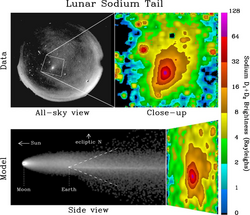
How the Lunar Sodium Tail Forms
The creation of the sodium tail is a continuous process driven by the release of atomic sodium from the Moon's surface. This sodium is ejected as a fine dust through three primary mechanisms:
- Photon-stimulated desorption: A process where light particles (photons) strike the surface, causing atoms to be released.
- Solar wind sputtering: The displacement of atoms from the lunar surface caused by the high-energy particles of the solar wind.
- Meteorite impacts: The physical collision of space debris that kicks up surface materials.
Once these sodium atoms are released into space, solar radiation pressure—the force exerted by light from the Sun—accelerates them away from the solar center. This pushes the atoms in the antisolar direction, stretching them into an elongated, comet-like tail.
The Role of Meteor Showers and Recent Discoveries
While the constant impact of small meteorites maintains a baseline tail, certain celestial events can amplify this effect. The Leonid meteor shower, for instance, intensifies the release of sodium, making the tail more observable from Earth than it is during typical periods.
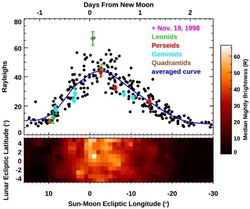
Recent space exploration has provided further insight into the lunar composition. In October 2023, the Indian Space Research Organisation (ISRO) through its Chandrayaan-2 mission confirmed an abundance of sodium on the Moon, providing critical data to support existing observations of the lunar tail.
Key Facts
- The Moon's sodium tail was first discovered in 1998 by Boston University researchers.
- The tail extends for hundreds of thousands of kilometers.
- It is formed by sodium atoms pushed away from the Sun by solar radiation pressure.
- The Leonid meteor shower increases the visibility of the tail.
- ISRO's Chandrayaan-2 mission confirmed high sodium levels on the Moon in October 2023.
| Feature | Detail |
|---|---|
| Composition | Atomic Sodium |
| Length | Hundreds of thousands of kilometers |
| Primary Driver | Solar radiation pressure |
| Discovery Year | 1998 |
| Key Contributing Events | Leonid meteor shower, solar wind, meteorite impacts |
Frequently Asked Questions
Can we see the Moon's sodium tail from Earth?
No, the tail is too faint to be detected by the human eye and requires specialized scientific instruments for observation.
What causes the sodium to leave the Moon's surface?
Sodium is released through photon-stimulated desorption, solar wind sputtering, and the impact of meteorites.
Why does the tail point away from the Sun?
Solar radiation pressure pushes the released sodium atoms in the antisolar direction, creating the elongated shape.
How did the Leonid meteor shower affect the tail?
The shower intensified the release of sodium, making the tail more observable from Earth than usual.
What did the Chandrayaan-2 mission contribute?
In October 2023, the ISRO mission discovered an abundance of sodium on the lunar surface, supporting the science behind the sodium tail.