
Mountain West Narrow Gauge Railroads: A History of Steel and Stone
At its peak, the Mountain West region of the United States was crisscrossed by an extensive narrow gauge system—railroads built with tracks closer together than the standard gauge. This network stretched from Montana to New Mexico, with the majority of its operations centered around hubs in Colorado and Utah. These railroads were essential for navigating the rugged, mountainous terrain to reach isolated mining communities.
The Rise of the Denver and Rio Grande
Opened in 1871, the Denver and Rio Grande Railroad was one of the earliest and most significant narrow gauge lines in the country. Its founder, William Jackson Palmer, was inspired after visiting the Ffestiniog Railway in Wales during his honeymoon. While in the UK, Palmer consulted with Scottish engineer Robert Francis Fairlie, who convinced him that narrow gauge was the most efficient choice for the challenging geography of the American West.
The Rio Grande effectively circled Colorado, utilizing feeder lines to reach vital mining towns such as Leadville, Aspen, Cripple Creek, Telluride, and Silverton. However, expansion was not without conflict. Between 1878 and 1880, the Rio Grande engaged in a "railroad war" with the Atchison, Topeka and Santa Fe Railway for control of the Royal Gorge canyon. This dispute was eventually resolved by "The Treaty of Boston" in 1880, which allowed the Rio Grande to push eastward toward Leadville and through the Black Canyon of the Gunnison toward Grand Junction.
Through affiliated companies, the network expanded further west to Ogden, Utah, and south to Santa Fe, New Mexico.
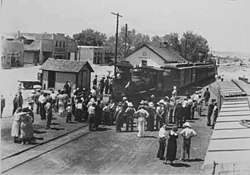
Evolution and the "Narrow Gauge Circle"
By 1890, the Rio Grande and the Colorado Midland Railway had built a new standard gauge joint line to Grand Junction, leading to the gradual re-gauging of the Rio Grande mainline. However, the southern portions remained narrow gauge and steam-hauled well into the mid-20th century. This area became known as the "Narrow Gauge Circle."
This circuit was made possible via the Rio Grande Southern, a line built by Otto Mears. To survive financial hardships and maintain mail contracts from the 1930s until its abandonment in 1952, the Rio Grande Southern utilized a fleet of unique "Galloping Goose" cars.
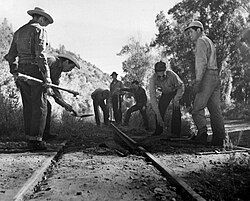
Survival and Tourism in the San Juan Extension
While many narrow gauge segments were abandoned, the San Juan Extension saw a temporary reprieve in the 1950s and 60s due to a petroleum boom around Farmington, New Mexico. As the oil boom faded, the Denver & Rio Grande Western (D&RGW) abandoned the line from Durango, Colorado, to Chama, New Mexico. In 1970, the states of Colorado and New Mexico jointly purchased the segment from Chama to Antonito to create the Cumbres and Toltec Scenic Railroad.
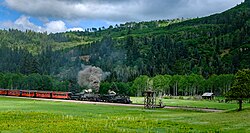
Meanwhile, the Silverton branch became a tourist magnet after World War II, aided by Western films shot along the route. The D&RGW operated it as an isolated steam route until 1981, when it was sold and rebranded as the Durango and Silverton Narrow Gauge Railroad.
Modern Challenges and Environmental Adaptation
Today, both the Durango & Silverton and Cumbres & Toltec face operational hurdles due to fuel availability and the Southwestern North American megadrought. Fire risk has become a critical concern:
- 2002: The Missionary Ridge Fire caused the first fire-related closure in the Durango & Silverton's history.
- 2018: The 416 Fire led to a federal lawsuit against the railroad, resulting in a $20 million fine.
To mitigate these risks, the Durango & Silverton phased out coal-fired steam locomotives in early 2024, converting its fleet to burn oil to reduce embers. Additionally, both railroads have purchased diesel locomotives from the White Pass and Yukon Route to serve as backups and alternatives during high-risk fire seasons.
Narrow Gauge Networks in Utah and Nevada
In Utah, three-foot gauge railroads emerged following the completion of the Transcontinental Railroad on May 10, 1869. The Utah and Northern Railway, which operated from 1871 to 1887, connected the Mormon Corridor to mining camps near Butte, Montana. This line was heavily influenced by investor John Willard Young and was later taken over by "robber baron" Jay Gould in 1877, bringing it under Union Pacific control.
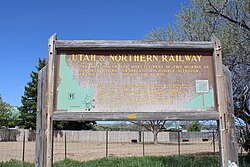
Other notable Utah lines included:
- American Fork Railroad: The first to use the Mason Bogie locomotive, an articulated design based on the British Single Fairlie.
- Wasatch & Jordan Valley: Transported granite for the Salt Lake City temple.
- Utah & Pleasant Valley: Served the coal fields of north-central Utah.
- Bingham Central Railway: A rare two-foot gauge operation that ran mostly underground through the Mascote Tunnel.
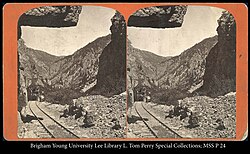
In Nevada, narrow gauge lines like the Eureka and Palisade and the Nevada Central served central and eastern mining districts. While there were plans to connect these to Utah and Colorado via the Salt Lake, Sevier Valley & Pioche Railroad, these goals were never fully realized. However, some equipment survives, such as the "Emma Nevada" locomotive.
Key Facts
- Inspiration: William Jackson Palmer based the Rio Grande's narrow gauge design on the Ffestiniog Railway in Wales.
- The Treaty of Boston (1880): Ended the "railroad war" between the Rio Grande and the Atchison, Topeka and Santa Fe Railway.
- Galloping Geese: Specialized cars used by the Rio Grande Southern to maintain mail contracts during the 1930s.
- Environmental Shift: The Durango & Silverton transitioned from coal to oil-fired locomotives by 2024 to reduce fire risks.
- Unique Engineering: The Uintah Railway featured the Moro Castle curve, the tightest curve on a US common carrier.
| Railroad Name | Primary Region | Key Feature/Legacy |
|---|---|---|
| Denver and Rio Grande | Colorado, Utah, New Mexico | Longest and most significant narrow gauge system. |
| Cumbres and Toltec | CO / NM Border | Jointly owned by Colorado and New Mexico since 1970. |
| Durango and Silverton | Colorado | Popular tourist route; transitioned to oil-fired steam. |
| Utah and Northern | Utah, Idaho, Montana | Connected Mormon Corridor to Butte mining camps. |
| Rio Grande Southern | Colorado | Known for the "Galloping Goose" mail cars. |
| Uintah Railway | Utah, Colorado | Home to the tightest curve (Moro Castle) in the US. |
Frequently Asked Questions
What is a narrow gauge railroad?
A narrow gauge railroad is a system where the distance between the two rails is narrower than the standard gauge (which is 4 feet 8.5 inches). This design allows trains to handle tighter curves and steeper grades, making them ideal for mountainous terrain.
Why did the Durango & Silverton stop using coal?
The railroad phased out coal-fired locomotives in early 2024 to reduce the emission of embers, thereby lowering the risk of starting wildfires during the Southwestern North American megadrought.
What was the "Treaty of Boston"?
The Treaty of Boston was an 1880 agreement that settled a conflict between the Denver and Rio Grande and the Atchison, Topeka and Santa Fe Railway over control of the Royal Gorge canyon.
What were "Galloping Geese"?
Galloping Geese were a fleet of improvised, lightweight railcars used by the cash-strapped Rio Grande Southern Railroad to maintain their mail contracts from the 1930s until 1952.
Which Utah railroad used the Mason Bogie locomotive?
The American Fork Railroad was the first in the region to utilize the Mason Bogie, an articulated locomotive design derived from the British Single Fairlie.