
Music in Reformed Worship: From Silence to Modern Hymns
The role of music in Reformed worship has undergone a dramatic evolution over five centuries. From early periods of total prohibition to the rise of exclusive psalmody and the current modern hymn movement, the tension between spiritual edification and physical expression has shaped the sonic landscape of the church.
The Early Reformation and the Debate Over Music
In the early 16th century, views on music varied wildly among reformers. In 1523, Ulrich Zwingli abolished music in Zurich entirely. His decision was rooted in the belief that the Bible did not authorize music in worship and that physical means could not lead to spiritual edification.
Conversely, other German cities like Nuremberg and Erfurt published Protestant songbooks before Martin Luther's Geystliche gesangk Buchleyn. In Strasbourg, under Martin Bucer, the church became one of the first to replace choral singing with congregational singing. While early Strasbourg liturgies lacked music, publishers soon added musical notation, initially focusing almost exclusively on biblical Psalms.
In Constance, led by Johannes Zwick and the Blarer brothers, a more balanced approach emerged. The Constance Hymn Book of 1540 divided its content evenly between hymns and psalms, a trend that Strasbourg eventually followed by including original hymns in their Psalter starting in 1537.
The Era of Exclusive Psalmody
A pivotal shift occurred in 1538 when John Calvin began work on the Genevan Psalter. Written in French, this collection featured translations by poets like Clément Marot and melodies by composers such as Louis Bourgeois and Claude Goudimel. This work championed exclusive psalmody—the practice of singing only biblical psalms—which became the dominant Reformed practice for the next 200 years.
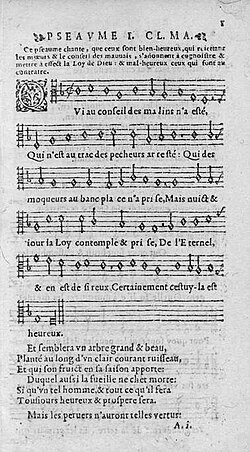
Under this tradition, congregations sang psalms in unison, though harmony was permitted in private settings. This practice spread widely, influencing the Scottish Psalter of 1564. In these services, a leader would sing a line, and the congregation would repeat it. While organs were forbidden, trumpets were gradually introduced. Other popular works included the 1562 English Sternhold and Hopkins Psalter.
By the late 16th century, the Reformed tradition began preferring literal translations of the Psalms over the looser versions found in the Genevan or Sternhold and Hopkins collections. This led to influential 17th-century publications such as the Scottish Psalter of 1635 and the Bay Psalm Book of 1640, the first book ever printed in America.
The Transition to Hymnody
The 18th century brought a shift toward more flexible musical expressions. Isaac Watts, an English Congregationalist minister, began translating psalms more freely. Critics argued these were paraphrases rather than translations, but Watts' work, along with the rise of pietism (a movement emphasizing individual piety and emotional experience), increased the dominance of hymns.
By the mid-19th century, hymnody became acceptable for Presbyterians, and the use of choirs and organs was adopted in Reformed churches, including those in Zurich (which had ended its total music prohibition in 1598). However, some groups, such as the Reformed Presbyterians, continue to maintain the tradition of exclusive a capella psalmody.
The Modern Hymn Movement
In 2001, the publication of "In Christ Alone" sparked the modern hymn movement. This movement grew primarily among Reformed Christians as a reaction against the commercialism and perceived theological weakness of the Contemporary Christian Music (CCM) industry.
The goal of modern hymnody is to prioritize rich theological truth and lyrical content over repetitive choruses or complex musical composition. Key contributors and works include:
- Keith Getty & Stuart Townend ("In Christ Alone")
- CityAlight ("Yet Not I But Through Christ in Me")
- Matt Papa & Matt Boswell ("His Mercy is More")
- Stuart Townend ("How Deep the Father's Love for Us")
- Other influential artists such as Sovereign Grace Music, The Enfield Hymn Sessions, and Aaron Keyes.
Key Facts
- Ulrich Zwingli banned all music in Zurich worship in 1523.
- Exclusive psalmody was the dominant Reformed practice for roughly 200 years following John Calvin's Genevan Psalter (1538).
- The Bay Psalm Book (1640) was the first book printed in America.
- Isaac Watts transitioned the tradition from strict translation to free paraphrase and hymn writing.
- The modern hymn movement focuses on elevating theological depth over musical commercialism.
| Period/Movement | Key Figure/Work | Primary Musical Focus | Notable Characteristic |
|---|---|---|---|
| Early Reformation | Ulrich Zwingli | None (Abolished) | Belief that physical means cannot lead to spiritual edification. |
| Genevan Tradition | John Calvin | Exclusive Psalmody | Unison congregational singing of biblical psalms. |
| 17th Century | Bay Psalm Book | Literal Psalm Translations | First book printed in America (1640). |
| 18th-19th Century | Isaac Watts | Hymns and Paraphrases | Shift toward pietism and acceptance of organs/choirs. |
| Modern Era | Getty & Townend | Modern Hymns | Emphasis on rich theological truth over CCM styles. |
Frequently Asked Questions
Why did Ulrich Zwingli ban music in worship?
Zwingli believed that the Bible did not allow for music in worship and argued that physical means were incapable of producing spiritual edification.
What is exclusive psalmody?
Exclusive psalmody is the practice of singing only the biblical Psalms during worship, a tradition that became dominant among Reformed Christians for about 200 years after the introduction of the Genevan Psalter.
What was the significance of the Bay Psalm Book?
Published in 1640, the Bay Psalm Book is historically significant as the first book printed in America.
How did Isaac Watts change the way psalms were sung?
Watts moved away from literal translations, instead creating free paraphrases and original hymns that imitated the psalms, which helped pave the way for broader hymnody in the church.
What distinguishes the modern hymn movement from Contemporary Christian Music (CCM)?
The modern hymn movement seeks to prioritize deep theological content and lyrical richness over the commercialism and repetitive choruses often found in the CCM industry.