
Nakhchivan Culture, Architecture, and Traditions
Nakhchivan is a city of profound historical depth and vibrant cultural identity. Recognized as an Islamic Culture Capital in 2018, the city serves as a living museum where ancient architectural marvels coexist with modern amenities. From its world-renowned mausoleums to its unique culinary heritage, Nakhchivan offers a window into the enduring spirit of Azerbaijan.
Key Facts
- Architectural Landmark: The 12th-century Momine Khatun Mausoleum is the city's most iconic sight.
- Culinary Staple: Tendir lavash is a central element of local diet and culture.
- Sacred Site: Ashabi-Kahf is a natural cave sanctuary attracting tens of thousands of pilgrims annually.
- Cultural Recognition: Designated as an Islamic Culture Capital in 2018.
- UNESCO Status: The city's mausoleums were submitted for UNESCO World Heritage consideration in 1998.
Architectural Heritage
The skyline of Nakhchivan is defined by its impressive collection of mausoleums, reflecting centuries of artistic and spiritual evolution. The most prominent is the 12th-century Momine Khatun Mausoleum (also known as Atabek Gumbezi). Built for the wife of Eldegizid Atabek Jahan Pahlivan, this 10-sided monument is crafted from turquoise glazed bricks and adorned with intricate geometrical motifs and Kufic script (an early form of Arabic calligraphy).
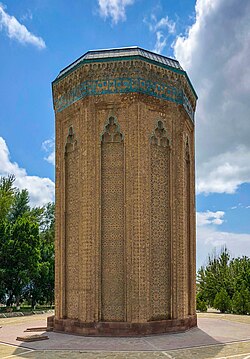
The Momine Khatun Mausoleum was designed by the architect Ajami Nakhchivani, whose statue stands nearby alongside a bust of Heydar Aliyev. Another work by Nakhchivani from the 12th century is the octagonal Yusuf Ibn Kuseir tomb, known as Atababa, located near the main cemetery.
Other significant architectural sites include the Gulustan, Noah's, Garabaghlar, Imamzadeh, and Huseyn Javid mausoleums. The white marble mausoleum of Huseyn Javid, completed in 1993, honors the Azerbaijani writer who perished during Joseph Stalin's Great Purge. This site has become a symbol of Nakhchivan's resilience during the Armenian embargo.
Cultural Amenities and Museums
Nakhchivan boasts a diverse array of venues for the arts. The Heydar Aliyev Palace features a theater hall for 1,000 people and a permanent local painting exhibition. The restored Soviet-era Opera Theatre serves as the home for the Nakhchivan State Musical Drama Theatre, hosting operas, musicals, and concerts.
Museums and Galleries
The city's rich history is preserved across several specialized institutions:
- Historical Museums: The Nakhchivan State History Museum, the State Carpet Museum, and the literature museum of the Nakhchivan Autonomous Republic.
- House Museums: Dedicated sites for Jamshid Nakhchivanski and Bahruz Kangarli.
- Specialized Sites: An archaeological museum on Istiqlal Street and the Juma mosque, noted for its large dome.
- Modern Institutions: The Museum under Open Air, the Heydar Aliyev Museum, and the Memorial Museum (Xatıra Muzeyi), which documents the national strife between Armenia and Azerbaijan.
Sacred Sites and Spirituality
Located in the eastern part of the city between the mountains of Ilandag and Nahajir is Ashabi-Kahf. This sanctuary, situated within a natural cave, is regarded as a sacred site not only within Azerbaijan but across the Middle East, drawing tens of thousands of pilgrims every year.
Culinary Traditions
The cuisine of Nakhchivan is characterized by hearty flavors and traditional baking methods. Signature dishes include shirin plov (sweet rice with mutton, hazelnuts, almonds, dried fruits, and gravy), as well as dastana, komba, and galin.
Central to the local table is lavash, a flatbread made from flour, water, and salt. In Nakhchivan, the variety of bread is extensive. Tendir lavash is a paper-thin bread baked by sticking the dough to the hot inner walls of a tandir (a traditional clay oven). Other varieties include the thick galin, dastana, and the ash-cake known as komba. Lavash is so culturally significant that local proverbs link its presence to the end of conflict.
A popular local tradition is the durmek, a roll-shaped sandwich. These were traditionally given to children for school, filled with ingredients such as butter and jam, cheese, cottage cheese, herbs, potatoes, or boiled eggs.
Traditional Festivals
Nakhchivan celebrates its agricultural bounty through annual festivals held at the Nakhchivangala Historical-Architectural Museum Complex:
- Goyja Festival: Dedicated to the goyja (a cherry-plum), featuring jams, compotes, pickles, and dried versions of the fruit.
- Kata Festival: Held in April, this event promotes kata, a flat pie wrapped like an envelope and baked in a tandir. Fillings include wild spinach (shomu), pumpkin, nettle, bean, lentil, or other mixed greens.
Sports and Media
The city is a hub for regional media, housing the newspaper Sharg Gapisi and the regional channel Nakhchivan TV. In sports, the city is represented by Araz-Naxçıvan, a professional football team in the Azerbaijan Premier League. The city also excels in futsal, with Araz Naxçivan competing in the UEFA Futsal Cup. Additionally, Nakhchivan hosted the Masters Weightlifting World Cup in 2014.
Summary of Nakhchivan's Cultural Highlights
| Category | Key Examples | Notable Feature |
|---|---|---|
| Architecture | Momine Khatun Mausoleum | 12th-century turquoise glazed bricks |
| Spirituality | Ashabi-Kahf | Sacred natural cave sanctuary |
| Cuisine | Tendir Lavash | Paper-thin bread baked in a clay oven |
| Festivals | Goyja & Kata Festivals | Celebration of local fruits and flat pies |
| Sports | Araz-Naxçıvan | Professional football and UEFA futsal |
Frequently Asked Questions
What is the significance of the Momine Khatun Mausoleum?
It is the city's main architectural sight, a 12th-century 10-sided monument decorated with Kufic script and turquoise bricks, designed by the architect Ajami Nakhchivani.
What is Tendir lavash?
Tendir lavash is a traditional Azerbaijani flatbread that is rolled very thin and baked by sticking it to the hot inner walls of a tandir (clay oven).
What happens at the Goyja festival?
The festival celebrates the goyja fruit (a cherry-plum) and showcases various products made from it, including jams, compotes, and pickles.
Where is the Ashabi-Kahf sanctuary located?
It is a sacred natural cave located in the eastern part of Nakhchivan, situated between the mountains of Ilandag and Nahajir.
Which sports teams represent Nakhchivan?
The city is represented by Araz-Naxçıvan, which competes in the Azerbaijan Premier League for football and the UEFA Futsal Cup for futsal.