
Nasha Niva: The Newspaper That Shaped Modern Belarusian Identity
At the dawn of the 20th century, the Belarusian people faced a critical challenge: their language was primarily spoken by the peasantry and largely ignored by the intellectual elite. In this climate, Nasha Niva emerged not merely as a publication, but as the heartbeat of a national awakening. Inspired by the political newspaper Iskra, Nasha Niva became the primary vehicle for consolidating a Belarusian political nation and standardizing a literary language.
The publication was born from the vision of journalist Anton Łuckevič, who announced the creation of a party newspaper during a BSA conference in June 1906. Alongside his brother Ivan and landowner Alaksandar Ułasaŭ, Łuckevič established a platform that would bridge the gap between rural life and political consciousness. The name, meaning "Our Field," was drawn from a poem by Janka Lučyna titled "To Fatherland."
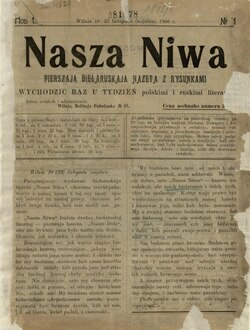
Key Facts
- Founded: November 23, 1906.
- Circulation: Approximately 3,000 by 1911.
- Total Reach: Over 1 million copies published between 1906 and 1915.
- Language Impact: Standardized Belarusian orthography, grammar, and word-formation.
- Alphabet: Used both Latin and Cyrillic scripts until October 1912, then switched exclusively to Cyrillic.
- Pricing: 5 kopecks per issue or 5 roubles for an annual subscription.
The Editorial Engine and Political Struggle
The newspaper's leadership was a "who's who" of early Belarusian intellectual life. While Zigmund Volsky served as the first editor, Alaksandar Ułasaŭ took the helm from the fifth issue onward. Over time, other pivotal figures joined, including Vacłaŭ Łastoŭski—who managed the historical agenda—and the renowned poet Janka Kupała, who became editor in March 1914.
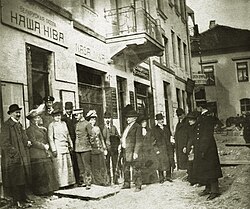
The editorial office, located at Wileńska street 14, was characterized by a strange internal hierarchy. The "Upper House" (the Łuckevič brothers and Ułasaŭ) handled financial survival and high-level decisions, often communicating with the "Lower Chamber" (the staff performing daily tasks) via notes passed through a slot under a door. This tense environment is believed to have contributed to the suicide of staff member Siarhiej Pałujan in 1910.
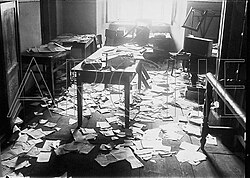
Operating under the watchful eye of Russian censorship, the newspaper frequently faced persecution. Even a 1907 discussion on agrarian reform, which included a piece on New Zealand's land questions, was deemed "seditious." This led to the imprisonment of Alaksandar Ułasaŭ and the frequent confiscation of entire print runs.
A Catalyst for Language and Culture
Nasha Niva played an invaluable role in transforming the Belarusian language from a peasant dialect into a literary standard. By maintaining an interactive relationship with over 3,000 correspondents, the editors could identify and implement the most widespread linguistic norms across the country.
The publication discovered and promoted legendary literary figures, including Maksim Bahdanovič, Źmitrok Biadula, and Jakub Kołas. Beyond the printed page, the newspaper advocated for the right to use the native language in schools and churches, fighting the systemic neglect of Belarusian culture by the upper classes.
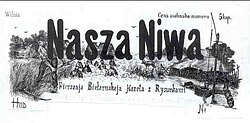
Expanding the Cultural Ecosystem
The influence of Nasha Niva extended far beyond journalism. It functioned as a coordinating hub for several major projects:
- Publishing: Produced annual Belarusian Calendars (almanacs), original books, and translations.
- Specialized Media: Launched the satirical magazine Krapiva (Nettles) in 1912 and the agricultural magazine Sacha (Wooden Plough) in 1913.
- Museums: Ivan Łuckevič began collecting artifacts for the Belarusian National Museum under the newspaper's auspices.
- Arts: Assisted Ihnat Bujnicki in forming the first Belarusian theatre company.
The Impact of World War I and the End of an Era
The outbreak of World War I in 1914 placed the newspaper in a precarious position. To avoid charges of disloyalty to the state, the editors ceased direct criticism of the government. However, they remained neutral, describing both the Russian and German armies as "alien" forces.
As the war progressed, the publication suffered. Issues were halved in volume, and state censors left prominent blank spaces on the pages where content had been excised. The newspaper finally ceased publication in the summer of 1915, following the German occupation of Vilnius and the conscription of most of its staff into military service.
| Metric/Feature | Details |
|---|---|
| Total Copies Published | Over 1,000,000 |
| Key Sections | Political review, countryside/city life, literary works, agriculture, history |
| Primary Goal | Consolidation of a Belarusian political nation |
| Script Transition | Dual Latin/Cyrillic (1906–1912) → Cyrillic only (1912 onwards) |
| Legacy Term | The "Nasha Niva period" of Belarusian culture |
Frequently Asked Questions
What was the primary goal of Nasha Niva?
The newspaper's main objective was the consolidation of a Belarusian political nation and the preservation and promotion of Belarusian culture and language.
How did the newspaper influence the Belarusian language?
It established standards for the literary language by incorporating widespread usage patterns from thousands of correspondents, effectively fixing the orthography, grammar, and word-formation of modern Belarusian.
Why did the newspaper switch from dual scripts to only Cyrillic?
From 1906 to October 1912, the paper was printed in both Latin and Cyrillic scripts to reach a broader audience; however, from the 43rd issue on October 24, 1912, it transitioned exclusively to the Cyrillic alphabet.
What happened to the editors after the newspaper closed?
Many of the central figures, including Anton Łuckevič, Alaksandar Ułasaŭ, Branisłaŭ Taraškievič, Źmicier Žyłunovič, and Vacłaŭ Łastoŭski, later fell victim to Soviet repressions during the 1930s.
What is the "Nasha Niva period"?
Historians use this term to describe the early 20th-century era of Belarusian culture characterized by the quantitative and qualitative advancements in society and art driven by the newspaper's activities.